Categories
India

India continued.

We came out of the Spencer Plaza in Chennai which was across a wide busy road from our hotel and were accosted by an auto rickshaw driver calling himself Joseph Hallelujah. He was not small and was impressively good at English and joviality, and asked if we needed his services. I told him we were over the road at the Taj Club Hotel and he offered a ride for R10 which is about 25 cents so off we went at speed straight through the six lanes of traffic and were safely deposited at the front door, having serenaded him with a certain song composed by L. Cohen decd. Then as expected came the questions about tomorrow’s travel requirements with offers of improbably priced deals. As it happened we did need an auto for the next day so 10 o’clock was the pickup time. This guy exemplified the entrepreneurial spirit of Indians who are happy to give every chance a go. I knew there would be requests to visit “my friends shops” which would need to be limited, but also knew we would both end up happy. As it turned out he was even more business savvy than I thought because he subcontracted the work to his “brother” whose happy demeanour diminished greatly when the one friends commission paying shop I agreed to visit was one we had already been to. But I paid him a better than normal tip so he left happy. Tipping in India is easy to swallow because it is cheap.

Our party on this second part of travelling in India was only three, being Kay and her niece Philippa and me. It was all very efficiently organised through our usual agency, Perfect Travels, so I didn’t have much real responsibility. The itinerary was four cities in the south where we hadn’t been before, Hyderabad, Bengaluru, Mysore and Chennai none of which are tourist necessities but still interesting and with plenty of shopping opportunities. Kay and I arrived with 30kgs of luggage and left with 80, plus there are three carpets being sent, and she describes this as a very successful trip.

Buying carpets is fun in India mainly because the sellers are almost always Kashmiris who have scattered throughout India and the rest of the world because of the ongoing military problems at home. They are the best salespeople I have ever come across and after years of probably expensive practise I think I have sorted out how to get a reasonable deal. The biggest problem always is having an idea of the real value of what you want and on this trip I bought five carpets so by the last one I actually did have some idea of that. I also finally realised that the chat about other stuff is important and time is not,so I didn’t hurry and took lots of time to finally agree on the deal. Back in the car we were talking about it and the guide, who was listening in, said the guys in the shop had said that I was very knowledgeable and good at getting the right deal which made me have less post purchase dissonance than usual and proves that b.s. does baffle brains. I am available for fixed price hire.

In order to cope with all this stuff we have bought two large new bags have been purchased, the last from the Mysore Tarpaulin Company where one of the offerings was actually made of canvas and looked indestructible. You cannot escape any commercial transaction without plenty of paper work and leaving it behind causes consternation. Everything has been made more difficult by the outlawing of the two largest currency notes just after we started but more of that later. Indian love of complicating simple transactions is everywhere including tourist attractions that require tickets. The ticket office is often quite a way from the entrance and there are usually two people on the gate, one examines the ticket very carefully then puts one or two inked stamps on it, the second produces a train conductors clipping thing and clips the ticket once or twice depending on the number of stamps. There may be a third person to open the gate. They have a lot of people to employ. Airports are even more fun although the security is a bit less than last time when nuclear war with Pak (they also love abbreviations) was imminent. The big thing is having a baggage label on your hand luggage which collects about three stamps but no clipping. You also get the full arms out examination and the last one caused me some discomfort when the metal detector was waved a little too closely to the front of my pants. Speaking of which, Indian women’s dress culture includes covered legs and when Kay bought an outfit of a dress and leggings the nice young male assistant told her when she got to her country she could take her pants off.

The lack of infrastructure commiserate with requirements is one of India’s biggest problems but things have improved since 2007, the last time we were here. There are some good intercity motorways and most airports we have used are new. Every big city is building underground or elevated metro lines at considerable inconvenience and the major problem seems to be getting them finished. Chennai is the fourth biggest city and their metro started construction in 2007, my Lonely Planet says it would finished in 2015, now it’s still at least four years away. As we got to the airport we saw the metro station there even has the trains sitting waiting but nowhere to go. One good thing to come from the currency chaos is that toll collections have been abandoned so things shift along better. We did a railway trip from Mysore to Chennai, seven hours, and although first class is a little shabby the food was really good and we met some very nice people. They still paste a list on the outside of the carriage with your name and seat number on it. Luckily we were met at the carriage door on arrival because Chennai station is the same slightly scary and totally confusing place it was 18 years ago when Kay and I took one look and decided using a bus would be better.

As expected food has been a highlight ranging from cheap chain places to some pretty smart restaurants. Philippa’s best memory is a seafood place where we were seated “on the beachside” which meant a table by the wall on which there was a beach mural. We also visited a winery which is one of the best in India, called Groverzampa and they make some good wine. Our guide apparently combined being a dj with winery guiding and was very funny when you could understand him. He’s a Moslem and explaining to us how his love of wine fitted in with his parents expectations was an interesting example of intergenerational incomprehension. Another visit was to a much hyped film studio near Hyderabad about which we knew nothing apart from that locals thought it was wonderful. We were booked in for the VIP package so had an a/c bus to get around the very large place. The bits we saw about actual film making belonged to a past era although the permanent sets were a little interesting. It gradually dawned on us that we were supposed to be there for 9 hours doing stuff that belonged to a 1950s winter show so we sorrowfully explained to the guide we had to leave a bit after halfway. Back in our hotel Kay told a staff member where we had been and she couldn’t understand why we were back so early.

For me the best sight seeing thing has been the Mysore Palace which is quite stunning. It was built in the early 1900s and shows how unbelievably rich this royal family was. Scandinavian simplicity it is not but as a statement of which end of the food chain these guys were it is emphatic. Mysore was on high security alert when we arrived with soldiers in camouflage gear with Kevlar armour at major road crossings and the odd APC in the background. There was a local king called something Tipu in the 17th century who fought four wars against the British and lost his life in the last, being found very dead under a pile of bodies when it was over. This was not usual behaviour for a king and he is regarded as a genuine hero and there is now a commemorative annual holiday which started in 2015. He was a Moslem and as a not really appreciated minority his present day coreligionists took advantage last year and caused mayhem. This year they just noisily drove around waving flags.

When not being guided we have had great fun getting about in the auto rickshaws. Philippa looked a little pale after her first experience but quickly became a veteran ignoring the buses six inches away and not flinching when we whipped through traffic the wrong way. We only had one driver try and put a move on us when, after agreeing a price of R100 and starting off, he tried the old 100 each trick. Kay and I have been through this before and after demanding he stop the girls got out and I had a stern word. I didn’t want to get another driver because a man from the hotel had told him where to go and I didn’t think I could explain it another driver, so when he agreed it should just be 100, and ” sorry no understanding” was mentioned we carried on.

The greatest confusion and unnecessary chaos has been as a result of last week’s central government decision to stop R500 and 1000 notes being legal tender. The reasons given are to fight the black economy and fix the problem of counterfeiting. The result has been complete disruption to an economy that at a retail level is largely cash based and these notes account for 90 percent of cash transactions. Obviously doing something like this requires a lot secrecy to make it work and it appears this was achieved as far as ordinary people were concerned, but you would think that someone might have considered the extent to which replacement cash that would be required and how to distribute it, and that the one new note they initially produced might have to fit into atms so it could be dispensed. It didn’t. This nice pink note was for R2000 and you could only exchange 4000 of the old stuff, which is about NZ$80. So everyone with old notes queues up at the beleaguered banks with photo copies of their ID plus original and the miserable 4000, when inside a form has to be completed including the serial numbers of each note and eventually they come out with two nice new notes. Only to find that most retailers have run out of change so you can’t use them. I speak from experience. We had 30000 of the of the outlawed currency so stood in a good humoured queue for an hour and got 12000 changed, and then got rid of the rest when buying a carpet as retailers can bank the old stuff until 20 Dec and presumably fake records to show having received it prior to d day. The announcement was at 9 p.m. and the sales of gold soared that night as everyone with unexplainable money rushed to turn it into something else. Train tickets could still be bought with the old money so ticket sales multiplied by ten times. Still on the day we left, a week later, atms were running out as soon as they were refilled, banks couldn’t get enough cash and small traders had no business. It will end up as a classic example of how not to do this. The base problem is a corrupt society from top to bottom and while this will be a one off cost to those who cannot get rid of their black money nothing has been done to get at the real problem. In fact when everything eventually gets back to normal those with lots of cash to hide will require less storage space because now they have a 2000 note to use instead of only a 1000.

While were staying in a delightful old small ex palace in Bengaluru we had breakfast outside, under an umbrella in the middle of a gravelled area of the garden. The second morning it was my birthday and our driver, working under slightly off target instructions from his employer, came over to the table with a colourful bouquet of flowers and gave them to Philippa, who blushed and sincerely hoped they were not a token of affection, then he offered her heartfelt birthday greetings. None of us was brave enough to correct him. India is like that. Things happen but not always as you expect them to.

If you haven’t been there you are missing out.

Dennis.
Categories
India Ukraine

To India, via Ukraine.

My itinerary for leaving Georgia went like this:

14.9.   Taxi to Tblisi airport 12.30,  flight to Dubai 13.35, arrive in Dubai about 18.00.  Take taxi from Terminal 1 to Holiday Inn near Terminal 3.
15.9.  Shuttle to terminal 6.00, flight to Delhi 8.20.

All very simple and no need to rush.  The first bit worked as planned and I was at the Tblisi airport in good time.  It wasn’t very busy and I wasn’t sure where the check in counter was so I showed my ticket to a nice lady at information, and she promptly informed me I was exactly one month late to catch my flight.   That was a bit of a blow as having booked it myself there was no one else to blame, not even my wife, and I could not miss my connection to Delhi where she would be waiting for me.  Fortunately there were several travel agencies in the airport and I found one that had a nearly English speaking person and we started the process of getting to Dubai in time.  Things were initially confused because of language but after an hour it was clear my only choice was to fly to Kiev in Ukraine and make a quickish transfer to a flight to Dubai that arrived at 2.30 a.m.  For a while it seemed the only seat on Ukraine International Airlines was a ruinous one in business class but at the last minute a cheaper choice was found.  This airline is a no frills variety and when you book at the last minute they know you have no choice and charge in a very frilly way.

All I can tell you about Ukraine is that the Russian missiles were inactive and from the air it looked very flat.  Arrival in Kiev was on time and I was starting to relax until I hit the queue at transit security.  Apparently nobody wanted to stay in Kiev and the only xray machine wasn’t too quick.  Loathing and angst were predominant as we all started counting how much time was left to make our connections.  A couple of French guys tried to politely move through the queue but got stuck behind me.  When I finally emerged from the bureaucracy my bag was in backpack mode and I ran for a surprisingly long way and just made the last bus to the plane.

To complete the picture the airline served one glass of water per sector; the immigration queue in Dubai took over an hour to get through; the taxi driver to the hotel was extremely upset he wasn’t taking me a long way and I got two hours sleep before making it to Delhi and finding Kay.

All of which is a long intro to our three week Best Exotic Fabric Tour in India.  This tour is an annual event organised by Jane in Hamilton to raise money for the education of her deceased sister’s children  –  she was married to a very nice Indian man named Bhooi and he is keen for the three children to be educated in NZ.  They are at Hillcrest High.  This is my fifth, and Kay’s fourth trip to India and although it covered familiar territory I was happy to go because the local connections mean you get to do and see stuff you never would in an normal tour.  Bhooi organised the itinerary and although there was an emphasis on fabrics we also did a carefully selected group of sights.  We were mostly in Rajasthan where everything associated with fabrics is a major industry and I qualified because last time there I bought nine bedspreads.

Our group was about twenty persons, it varied, and there were only three men.  We knew a little less than half of those and some of them read these stories so I have to be careful in my reporting.  In fact it was a pretty good group with no standout wallies but three weeks all together is a long time and I am sure everyone else was like me and at times suppressed the desire to be a bit forceful. The good thing about having my first real tour group experience in India is that in that there you have to become extremely philosophic and patient about everything.  If you stay in normal mode you’ll end up terminally frustrated, and I was ready and mentally prepared for that so it was easy to extend this attitude to dealing with all the other people.  You may be surprised to know I was not even tempted to explain the realities of issues like religion, alternative medicine or geopolitics.

Our main transport was a big bus that had air conditioning and also little fans above the passenger windows, which converted to a blunt instrument when we hit big bumps that made one ascend vertically.  We all got quite fond of our bus which was a haven of comfort and predictability after being in the chaos outside.  The driver started smiling at us after Bhooi told him he was not allowed to accept commission from the places we stopped at, but he would get a substantial tip if all went well.  His assistant, Sanjay, was a favourite of the ladies because he was polite, helpful and had a wide range of shirts including a special kurta for Diwali.  We had the delight of being in Jodphur for Diwali and for a couple of days locals had been warming up with sporadic outbreaks of loud fireworks.  On the big night it sounded like the Pakistanis had crossed the nearby border and were engaging in street fighting as well as significant artillery bombardment.  Our driver dealt very competently with the excitement of driving in Indian traffic including pulling off u-turns, several times in the face of heavy traffic.  It was fun watching and listening to our group’s reactions to what goes on on Indian roads.  Although you still get occasional livestock on major roads and people going the wrong way on one way lanes, traffic behavior has improved.  I think the huge increase in private car ownership plus some better roads have helped, although in the cities it is still every man, bicycle, auto and pedal rickshaw, car, truck, bus, cow, cart and motor bike for itself.  Apparently there are 5.5 million motor bikes in Delhi.

Secondary transport has been auto rickshaws,  jeeps and assorted people mover things.  The jeeps took us out of Jodphur to have dinner and entertainment at a house owned by a lady whose block printing clothing workshop we had visited.  It was hot and sunny when we left so I got in first to ensure we were in a jeep with a roof and forward facing back seats.  Which promptly backfired on us when at the first corner we loudly blew a tire and then got jammed into the back of an uncovered jeep that seemed to have no suspension.  My view was backwards and the front tires of the following jeep made an interesting pattern as they turned with alternating bald black rubber and whatever has replaced canvas under that.  I love driving in auto rickshaws because death always appears to be imminent but so far it hasn’t happened.  Watching the newcomers reactions to the proximity of the other traffic was very amusing.  We also flew to and from Varanasi and the to flight was supposed to leave at 6.15 p.m. but when we checked in, much later than I would have done, we found out it was leaving at 5 and was now on the runway.  I was delighted when we were then told that as we were carry on luggage only they would call it back, however we still had to do security and catch the boarding bus so when we all filed on the other passengers looked just a bit annoyed at the extra half hour of waiting.  There was no abuse.

In all the time I have spent in India I must have walked peacefully past hundreds of cows and bulls doing their sacred thing getting in everybody’s way.  So it came as a great surprise when walking amicably down a street in Mandawa to suddenly feel a significant pain in my right thigh, I jumped back to see the attacker was a grumpy bull which thankfully had rounded points on his horns.  Everyone else thought it was very funny.  This was the first town on our tour and although it has interesting attractions it is not in the top division.  We arrived in the dark in front of our hotel which was covered in flashing lights and surrounded by people enjoying a big celebration complete with extremely LOUD music which permeated every part of the hotel.  One of our party had arrived a couple of days late because when she got to Auckland airport she discovered her passport was still in her photocopier in Turangi.  So she got off the plane in Delhi, had very little sleep, endured a day of rough roads in the bus and was looking forward to a quiet lie down only to find this bedlam, which was for her far too much to cope with.  The rest of us joined in the fun as there was no other choice and it was all over by midnight.

Our next celebration was a double birthday including Kay which was held on the rooftop of our hotel in Jaisalmer with magnificent views of the wonderful fortress, and a couple of bottles of local bubbly and some red and white.  When we first left Delhi our bus stopped for a very long time on bridge while we waited for Bhooi and later l learnt the delay was mainly due to his determination to buy the bubbly despite it being a dry day in Delhi.  India is still a bit funny about booze but there are alternatives in the government owned bhang shops, or the community we visited who don’t drink alcohol but do drink a mixture of water and opium.  None of us were game enough to try it, because it was before lunch and one doesn’t do such things in the morning.  When in Pushkar we had the top floor of a nice hotel to ourselves which allowed the sneaky consumption of banned booze.  This place is so holy you can’t even get an egg, let alone a bottle.  The local wine we had was acceptable and after a hard hot day’s work the Kingfisher is exactly right and management made sure a supply was available.

But the main activity has been shopping.  Sometimes from shops, sometimes after seeing things like block fabric printing or weaving and always at every opportunity.  We had to buy a new and large case about halfway through as have many others and I shudder at what that is going to cost to get home.  There has to be an upwards blip in the Indian retail stats.  It’s been like watching a swarm of locusts, which I never have but I’ve seen them on the telly.  Right to the very end of the tour they unflinchingly kept going.  The best one to observe is married to famous sunken sailor and her first language is Spanish. She would emphatically say she would not buy anything today and then surrender the moment something tempting was flung in front of her.  I only have four new shirts and a half share in four carpets.  So far.

All the spending was made easy by the Bhooi bank.  He doled out cash on request and at the end of the tour we paid in U.S. cash or transfer to his NZ account.  We all won by not paying the usual fees and didn’t have worries of finding a suitable ATM or a money changer.  Bhooi has admitted that the bank suffered under the pressure of unexpectedly high demand due to the level of spending.  We also had no worries about tipping because it was all included which I certainly really appreciated.  There is nothing worse than having no idea of what the tip should be and never being certain if you’re a mug for paying too much or a miserable NZer who never pays enough.  It was fun swanning out of the toilet stop places on the road and saying to the person with their hand out “Group. Bhooi.”

This is not an expensive trip, excluding shopping, and the hotels have been from good Indian mid range to a step below.  They are a reflection of India in that they do the job but not always as expected.  Usually something doesn’t work, like the hot water or light switches.  Some of us have been rather critical of the cleaning standards and reckon they have to scrub out the bathrooms, but Kay and I have had a lucky run and even had a good room in the building project we stayed in in Udaipur.  We had great views of the Lake Palace but some of the others had to be shifted to another hotel.  All came right with plentiful drinks on the roof with its fantastic views over the lake.  We are presently back in Delhi and the guest house here seemed a bit of a dump when we first arrived but now it’s just normal with the only problem being no hot water, which is not a big deal given how warm it is.  Apparently we should have some soon.  Yeah….

India is still a place of huge contrasts, illogical inefficiencies and bureaucratic nonsense.  Right from the visa application which wants your father’s place of birth to the triple carbon paper invoices you can only wonder at the time wasted achieving nothing useful.  Convenience stores are a real rarity and we have seen no supermarkets which reflects a retail scene where apparently 40 percent of fresh produce rots before it is sold.  This is just an example of what happens with several layers of venal self-serving politicians plus vested interest groups plus an innate dislike of change.  On the roads there are two truck brands, both local, both owned by powerful companies that don’t want competition, and both making a product that probably wouldn’t be allowed on the roads in western countries.  I am really surprised at the levels of pollution we have seen and the trucks wouldn’t be helping.  But it also is still the most interesting country in the world to visit with genuinely friendly people who don’t always turn out to own a shop, and there is a sense of humour close to the surface.  Even with beggars.  My usual response to the fully formed ones is to hold out my altered right hand and make whatever imploring noise they are making, and once when I did this the beggar put the coins she was showing into my hand and looked at me probably saying two can play that game.  And the food is great.

Now for the very first time, and exclusively here, we reproduce a poem in rhythmic whatsit by K J

A bus full of ladies touring with flair
With Dennis and Tony and Terry and Blair
Guided by Boohi, accompanied by Jane
In rickshaw, on camel across the terrain

Now Nikko is here and she has the art
Of stopping a plane just about to depart
At sunrise and sunset we take photographs
And some of each other dressed up just for laughs

At least twice a day we scoop up yum curries
And once, off in jeeps, we saw and bought durries
When given the chance we shop up a storm
Overnight tailormades picked up in the morn

We’re decked out in jewels grabbed at various stops
And colorful pants with decorative tops
Handmade decorations to take home for a friend
Heavier rugs we’ve just had to send

Dozens of scarves, soft pashminas and shawls
Hurrah!  Bank of Bhooi will pay for it all.

KJ

Categories
Georgia

Georgia. Do your best.

When you cross the border into Georgia from Armenia there is a subtle difference which took me a little while to appreciate, and it is that things are less scruffy.   The houses look a bit better maintained, the roads are smoother and the land is tidier.  The unemployed guys standing around smoking and fiddling with the front of their underpants were better dressed and the shops had more stuff.  I was sharing a taxi and we got dropped off at a metro station on the outskirts of the capital, Tbilisi, and after changing money I thought I would get a taxi to my hotel as I didn’t want to cope with working out the mysteries of the metro right then.  It turned out to be not too far but the driver was either a moron or from another planet and it became a major production with the usual acrimonious ending where he thought I should pay for his lack of knowledge plus a lot of tourist tax.  When I became more familiar with local prices it was clear he got more than he should have but it was about half of what was being demanded.  Always get out and retrieve your bag before payment negotiations.

There is a lot to like about Tblisi.  I was staying in the old city which has cobblestones and heaps of places to eat and drink and even the obligatory Irish bar where I watched the ABs play Argentina starting at 2a.m.  The city is built around a river and has some very modern stuff including a cool pedestrian Peace Bridge which Hamilton needs, and lots of old decaying buildings which one day when restored will be very cool.  Some won’t make it as you can see the cracks and it is surprising how far a building can lean without falling.  They mostly date from early 1800 as the place was leveled in 1795 by an invading bunch of Persians.

I need to digress into history a little here but will return.  Georgia was absorbed by Russia after the levelling and stayed that way until 1991.  Apparently in the Soviet days it got a little more leeway than other parts, maybe Stalin being Georgian helped, and it was the big agricultural supplier as well as the main wine making area. When the Soviet break up happened Georgia ended up with economic chaos as their market for agricultural stuff disappeared, power was in short supply and food hard to get.  The locals I have talked to about those times get a funny look on their faces when discussing it.  I asked one person why this happened and was given an example of how Soviet industry worked in explanation. –  a ballpoint pen has about five parts and each would be made in different parts of the empire and assembled in another.  So when a couple of the parts are made in now independent republics that have no understanding of how to make or source or trade the rest the specialist factories accumulate huge stockpiles of useless parts  and eventually close down resulting in unemployment and no pens.  Also Georgia was at that time basically at war with Russia over two areas that wanted to leave, South Ossetia and Abkhasia.  They lost and although these places show on maps as part of Georgia they are really Russian.  And then in 2003  came the Rose Revolution which was peaceful (hence the bridge) and the old guard ex Soviets resigned and the revolutionary leader, Saakashvili, won the following election and set about remaking the country.  He has been described to me as a crazy man which I think means he had big ideas that seemingly were impossible.  One was to eliminate corruption and crime which were pervasive then, and he did it.  That was amazing as I am sure it would originally have been no different from all the other now very corrupt ex Soviet countries.  Apparently he started with a group of honest army officers, then fired all the police and I think with European help trained a new lot from scratch.  Along with that government departments were made as open as possible and citizens can see lots of stuff on the internet that used to be hidden.  When I am home I’m going to find out more because this is unique.  He also had some very modern buildings put up, and that leads back to modern Tblisi.  Because there are some there he was responsible for.

My main focus in Georgia was a three-day wine tour that I organised with a local agency that specialises in such things but they definitely do not specialise in effective communication.  However, it was a well organised and comprehensive look at the oldest wine industry in the world, which has been around for at least 8000 years and has over 500 different grape varieties.  The traditional way of production uses large clay urns (qvevry) that are buried in the ground rather than stainless steel tanks or barrels, but they also do that as well.  The traditional white wine takes a bit of getting used to, but I have fought my way through to appreciation, and the best reds are very good.  When the economic chaos happened and the Russian market disappeared a lot of vines got pulled out but things are going well for them now and in USA Georgian wine is a new cool thing, apparently.  My guide was certainly not typical given her very bright red orange hair colour with blond undercut at the back and lack of a husband, but she was very knowledgeable and good fun.

Georgian custom is the guests are king and all kings want to eat and drink a lot.  The two go together although drinking may be done solo as well.  One drinks wine and chacha with the later being the same as French eau de vie or Italian grapa. However you describe it I reckon it’s drinkable aviation fuel.  One does not sip and appreciate the flavours, one listens to lengthy and sincere toasts about subjects such as families, ones country, peace, wives, friendship, rugby and even late one evening, Russian people.  That was because there were a couple with us. Having listened and done lots of glass clinking, sometimes twice because the speaker thinks of additional details for the toast, one drinks the lot immediately.  This is ok with glasses of wine because there is recovery time before the next toast reaches its climax, and I know about drinking wine, but chacha is a different story and extreme cunning is required to avoid falling over.  The highlight of the wine tour was such an evening where the guide, driver and I were guests of a family in a house in a small village.  The patriarch was a gifted toast maker in six languages and a good musician as were his daughter and son.  The food was all home grown and delicious and the best bit of all was at the beginning when touring his orchard and garden we stopped by the special dinning shed and he shifted a big round stone off the top of his qvevry which was buried and ladled out glasses of wine for us.  I want one of these close to my bbq.  The worst part was at the end, when I thought I had done very well in avoiding too much chacha, our host produced the dreaded formal cow’s horn drinking vessel and we had to have one last toast in the proper way with the horn.  Those things hold quite a lot.  The next day I asked the guide if he was just a gifted actor or was he for real, and she said it was just him.  He gave me a bottle of chacha as we left which was gratefully received by the guy on reception when I returned to Tblisi.

After all that punishment I headed for the purity of the Caucasus mountains and a small town called Mestia.  It is in one of a series of very isolated valleys surrounded by big rock and ice serrated ranges that reach to a bit over 5000m.  They have their own language and think Mr Saakashvili is a great guy because not only did he get them a real road that doesn’t close  during the six months of winter snow, but he also had a  town square with public buildings constructed.  The police station looks like a giant leaned very hard on the top of one end.  All of which means there are now jobs in tourism and no one is complaining about all the changes.  This time of the year the forests are gold and red and spectacular, however that and the mountains are not the big tourist attraction. The special thing about Mestia and the surrounding villages is that in the 10 – 12th centuries the families built defensive towers attached to their houses and over 200 still remain standing.  Apparently they not only had to contend with raiders from the north coming over the mountains they were also very enthusiastic about feuding with each other.  The place has a Lord of the Rings feel about it and is stunning.

I was the oldest tourist about and the only one not clad in trekking gear and a pack but people still talked with me, especially when they knew where I was from.  Everyone either had NZ high on their list or had been there for a wonderful time.  I stayed at Rozas Guesthouse which cost $15 a night for a spacious room and breakfast.  The downside was no sheets, no towels, no soap or shampoo and shared bathrooms of which I was only unprepared for the lack of a towel but a t-shirt did the job.  Also it was a bit of climb up a very rough track. The upside is you meet lots of interesting people including a Sri Lankan Tamil now living in Oz who drank pinot noir, outside of Georgia, and had very similar opinions to me on everything apart from the legality of a certain Sri Lankan spin bowlers action.  We were having a beer at the local cafe when he saw someone get a litre carafe of red wine, he smiled and said we have to see if that tastes acceptable, and we did and it was.  I also made a mistake when I popped into the owner’s room to ask about the wifi.  Mr Roza immediately sprang up from watching tv and whipped the top of an admittedly small bottle of chacha and once again lots of toasts took place.

 I flew to Mestia from a small secondary airport near Tblisi in a Russian twenty seater belonging to Vanilla Air.  The plane was about a third full which is no surprise because they don’t exactly encourage travellers.  I tried to book a few months ahead and was told bookings could only be made 28 days in advance.  So I waited and tried again to be told I could make a booking but it had be paid for in three days or it would expire, and no, they did not accept credit cards.  However a bank transfer was a good thing  –  this was for a $40 fare and the costs of a transfer were more than that.  It was a great flight alongside and over mountain ranges and then down into the valley threading our way around the sides of stuff towering way above us.

On the way out I used the usual transport which are van buses called marshrutky.  It was very full.  For the first time on the trip it was raining.  The road was of average condition but mostly switcbacks with a long way to the roaring rivers at the bottom and luckily the driver was only moderately aggressive.  I had one the next day on my way to a resort city on the Black Sea who had a sincere belief in his own immortality and that every other driver would get out of the way. No one else seemed worried.

Drivers in Georgia are generally not too bad apart from the tailgating that seems a necessary behavior.  I haven’t seen any gangsters in their nazi cars with shaven heads and big gold necklaces.  I assume Mr S’s anti corruption efforts made them find something else to do.  Georgian people are very thankful for the rule of law and I suspect a bit amazed at what happened although they did vote out Mr Saakashvili, and there was an election a couple of days ago which was pretty low key.  His party came second again.  The man is now governor of Odessa in Ukraine and one assumes they must have some major problems there to convince them to bring in an honest outsider.

This is a great country to visit and if you have the time when going to or leaving Europe next give it serious consideration.  You can fly to Dubai from Tblisi easily.  Even a few nights in Tbilisi with a day wine trip would be different than usual and it is safer than Auckland, for those of you who worry about such things. Despite the cultural desire to toast every possible good thing I haven’t seen any drunks causing trouble or aggressive social behavior.  The expat guys I met when watching the rugby test included a kiwi who had worked in a lot of countries and he thought Georgians were people with a good attitude and a way of life that had a lot to be said for it.   He had recently turned out in a oldies rugby team, for the first time in twenty years, that raised a lot of money for charity and reckoned there wouldn’t be any other place where your opponents would include two government ministers and a billionaire.

The last part of my travels was a visit to a long time beach resort city on the Black Sea coast close to the Turkish border, called Batumi.   During the Soviet times that border was closed and it declined but once again Mr Saakashvili came to the rescue and decided it should be a fun place again to bring some money into the area.  It is a nice town to spend a couple of nights and a good mixture of different architectures plus a six kilometer boulevard along the shore.  I don’t think much of stony beaches so have only looked at it but I did pay to ride up a very modern tower which just moved ever so slightly in the breeze at the top.   It was comparatively expensive at $5 as things here are pretty cheap.  A main course in a nice restaurant plus a couple of glasses of wine costs less than$15.  As I may have said there is a lot to like about Georgia.
Dennis

Categories
Armenia

Armenia.

Quite possibly the only thing you know about Armenia is that they have a disagreement with Turkey about the use of the word “genocide”, and if you know more you can have an extra glass of wine tonight.   The main historical things to know about Armenia are that it is an ancient nation and the first christian one dating from 301; that it has been almost continuously either been ruled by another power or has been fighting a war; and that between 1915-22 the Turks caused the deaths of about 1.5 million Armenians while doing some ethnic cleansing.  The Armenians say this was genocide and the Turks hotly deny it.

They certainly do not like Turkey as indicated by a sticker I saw on a car which showed two smiling cartoon boys peering enthusiastically on the Turkish flag.  Apart from all the deaths, the Turks also  cunningly got hold of the Armenians beloved Mt Ararat which is easy to see from their capital, Yerevan, and this is apparently like having a never healing wound.  Right now they have an ongoing fight with Azerbaijan about an area called Nagorno-Karabakh which is ethnically Armenian so the Armenians fought a war with the Azers and currently still hold it.  Although they try to balance between Russia, Iran and the USA, a tricky thing to do, the Armenians really are largely reliant on Russia economically and militarily.

Depending on what cultural followings you have you will know about some Armenians. –  Agassi, Kacharturian and Kardashian to mention a sample.   The body shape of the latter is not common in Armenia.  The population has dropped from a bit over 3 million to about 2.8 in the last ten years due to economic immigration and there are an estimated 10 million outside the country.  Remittances are very important when a good wage is US$300 a month and unemployment is over 30 percent. As with all the ex Soviet countries it became independent in early 1990s and the communist bosses renamed themselves and hoovered up assets and political power.  It is a democracy but only one party has ever been in power.

I flew into Yerevan from Dubai on Flydubai which is an airline for very short people.  I have to say that Armenia has one of the easiest and cheapest visas I have come across and getting through the formalities on arrival was a breeze.  Yerevan is a very likeable capital, about 1.2 million people, with a central area that has lots of trees, parks, cafes, bars and statues.  There isn’t really anything old and touristy so I went to the Armenian Genocide Memorial which was impressive and quite briefly to the bronze age stuff in the History Museum.  Then I concentrated on food and wine.

The sights outside of Yerevan that one is directed to are mainly very old churches and monasteries, which I dutifully have seen.  Most of them are in isolated places, usually in the mountains, and the differences between each of them have to be pointed out.  The most interesting bit was a monastery that was built over a small dungeon where super saint St Gregory was incarcerated for thirteen years with only snakes for company.  The then king, Trdat 3, was going crazy so Greg was hauled up out the pit and cured the king who gratefully turned the state religion to Christianity in response.  That was 301 AD.  And I got to climb down a slippery vertical ladder, which was not designed for the digitally challenged, to experience this place.  When I made it to the bottom I found three nice Indian people so we had a discussion about the recent cricket test.  All the tourist attraction churches and monasteries were constructed between the ninth and twelfth centuries, just in time for Chiingis/Gengis and his horde to come and make a mess of them.

I did two days of trips out of Yerevan with the same careful and interesting driver.  At 18 he had gone to join some of the diaspora in the USA and without the necessary documents he got a job in LA and became a jewellery maker.  Subsequently he got married, had two children, bought cars and an apartment, always using another Armenian’s name, and he never had a driving licence.  After twelve years and with children getting to school age he decided to try and become legal which eventually meant he had to return to Armenia and start again with the application.  As well he had to pay a  US$5000 fine on arrival in Armenia for having avoided his army conscription.  A couple of years later while still going through the immigration hoops he got an email form his wife asking for $2700 being his half of the cost of his divorce and has never heard from his children since.   He is an intelligent thoughtful person but given to believing stuff that he sees on the internet and we had long conversations  with me politely explaining why much of it was nonsense.   He told when were finished how appreciative he was for having someone as wise and educated as me as his client and he had learnt a lot.  What a sound person.

After Yerevan I headed north for Georgia and stopped a night in Vanadzor, a place of about 80,000 people.   It’s a good example of what life is like outside of the capital.  Almost all of the industrial plants from the Soviet times look like they have been the recipients of a nuclear explosion, derelict, rusting and stripped of anything of value.  There are lots of long unfinished building projects, a few flash new places and plenty of small obviously struggling businesses.   Most of the housing is in decaying apartment blocks.  It’s another place Kay would not want to live in.  Near by is the Debed Gorge which was a magnet for monastery builders because of the spectacular scenery and steep cliffs that could be fortified.  On my way to the border with Georgia I looked at four of them in the company of a Polish chap who took a real Bible with him and spent much longer than me at each one.  He was with me because I had hired a taxi and he was available to pay half the cost.  The taxi driver was about fifty and not small, one of those guys whose neck is as wide as his head and his name was Ashot.  I remember because it was cleverly on the back of his car in small silver letters the same size as those that said Mercedes.   He was quite happy to tailgate police cars before ripping past them and when we were behind trucks I think the front of the car was under the back of the truck.  I can’t be completely sure because although I started out in the backseat intending to take turns I quickly decided to stay there.

I have to mention agriculture so Colin doesn’t feel left out.  There is not a huge amount of flat land where I have been, but what there is is cropped and it has recently been harvested so everything is brown and bald, waiting for winter snow.  There is some market gardening, lots of grape vines and large areas of walnut plantations.  It all looks small scale and there is not much machinery to see.   Although we did pass one new huge tractor with the biggest and meanest looking plough arrangement I have ever seen, obviously someone has relatives who have done well in the U.S.  In the hilly areas there are nomadic people who are presently driving their stock down to winter in mean villages.  Apparently they are not Armenians because Armenians do not deal with livestock, apart from eating them.  It must be true because I haven’t seen any stock in the cultivated areas.

The roads vary from great to not so good which is better than expected, and the driving behavior is reasonable.  In Yerevan you can step onto a pedestrian crossing with complete confidence that no driver will try to crush your toes.  That was a surprise.  There are lots of traffic cops who I have been told are only a bit corrupt and when they are patrolling they must have their flashing lights on, which is a good idea because you can see them from way off.  The reasonableness of drivers led me to think that maybe this was a place where people know how to queue properly, but when I asked about that the response was a gesture in the shape of a semi circle.  On my way to Vanadzor we had to stop for gas, I assume cng, and I was ordered out of the car while filling took place.  In the forecourt was a little building that appeared to have two atms inside and I had seen these before and wondered why they had signs with “bet” written on them.  And yes, they were automated self serve TAB equivalents.  I watched three young layabouts put their cards in and then instantly watch their money fly away.

Armenia was an add on to the main attraction which is Georgia but my short stay has been worthwhile, although I probably wouldn’t enthusiastically recommend it to any of you.  Equally I wouldn’t do it for Dubai either which I spent a couple of days in on the way over.  As far as I am concerned it has two good things, the Burj Khalifa which is stunning (the tallest building anywhere) and a very nice metro.  Not long after I started looking around I suddenly remembered the gist of a poem from my school days.  Ozymandius by Shelley which you can Google.  Quite how my brain suddenly reached back that far is a mystery.

Hajogh.

Dennis.

Categories
China Tibet

Second time around China

Kay: Dennis says that it’s my turn to start the bit about China.

In China they say that foreigners travel to learn, the locals travel to eat. Well, we must be very much at home because we’re doing both with alacrity, even devouring yak schnitzel. Our guides are often surprised that we’re not looking for western food and in 2.5 weeks we’ve succumbed to very fine pizza just once. On that occasion we sat on the streetfront verandah of a restaurant on Foreigner Street in Dali and provided immense entertainment for passersby who, after their initial delight at seeing whities, asked for photos with us and giggling got up-close and personal.

Most of our meals have been taken at small local places (unkindly known as “fly restaurants”) where we’ve relied very much on the photos in the menu or simply pointed to desirable dishes we could see others eating. The glossy food photos on the walls are generally not available.

There are immense numbers of Chinese tourists so they’re not all in NZ as you may have thought, but are being herded on & off coaches, up & around monuments and released into streets endangering others as they endlessly capture themselves on selfie-stick phone cameras. Luckily they avoid places slightly off the beaten track that require a bit of effort so we’ve had these largely to ourselves.

One such place was the 300 hectare Stone Forest where, after entering the park by battery cart, we climbed up and through amazing limestone formations that were widely discovered only 80 years ago. The people living there were tipped out and the hoards bussed in but they don’t want to do much walking.

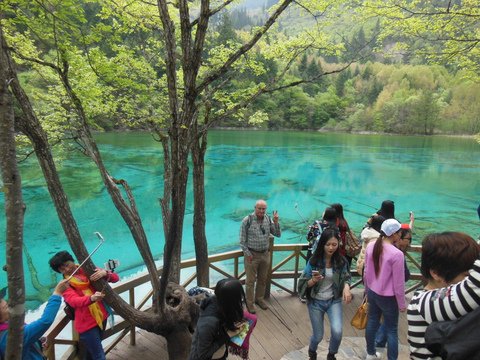
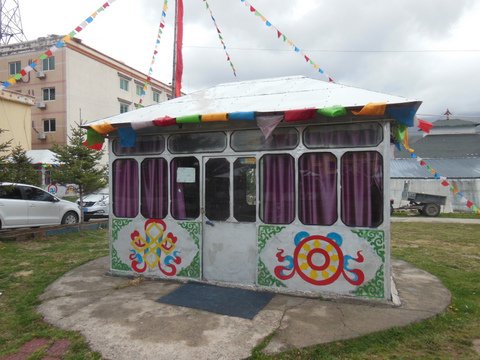
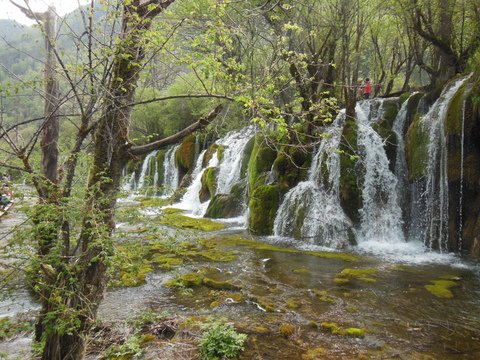
We’ve done a bit of altitude training as the plane to Jiuzhaigou landed at 3500 metres and it was certainly cold. This is the first time we’ve seen heavy coats and puffer jackets for sale right at the baggage carousel so you didn’t need to freeze before your luggage showed up. Quite entrepreneurial as the slower the bag delivery, the greater the sales. It was a 1.5 hour drive to the hotel downhill, hairpin bends all the way. Next day we wore all our clothes driving thru light snow to Hualong National Park where a gondola took us back up to 4100m and it was a 3k downhill walk back past hundreds of extraordinarily vivid coloured terraces very much like pictures of our lost pink & white terraces only in turquoise blues and greens but not thermal. Our private lunch that day was in a tiny Tibetan tin ger with purple curtains, sliding metal door and an alarmingly effective radiator set on the table top.

The UNESCO World Heritage Juizhiaou National Park hosts 45,000 people a day in high season and runs like clockwork. Scores of buses take everyone to the top of a glaciated valley so they can boardwalk/bus down in stages and we took the whole day viewing the hundreds of little blue lakes and wetland waterfalls. The park goes for kilometres and is absolutely pristine including No Smoking. Especially impressive are the spotless loos which, instead of “bin liners”, have heavy-duty “bog liners” and yes, it is all removed from the park by hand even for 2,000,000 visitors per annum. Because of the altitude there were brisk sales of personal oxygen cannisters or one could rest a while in “Oxygen Cafes”.

One of our requests to guides is to avoid museums and temples in favour of seeing what the locals get up to. We had a most entertaining afternoon in an enormous park in Chengdu where everyone empties out of the thousands of nearby apartments to relax, eat, exercise and socialise. Dozens of groups had their own forms of singing or dancing with sound systems at almost full blast. One requirement is that each must have a screen with the digital read out of the decibles they are creating to keep under the set upper limit. Those opting to sit quietly elsewhere to relax may avail themselves of mobile ear-cleaning services where chaps wander around with a handful of torture instruments and do a brisk job of twizzling inside people’s heads with long skinny brushes warmed up by the previous customer. Clustered on the perimeter of the park are the Desperate Parents. These poor mums and dads despair of their offspring ever finding themselves a suitable spouse so resort to public dating. All you need is a piece of A4 placed on the ground with a print-out of your marvelous child’s achievements and a list of the requirements for the future-in-law. They wander up and down reading them all and the vital phone number is in bold print at the bottom so almost immediately a spouse-seeking parent can call for an instant family appraisal. The said children (probably in their 30’s) are nowhere to be seen but go along with the process.

All our guides have rural village backgrounds and have similar stories of hard-working parents whose grown-up youngsters, now educated, have no desire to head back home to grow vegetables or follow livestock around the mountains. But the older folk still do it as evidenced by the intense farming of the land particularly obvious from the air. We visited a prosperous farming family at their home and their only child, now at boarding school, will not be back. Mind you, when a city-dwelling daughter has a baby, the grandmother is expected to move post-haste to the city apartment to look after the child for 12 years. One guide saw this as a particular problem because her mother has never lived anywhere but the country, did not know the city, had no other family or friends there and could not even speak the same language. But still she was going to come.

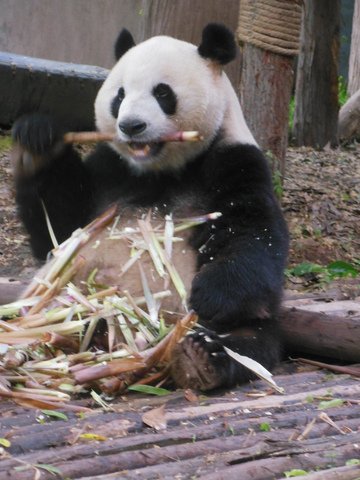
Most special thing? I must say that viewing a 2 day-old panda in an incubator was pretty darn special. The careful breeding program at Chengdu Giant Panda Base has seen the number of residents grow from 6 – 146 animals all outdoing each other for cuteness.

Dennis continues:

I approach using this keyboard with trepidation because when I was doing the NK email in Beijing I got a sudden frizzling pain in the side of my lower back, and for the first time in my life I had a seriously sore back. My apologies to those of you who have exhibited similar symptoms in my presence only to be told to stop malingering. It was fine for walking so I was happy to soldier on bravely but after about four days of involuntary groans every time I bent or sat down Kay and the jolly guide herded me into a rather grubby office where I was to be massaged by one of a group of deaf and dumb women. I had to take my shoes off and empty my pockets and lie on a well-used bed and all of me, apart from the bit being worked on, was covered by a fat eiderdown. Then I had an hour of relentless searching for sore bits starting with my head and it ended up with me hobbling out almost unable to walk and mentally planning how to get back to Beijing and on the next plane home. I said lots of negative things about traditional Chinese massages over the next 24 hours, and then things got better over the next 3-4 days and I don’t know if was the massage or just me getting better, but I am now back to the normal aches.

Kay mentioned the plane landing at 3500m and about half an hour before landing I awoke from a little nap and glanced out the window to see mountains at the same level we were and seemingly quite close enough for me to feel concern. When I looked more closely we were flying along a valley between some serious looking stuff well above us – I made my usual assumption for such situations, that the pilot probably wasn’t lost and also didn’t want to die. Anyone who wants to tell me about suicidal pilots need not bother.

We did lots of flying and a couple of airports later I ran foul of the security system and was stopped at their counter and sent back which resulted in my waving goodbye to Kay as she passed through. In China your baggage is x-rayed straight after check in and usually if you have a bomb you get called out straight away. In this airport they put an alert on their system so when I got to security I was flagged as a potential terrorist and told to go back to where I checked in. Unfortunately, it was a big airport and we had been guided to check-in so I didn’t have clue where to go and English was not widespread, but worked on the basis that if you keep asking and look bewildered someone will sort it out. I did eventually find counter F9 and was directed to the naughty room. You are not allowed lithium batteries in checked luggage and my old non-smart phone which had been through 5 of these x-rays previously, was the reason for the fuss. When I dug it out the guy laughed and told me to put it back and all was fine.

This is our second time in China and my request to China Guide agency (recommended) was more of the way of life and less big ticket tourist items, apart from pandas of course. My main conclusion after this trip is it sure has plenty of contrasts. The noise of what is presumably a normal conversation is amazing and you expect someone to pull out a knife and deal to the other given the way they go on; on the other hand, in the tea houses of Chengdu everyone sits around being relaxed and obviously in no hurry to do anything like work; then there are the dangers of being in a queue and not keeping your elbows at the ready because if you are not vigilant some middle aged lady will barge right on by; and as against that in one town we saw a group of old men in a park under a pergola which had lots of bird cages hanging from it and the old men bring along their birds so they can have a bird chat with all the others. The biggest contrast is the urban/rural one. The big cities are no different in most ways from anywhere else in the world, and often better, but the country is largely hands-on manual labour in ways that haven’t changed in a long time. The villages are not modern and still have a Leninist feel about them. When we were talking to the farming couple I asked about land ownership and it appears they own the plot their house is on but the farmed land is theirs only in the sense that they have a right to occupy that applies to their heirs, and they can sell the right to occupy, but the local authorities can also take it when they want to with an uncertain formula for recompense. Not the best way of encouraging aging farmers to spend capital on doing things more efficiently.

All of our guides had parents and grandparents still living in villages and they all are never going back to live there, which is the same as millions of other young people. One guide told us that over 200 villages a week are becoming depopulated and ceasing to be communities. I have no idea how accurate that is but has a ring of logic. We saw plenty of terraced paddie fields now growing a few fruit trees and young people are not obvious when you see a group in the fields. There is no ability to get spontaneous volunteers as in North Korea. Another of the guides had a mother from Shanghai which was about 5 days train rides away from where we were. This was explained by the fact that when the Cultural Revolution started the mother was a student in Shanghai and was trucked across the country to Yunnan, next to Tibet, to become a farm labourer and learn the joys of real work. Luckily she met the local accountant who eventually saved her from all that nonsense and she too never went back. There is a lot to be said for being an accountant.

There has been one major financial problem on this trip, apart from a couple of items Kay has had to have. When I left Auckland I also left my best travelling sunglasses behind. So first day in Beijing I went out exploring around the hotel and saw a shop that had a sign in English that said “Glasses”. Telling myself how clever I was at finding it I went in and found exactly what I wanted for about NZ$40. On the train back from NK they got lost. Nothing to do with the vodka. I was back in the same hotel in Beijing so I went back to Glasses, this time with Kay, and bought a replacement pair which weren’t as good but cost the same. Within 5 days they had disappeared so as the expense was now hurting I bought a pair in a market that cost $3 and they are pretty good and look the part. Because of this success I boldly bought another pair a couple of days later that cost $6 which have a complete wrap around look but as yet have not been properly tested in the field. About the difference between the cost of the first and second pair was squandered on a rare bottle of wine, in the sense that drinking wine is a rare thing at present, when Kay and I were entertaining the street crowds and eating pizza in Dali.

It’s a tough life and there is one instalment to come from Mongolia where we are presently, many miles from a tar sealed, or even metalled, road at a hot springs resort. But as an international guide book puts it “Don’t think it will be like NZ where you sit in a hot pool and look at mountains”.

The big question is why don’t old guys want a selfie stick?

Kay and Dennis.

Categories
North Korea (DPRK)

The Democratic Peoples Republic of Korea a.k.a. North Korea.

Should you ever get sick of where you live and want a complete change I have a suggestion for you. NK is about as opposite to NZ as you can get. My week’s visit was very intensive with no real unexpected adventures because that is pretty much impossible. I went on a tour, and our group was 8 in total including our leader and I think I was the least intellectually qualified which meant I had to be a bit careful before opening my big mouth and having an opinion. Our leader was a professor in north east Asian studies and an international leader about NK. He grew up in East Germany and Russia so had a good understanding of living in a communist society. There was a NSW Supreme Court judge who sounded like an Oxford graduate because he was, and he was also the author of several books with another one on the Korean War under way. His wife was also a graduate. The next intellectual was born in Iceland but lived in Norway, now retired as a professor, and his PhD was in economics and his speciality is fisheries economics. He was the oldest and is a considerable traveller who after a drink can recite his own humorous poetry in English. The only solo woman was a university career person in education and libraries who got a terrible cold for a few days and had firm opinions about what she was seeing. There was a younger couple, both Oxford graduates and she described herself as a conceptual artist but was far from flaky. The male rejoiced in the name of Mustafa Suleyman because his father was Syrian although he was born and lived in England, and if you want to be nosey google him – he and 2 others formed a company called DeepMind which they sold to Google a few years ago for $US140 million. A very sharp mind and a pleasant person, also very useful at fixing any tech problems those with smart phones had. And then there was me with a C average B Com from Auckland. I learnt lots just being in that group and if any of you have stuff on your computer or on a cloud you will be pleased to know that strangers getting at it is even easier than you thought.

As with all NK tours you also have guides/minders who are with you at all times apart from when you are in your hotel room or a toilet somewhere. There is no wandering off on your own, no walking down the street without them and if you are wearing unsuitable clothing they will sort you out – I had an informal jacket on when visiting the mausoleum and it got put aside. The librarian in our group was wearing a red puffer jacket and was told she should take it off and she flatly refused, which was a winning tactic. If you take a picture of the wrong thing they will help you delete it – I did this only once. Pictures of any one in a military uniform or of any construction are not allowed along with anything that might put the country in a poor light. Our leader said the first day with these people was very important because if they get the impression there are no stirrers they will relax and not make your life too difficult, so were very good and the next day there was no one observing from the back of the bus so we could do low down pictures whenever we wanted, and it stayed that way. We also got to do a few accompanied walks that were not on the itinerary and generally the guides were not too bad in the context of what could happen.

Times in NK are a bit tense at the moment because of the first congress of the ruling party in 30+ years. People work 8 hours a day, 6 days a week and on top of that have to do another 8 hours a day of helping the state which may be work such as gardening or rehearsing for spontaneous demonstrations of love and affection for the Leader, which was going on in a big way when we were there. On top of that they may spontaneously volunteer for extra work so things can happen much faster than normal. At present they are just finishing a 70 day period of spontaneous volunteering for all people in the country. They all look tired. Some of the terminology I am using is the translated stuff they use and became part of our conversations during the tour. We all did spontaneous stuff, but mostly we liked to do ON THE SPOT GUIDANCE. This what the very big boss does and there are lots of paintings and pictures of all 3 Kims looking leaderish and pointing while offering OTSG, and in the background support staff all have a note book and pen to record these divine utterances. . Mustafa said that he is known to do flyby micro management but now he is going to move to OTSG.

NK is a theocracy which for those who want to know, is a religious dictatorship. The religion is headed by Kim 3 at the moment but his departed dad and grandad are also gods and treated as such. The official paintings try to make them look similar but that fails especially with the present Kim 3 because not only is his face quite different but he is also really fat. More often than I expected we would all line up in front of statues, pictures or paintings of them and show our respects by bowing. Once we had to show respect at a big marble plaque that had Kim 2’s autograph on it. The nice ones in our group bowed deeply and I moved my head. We visited mostly big government stuff and there were always lots of statistics as in when the building started and finished, measurements, number of bricks and blocks of marble, and the deep significance of the relationship of some of these numbers to Kim 1, 2 or 3. So the length might be the numbers in the date of a birthday or something similar. Absolutely fascinating but surprisingly I can’t remember any thing specific. Also everything was finished really quickly, often in exactly one year because of the spontaneous volunteering of extra work by the worker soldiers.

Conscription is for 10 years and starts at about age 16. They do a lot of construction work and also are very good at military displays. You can tell the serious ones by the callouses on their hands because NK is keen on martial arts, and because civilians are often in uniform-looking clothes you can pick the real ones by their footwear – and avoid taking a picture of them. The famous traffic directors have very smart uniforms and very little traffic to direct and we were told the female ones are known as the flowers of Korea. They do actually do their stuff even when there is nothing on the road. Outside of the capital, Pyongyang, there are mostly bicycles and trucks with very few cars or buses and the roads are not too wonderful with some being about 6-8 lanes wide. We wondered if they were auxiliary airports. The locals apparently have a great regard for the army which may be because one of the axioms of the country is “Army First”. This came from Kim 1, or maybe 2. Hence the fixation on nuclear weapons and delivery systems in a country where oxen-pulling plows are common. Every bit of land that can be cultivated is. Rice is the main thing but they also do wheat, millet , potatoes and every vegetable. The countryside at present is brown because it is has been prepared for planting and in addition to the ox plows there are tractors for the big fields and paddies. The agricultural correspondent, who is not present, would wonder how such old and battered machinery could still do the job. They have no fertilizer because of sanctions and you see them making little piles of combustible stuff which is then burnt on the tilled ground. The villages all look the same with whitish cottages and curving tile roofs built after the war because everything got destroyed. There are no trees apart from ones planted (voluntarily) in the last few years, mostly along the roadsides. It gets really cold in the winter and firewood is hard to find.

Pyongyang is very, very different from the rest of NK. We were all surprised at how developed it is but this is not just something caused by economics. Because there is almost no market economy the big buildings and modern stuff you expect in a main city are there for a political reason. To live in Pyongyang you have to be a proven top supporter of the political structure and show that in all you do. Even if you wanted to get there from some hole in the country there are movement restrictions so a visit has to be approved by the authorities. The city, therefore, has to be better than anywhere else both to make people strive to get there, and to act as a symbol of power to the peasants who get to go there once or twice in their lives to do some spontaneous demonstrating or whatever else is decreed. Continuing on that approach the places that such people visit exude power – the mausoleum of Kim 1 and 2 is all marble and huge works of “art” that make you feel small, the passages are very long, the main rooms are very high and the lighting in the rooms where the supposed bodies lie is very gloomy and a bit spooky. I say supposed because all you see are the heads and I reckon Peter Jackson could have them made very easily. This place is called The Kumsusan Memorial Palace and apart from the remains, also has each of the two Kims Mercedes cars as well as a room each of all the honorary degrees, medals, welcoming plaques and other junk they received from repressive countries like Niger and the Congo. This does sort of spoil the impressions for ignorant westerners like us, but it shows how internationally important they were to the locals. NK is very keen on stating how all the world respects them and their achievements.

Some of the places we went to have very cool names. The Pyongyang Grand Peoples’ Study House is a sort of library and continuing education place where we were shown how they can play any sort of music as proved by a rendition of Hey Jude. Of course it stuck in my brain for the next few days partly because it was so incongruous. The Three Revolutions Museum had lots of cool stuff from the Korean War and the US Navy vessel Pueblo, (remember that ?) along with lots of exhibitions about how the glorious army captured it from the bastard imperialist Americans. Not surprisingly the Korean War is serious stuff for NK. I didn’t know the extent of the damage to them which was massive. All cities except one were levelled by unopposed bombing and it was a war so all participants did stuff that was not nice, although in NK it was only the bastard etc guys who were bad. Or so we were told. Down near the border with SK is The US War Crimes Museum which is pretty grim and covers in obsessive detail some nasty stuff the US forces did, and it is almost certainly true, but once again there is no balance and no mention of the SK troops. Or NZ for that matter. To say that NK is unable to move on is an understatement. They seem to want to stay there in the 1950s and that is a deliberate political position because a dictatorship that keeps its people in penury has to have an enemy to blame. And that is the bastard imperialist Americans. The DMZ was very peaceful and I sat at the table where the 3 years of armistice negotiations took place. We were also shown bits of a concrete wall built by SK which the NKs say stretches right across Korea and it can only be seen from the north, but SK and US say there are tank traps but no wall. I have done a quick google but can’t find anything definitive. This is not unusual as there is a lot of stuff about NK that is unknown. Our team leader often replied to our questions with an opinion but also a qualification that no one really knew.

NK used to be a non-monetary economy which meant no money was needed because the government provided everything and there was nothing, and nowhere, to buy stuff. After the famine in the 1990s people had learnt that when the government can’t supply you have to find another way and a small black market started. This still exists in a larger form and, as a counter, official markets have been set up. They generally have round blue roofs so can be seen, but visiting is not allowed for tourists. Basics like apartments, essential food and clothes, bikes and presumably cars are still provided but supplemented by buying privately, so capitalism is there and I can’t see it going away unless there is some catastrophe. All our questions to the guides about comparative wages were slid around so we don’t know who gets paid the most, or even if anyone does. There is certainly a more-equal-than-others class and they are obvious, especially the children who flaunt their superiority. This includes the guides who while not being ostentatious are from privileged backgrounds as tips in hard currency are very important. There is a local currency which tourists cannot have so all cash transactions are in Euro, $US or Rimimbi and everyone is good at the maths. The stuff we could buy was in hotel and museum shops and the range was limited, shall we say.

Geopolitically NK is a buffer between China, Russia, SK, Japan and the USA in several ways. It is paranoid about all of them and conducts a balancing act based around its nuclear weapons which is largely a bluff. They know that using a bomb anywhere would result in massive retaliation from which they have no defence, so they have to act like they are unpredictable and seemingly a bit crazy in order to keep the enemies off balance. And they do it well. I am sure in the back of the minds of the Kims and their mates, is the fate of Ghadaffi who stopped his nuclear program and ended up dead in a drain. It appears to be generally accepted that most of the enemies are quite happy to have NK between them but worry about Kim 3 having a meltdown and going away from the set routine and actually pressing the launch button, or offering OTSG for someone else to do it. NK, as it presently is, will not give up the nuclear option, they are very clear about that. Which raises the question about what will happen to the regime? There seems to be two choices: a gradual change as per China, to a more capitalist society or a big collapse. which would involve SK taking over. It is hard to see the later happening but who knows? NK talks big about unification but their formula is completely unacceptable to SK because they want equal votes but only have about half the population.

We never felt unsafe in any way despite all the military and police guns everywhere. Although we were mostly kept away from the locals we sometimes got to mingle and “hellos” and waves were swapped. We saw plenty of other tourists but in the hundreds at the most, not thousands. There is a beaten track and we kept running into the same people, our favourites being a couple from Kansas – the wife, who was in her 50s, had a penchant for filmy, very short-hemmed dresses which caused our guides much concern. The locals are quite conservative and restrained in their dress and always have a lapel pin starring the 2 first Kims. However, the lady from Kansas redeemed herself in our eyes when we visited a big park on May 1, an important holiday, when everyone had been issued with picnic food and beer and had crowded into this park to celebrate. This included women in traditional costume dancing and right in the middle was the tall blond from Kansas in the Korean costume of a colourful floor-length, A-line dress having a grand time and wowing the locals. We thought that took some doing so decided she must be ok. The hotel we were staying in had 43 floors with slow lifts and she was in the same lift as me the next morning so we a chat on the way down and she was in recovery from the exercise. Earlier in the tour we were staying in an old, traditional hotel with paper-thin walls and she and her husband were next door to our team leader. He heard them come in late at night, having partaken of the local rice wine, expressing endearments loudly for each other. He was very concerned at what noises might follow but luckily the rice wine won and all he heard was snoring. All the hotels we had were fine if a bit tired and we had plenty of food mainly of a sort that was what they thought imperialists would like. The local beer was fine and the best one was pointed out to us early on so we were experts and able to give OTSG to other tourists.

We left by train to Bejing, a 24 hour trip in 4 berth cabins. Being a generous person, and aware of the need of assistance to sleep, I repeated the exercise that Colin I did in Uzbekistan which was to buy a bottle of vodka. It came from Lithuania and apparently was good because everyone felt fine next morning. We could not get any glasses so I advised everyone to keep their empty water bottles for conversion to handy drinking receptacles with my Swiss army device, our German leader being very impressed at my experience in such matters.
When we arrived in Beijing I discovered I was a day ahead of myself because Kay was supposed to be there but wasn’t. But it was all right because I had a hotel booking and she turned up early the next morning.

There is lots more I could bore you with but this enough. If you want to know anything not mentioned just ask – I can go on for hours.

Dennis.

Categories
Mongolia

Mongolia – no boundaries, no fences and not many sealed roads.

Mongolians understand their place in life which, for females, is responsibility for everything inside the ger (also known as a yurt in other strange places) and the milking. There is plenty of that so they do get outside a fair bit. Men are in charge of all the outside stuff mostly related to stock management and discussing important other things like prices , but women get all the money earned. This division of labour specifically applies to 40% of the 2.7 million population who are nomadic herding farmers, but it also applies to village and city people as in most cases there is no more than a generation of removal from their living in the nomad world. Therefore Kay will write about inside the ger and I will deal with outside.

I organised our Mongolian trip through a local agency and we were provided with a husband and wife team of Nasan and Tuyu, the later being the guide and in charge of inside stuff and she spoke pretty good English. Nasan was the driver and owner of our 1998 Land Cruiser which was immaculate and never missed a beat in 10 days. He knew a bit of English but was reluctant to try when his wife was around. They were wonderful and I was happy to pay the exorbitant tip the agency suggested because they did a great job and looked after us like we were their grandparents.

Mongolia is a democracy following a peaceful revolution in the early 90’s although there is not a great deal of respect for those in charge who, I gather, are the elite and corruption starts from the top here. On our first day we were battling through the horrible traffic in the capital, Ulaanbaatar, where half the population lives, and there was a complete stop of movement because some one important was having a drive through town. When the large black car and outriders swept past the locals all made very sarcastic noises with their car horns which I suspect was not by mistake. The big industry is coal mining, not a good place to be now, especially when their trade is mostly with China which has stopped importing coal. They have other minerals the most important of which is copper and there is a huge big mine that has been some years now getting started and it is supposed to be the financial saviour of the country. Unemployment is currently high and there seemed to be a lot of big trucks parked up. But they have a safety valve for economic problems and that is agriculture.

It would have been good to have had the agricultural correspondent with us but he was otherwise engaged being luxurious in some couth part of the world. So I will just have to try hard to explain what happens in Mongolia. We have to start with land ownership because it is the basis of all economic processes. Everyone is entitled to a small plot of free land although you can’t ask for a specific one (unless you know some one who has influence and an unexplained pile of assets) and for most people, including just-born infants, this land will be near their village or city. For the nomads it is usually their winter camp which has sort of permanent stock shelters. These bits of land are mostly fenced and don’t amount to much in terms of area in the country. Then there are national parks of which there are a few, and then there is everything else which is owned by everyone and can be used by everyone and there are no boundaries and no fences and the only trees are on the steep non-grazable parts. It is one vast, wide open space with big plains, low rolling country and some not too precipitous mountain areas. In other words it is the steppe. So anyone who can get a few animals together and find a ger can set up camp and be a nomad.

Nomadic life here is not quite what you would think because they move between two main camps usually no more then 30 kms apart and often a lot closer. The winter camp is sheltered from the northerly winds as it gets extremely cold, and summer camps are near water supplies and somewhere the breeze can lower the hot temperatures. They live in a ger which is round, about 6m in diameter with one low door and no windows apart from the opening in peak of the roof. All the family lives in this building so as you can imagine they are very compact with what they have inside. The toilets are 3-sided flimsy things with no roof, a long way from home – say 50-70 metres and could be described as rudimentary. I did see a tin bath so presumably they can have a wash once in a while. We spent visiting time with 3 families and had 2 nights “living” with a family at a homestay where thankfully we had our own ger, but no ensuite facilities. Livestock are sheep and goats which run together because sheep are stupid and need goats to lead them, cattle, yaks, horses and camels (2 humps) in combinations that suit the nomads and land conditions. A good ewe is worth US$80, a cow $400 and a camel $750. I never got an answer about yaks. All are milked and the magic herd total that signifies wealth is a combined 1,000 head. The only technology they use are 2 poles in the ground for breaking-in horses. No machinery apart from motor bikes. Dogs are for warning about bad people and wolves, and rounding up stock takes several people on horse, bike or foot. I doubt anything about the operations of this range life have really changed in hundreds of years, apart from mobile phones which make finding out where missing stock are much easier. An example is from our homestay visit when in the evening it was time to separate the calves from the adult yaks so the later could be milked in the morning. The calves were put in a sort of rackety pen made of 4 gate-like things tied together with leather straps. Then everyone milled about trying to catch the calves while a few horsemen lurked in the distance to return the animals that didn’t want to be caught or stay and watch the action. A few metres of wire netting set up in a right angle would have made it all a lot quicker and easier. No one has ever heard of a mechanical shearing set up let alone a portable one and hand milking is how it is done. All of which is the main attraction. These guys are a living, viewable anachronism and they are very welcoming in a reserved way.

Our tour also took in other sights and worthy things like a couple of museums; several Bhuddist places including one that took 3 hours of hiking up and down to get to where the highlight for me was Tuyu and I having lunch with the only monk in his ger; the country’s biggest waterfall that would not get a mention in NZ; and best of all a huge stainless steel sculpture of Chiingis Khan, possibly known to you as Ghengis. Not much really but we only saw the central part of the country and really it is the land and the nomads that are the highlights.

The roads were a hoot. There are sealed roads between the major towns of which there are not many, and once you leave those roads you are on dirt tracks. Didn’t see any metalled roads. Even when we went to a hot springs tourist place with lots of camps and accommodation there were just tracks across the steppes and over the hills. Naturally each driver has their own idea about the best way to proceed so there are usually a wide range of tracks to choose from, or you just start a new one. Nasan loved it. We met only 3 bridges off the sealed roads and one was spectacularly busted, and the other two were of the “passengers walk across before the car” variety, so we just cautiously forded all the waterways we came to. The weather we had was unseasonally cold,with times of snow, hail and freezing wind from Siberia all which added to the fun of open country driving. It also made visting the open air toilets somewhat uninviting and helped when we had 4 days with no running or heated water, because no one sweated. Our accommodation outside of Ulaanbaatar was in gers and I liked them – they make excellent roomy and warm accommodation as long as you keep feeding the stove. The slightly unreal thing about living in a ger is the divide between out and in. When you are in with the door closed it is dark and there is no connection with the outside given no windows. Then you bend down and go outside and you are immediately in the farm with no porch or path to the gate. Just straight into the huge big outside.

Kay’s turn:

Before we got to experience a ger we had a day in Ulaanbaatar where we could access google and go to a concert. Magnificent!! We were treated to throat singing, traditional dulcimers, hearty ballads and a contortionist for good measure.

Next morning we headed off for the first ger visit but it was so darn cold even our hosts would not venture outside for a scheduled camel ride but were content to watch us eat the hotel packed lunch and, with Tuya translating, ask about farming in NZ. Being springtime, the tourist season was just starting and we were amongst the first to arrive. It was 3 hours driving 180 km to the Sweet Gobi Ger Eco-Camp which hadn’t quite got itself into gear but our thickly felt-lined ger was ready with a goat dung fire but no heating in the dining room. Have you ever tried eating with your hands in your pockets wearing 5 layers on the top and even golf wet-weather pants over the lower layers? It was candlelight only in our ger but we got the thermometer up to 38 degrees so there’s a lot to be said for good goat dung. Next morning we clambered into our Cruiser still wearing 5 layers until the vehicle warmed but happily heading for 2 nights at Tenskher Hot Springs with steaming pools to look forward to. Enroute we had the compulsory monastery visit. It was under renovation and all the wooden carved features from 1600’s had been taken down for refurbishment and, it was covertly revealed, could be quietly purchased if the guide could please secrete it up her jacket until we left. Nice little earner for the workmen.

With snow gently falling for part of the trip we took 4 hours to drive 260 kms which was plenty of time for Tuya and Nasan to present D with questions as to how to go into the tourist guiding business on their own account. The mentoring continued until we arrived at the not-Hot Springs. It seems there was a rather obvious problem with the spring only dribbling. This was log cabin-style lodge accomm with a room for us upstairs. Maybe it was the height from ground level but no water could make it up that high to our taps nor to our toilet so there was an expressionless young lady detailed to intermittent bucket brigade. Late that night there was a warmish outside pool available so I plonked in wearing a fair number of clothes that needed washing and as the little snowflakes fell around us we lolled about to the amusement of builders working well into the night on the lodge extension. The owner of the establishment was a bulky, jovial retired wrestler who rocked up the next morning with his bone-crushing handshake. He would have been just the man for dealing with 2 carloads of Mongolians who had pulled up at 1a.m. demanding hot water and food or they’d shoot the pregnant hotel manager. There was no food, there was no hot water and, fortuitously, there was no shooting just a lot of yelling.

We walked 4kms the next morning to visit a nomad family who welcomed us traditionally with warm yak’s milk, a snack of bread with clotted cheese and an offering from the snuff bottle. Apparently the conversation was about their intention to venture into homestays with special reference to the toileting requirements of visitors. Later in the day I trudged to a neighbouring “resort” to have a shower as there would be no likelihood of such things for several more days. There would also be no electricity for lighting or charging devices.

In China I had tried, without success, to buy velcro to mend the handle on D’s bag. Tuya knew just the very place to get it at a “blackmarket” in a small town so when we stopped off for that she was insistent that I also buy some fabric for a child’s garment. She’d seen me knitting (first tourist ever) so thought that at our ger homestay The Lady would show me what to do. Somehow I couldn’t quite see this as a good idea but went along with it. It turned out that The Lady of the family who was hosting us had a household (rather, gerhold) of herself, husband, a visitor who seemed interested in the daughter, 3 almost-adult children, a 2 year-old and a baby and just 2 beds. (I suspect we had the usual 3rd bed in our ger). She had to get up early to make the fire, boil up milk to make yoghurt, seive the cottage cheese, feed the baby, sweep out and make breakfast bread for everyone. Then it was yak-milking time (I helped with that) before more boiling of milk, feeding of baby (who didn’t have any form of diaper – don’t ask) and soup making. Tuya couldn’t see what my problem was with expecting her to fit in a few hours sewing. So in due course I was summoned to the family ger with my fabric, the hand-operated sewing machine from the 1930’s was set on the only flat space and, using a piece of soap, The Lady traced around an existing child’s deel (pronounced dell). That is the outer layer that everyone wears. No pins, just place the fabric under the machine needle and go for it. The iron was needed but with few places to look, it became obvious that the neighbour had not returned it. A son was despatched on the motorbike and he returned victorious with an old electric iron from which the surplus electric cord had been cut off and he quickly placed it on the top of the covered fire to heat. It wouldn’t get hot enough to do the job so I suggested that if I held the fabric against the burning hot chimney and pressed with the iron it wouldn’t need to be hot. Not sure how Tuya translated that but everyone was suitably impressed with the solution. There were a few snowflakes or hail coming in through the chimney gap in the roof landing on my head.

A small family arrived on a motorbike looking for their goats so they too crowded into the ger and there were now 17 of us. They left before the evening meal – primarily a tasty boil-up of goat, potatoes and carrots. They eat a terrific amount of meat and milk product with a few purchased vegetables. They can’t have gardens because the roaming animals would ruin it and they would probably be moving camp before any harvest.

That night it was so dark, it hailed, the wind got up, the temperature dropped and the distance to the plastic-walled shortdrop seemed to double. The Kapiti ice cream container no longer held the medical kit.

A couple of days later we were in international departures at Chenggish Khaan airport, Ulaanbaatar (cheapest duty free perfume in the world) and as I looked out at our plane I commented that my bright orange suitcase had not appeared to be loaded and I couldn’t vouch for D’s either. However, one must trust the system and as we were transitting through Beijing to Shanghai perhaps they had been given special treatment. “Special treatment” is right as they finally rocked up 20 hours behind us.

And now we’re back where we belong.

Until next time…..

Dennis and Kay

Categories
Uzbekistan

The final chapter – Uzbekistan

I am very sorry to advise that there will be no Special Correspondent report this time.  He says he is suffering from mental exhaustion from being made to look at too many old buildings. and physical exhaustion as well, from the tour leader’s obsession with walking as much as possible.  I don’t think he is really that badly effected and suspect he just wants to get home.

We have now finished the tour and are in Tashkent where we fly out from tomorrow.  Our last country has been Uzbekistan to which we had two visits.  The first one started in Termiz, the place where I had to climb the hotel fence at 4am.  From there we went to Buhkara and then after visiting the delightful Turkmenistan we came back to Uzbekistan and went to Nukus, the Aral Sea, Khiva, Samakand and now Tashkent.

Uzbekistan is mostly flat and is an irrigated desert. It grows a great deal of cotton, has about thirty million people including the obligatory president for life and is a police state, but no where as obviously as next door.  There are plenty of road blocks and lots of uniforms and I don’t think a crusading reporter would be around for long, but on the surface it is a friendly and relaxed place.  As previously reported we wondered what we had struck on our first day in Termiz, we were out on a local look drive but didn’t realise we needed our passports.  At the first road block we tried using our NZ driving licenses, but that didn’t work so back to the hotel.  Apparently all the attention there was because it is close to the Afghan border and the associated drugs.   When we were getting ready to leave the next morning Colin was  approached by our nearly non-English speaking driver and asked for a reasonable amount of money, which he handed over.  I fired off an email to the tour organiser asking what was going on, but all was soon revealed when we had to have an oil change and and apparently the driver had run out of cash.  We also had to advance the cost of a bribe to get through a road block quickly, but were repaid on arrival in Buhkara.   Colin was obviously distracted by all of this because he later found he had left his wallet in the car which caused a short panic before being quickly solved.

Buhkara, Khiva and Samakand are the serious Silk Road attractions in Uzbekistan and therefore are interesting because of the history and the sheer beauty of some of the sights.  To go with that are tour parties, mostly of old people, and lots of tourist retail activity.  We are now experts on silk, cotton and camel wool scarfs and given the number Colin has bought he may be going to open a shop.  We have taken all the necessary pictures and even made a special night visit to the Registan to see it all lit up.   The biggest advantage of tourist places is that you can get a decent feed and sometimes a reasonable glass of wine.

Food is not a strong point in Central Asia.  Generally it is plain cooking based on meat, potatoes, carrots and rice.  The much vaunted plov turns out to be all of that together.  About the only interesting flavours have come from fennel and the sometimes available chilly sauce.  There must be something tough in the food because gold teeth, especially sort of edging of the front ones, is common.  We recently had an overnight train trip and took our meal with us so we would have the right amount of nutrition and induce sleep.  Bread, salami and vodka.

Colin was still recovering from the effects of a wobbly stomach when we got to Nukus so didn’t come on the overnight camping trip to the Aral Sea.  All alone, apart from a driver and guide, I went to look at the biggest ecological stuff up in the world and it is impressive how much of the lake has gone.  From the once main town on where the shore used to be we drove 200ks to the present shore.   The driver told of how he used to swim at Moynak, the town where there used to be a fish cannery, and now it’s visited to look at the rusting boats sitting where they used to float.  I had a Dead Sea swim because it is so salty and can report it is fun floating on one’s back with arms and legs up in the air.  The lake is disappearing simply because Turkmenistan and Uzbekistan take all the water that should flow into it for irrigation.  There are regular conferences about how to fix it but it won’t happen because Uzbekistan is fixated with growing cotton which is a major earner, and Turkmenistan probably could afford to stop irrigation but they would have a huge unemployment problem.  So it will end up another desert and I suppose there is an argument that says if they would rather have an agricultural industry than a big lake, why shouldn’t they.

One of the fun things about visiting Uzbekistan is the currency.  The black market rates mean things are cheap, just to pick a random example a 1.5 litre bottle of beer costs about $1.20.  The downside is that the money comes in 1000 Som notes, each of which is worth about 20 cents and that means walking around with an inch thick wad of cash.  Locals can count it at impressive speed and the thick pile diminishes very quickly. If you change US$100 you need a bag to carry it.

Central Asia has been a great trip with a lot of variety of scenery, people, political organisations and roads.  Lately the roads have been reasonable but we have endured some of the worst I have seen.  The weather has been kind although one of us has mentioned a few times that he doesn’t like being cold and also doesn’t like being hot.  The accommodation has covered the lot from a shared tent with a useless zip, to yurts and to a five star marble palace with all graduations in between.  Colin and I have managed seven weeks without any arguments or sulking and probably confused our various drivers and guides by our strange kiwi bloke humour.  Luckily we have not been detained by uniformed personal but Colin has tried hard to find the boundaries for ageing tourists.

But wait……

Colin says, I’m not exhausted but am ready for home. Dennis has organised a great trip and we have had very few downs and many, many ups. It’s very special to have a travel companion where you can share the joys and also cope with the glitches if they arrive.

So we say farewell to Uzbekistan, Turkmenistan, Tajikistan, Kyrgyzstan and a small bit of Kazakhstan and hope to see you soon.

Dennis and Colin.

Categories
Turkmenistan

Turkmenistan

The last chapter ended in Uzbekistan where we spent a few days before crossing into Turkmenistan.  We have now finished with Turkmenistan are back in Uzbekistan for a more substantial time, but this is all about one of the stranger countries I have been in.

Turkmenistan is a big desert with some irrigation and a lot of gas.  The population is 5+ million and it has a president for life with a complicated name who does as he wants.  When the country became independent in 1991 the existing leader changed the name of the communist party to something with “democratic” and “people” in it and set about becoming a personality cult absolute dictator, which he did until a big heat attack got him.  He has left a legacy for the next guy of golden statues of himself and lots of grandiose white marble buildings all over the place.   All financed by the world’s 4th largest gas reserves.

We were closely inspected at the border for illegal medicine on both the Uzbekistan side and the Turkmenistan side, and why it is done when you are leaving I do not know.  When we got to the first Turkmenistan bit of the border we patiently queued for a form, which was completely in Turkmenistan language with no useful signs showing what it all meant.  After considering taking a guess I went to the next counter and tried to mime our problem, which earned me a stare then “Five minutes meester”.  So we waited and nearly on time in bustled a large untidy guy who turned out to be our very competent Turkmenistan guide, Oleg.  He filled out the forms and herded us through the rest of the nonsense.

Petrol costs less than 50 cents a litre and our initial vehicle used plenty as it was a very large Chev with three rows of seats.  Our time in Turkmenistan covered three main activities: being old stuff, playing in the Karakum Desert, and Ashgabat the capital.    There are some consistent things that are everywhere, excluding the desert, and they are pictures of the boss and policemen.  The Special Correspondent for Police earned his title for annoying the latter more than I did and will report in detail later.  Suffice it to say that one was rarely out of sight of some creature in uniform with a big communist hat.

The old stuff covered three sights and included a bronze age city complete with ceramic kilns and shards of ceramics lying everywhere.  I picked up a nice vase base that was 4500 years old, but threw it away when I remembered getting even a new carpet out of Turkmenistan requires special permission, so who knows what would happen to someone sneaking out an unwanted bit of fired clay.  The other two sites had newer stuff, like the middle ages.  One of them looked like long rows of clay hills, which were actually the melted down clay brick walls of a large trading city.  This one was called Merv, and we stayed nearby in the city of Mary.  There were lots of mausoleums and other holy buildings where pilgrims leave little offerings to signify to Allah the need for his help, like a little pile of bricks for a house, car keys, and little miniature baby carry cots.  Oleg put this sort of behaviour down to bad education.

Playing in the desert took three days and was very interesting as well as sometimes trying.  We were a convoy of three vehicles one of which was Oleg’s mechanical man who came with his two boys and a mate.  The other was a spare vehicle.  Oleg reckoned one did not mess with the desert.  Early on in the first day we apparently took the wrong choice at a junction and ended up with no tracks to follow at a shepherds hut that surprisingly had a very optimistic drawing of a female on the wall.  Luckily the shepherd was not out tending his flocks and was enticed into showing us the motor bike track to the next shepherd’s hut, which was six kms away.  We were now in a Toyota Land Cruiser which is a lot wider than a motor bike but off we went.  Our driver was a quiet guy but he did a lot of muttering in Russian while trying to follow the bike through sharply undulating sand hills with scratchy bushes all over the place.  It seemed much longer than six kms but we got back to vehicle tracks and eventually to the village where we were staying in for the night.

Even though I have a clear picture of this place in my mind it is hard to describe but……..  Medieval comes to mind, but there were lots of noisy motor bikes, mobile phones and some vehicles.  It had about forty mud brick flat roofed dwellings one of which had once been white, and it belonged to the richest man who was our host.  There were also a few yurts and we slept in one.  Before that we had to eat and luckily, from my point of view, Oleg prepared our meal which was plov.  This is rice with bits of meat and veg and it was cooked in the kitchen which was three clay fire places out in front of the house in the open.  Colin was being betrayed by his stomach and other parts and was not keen on staying up late and drinking vodka, which Oleg reckoned was the best way of fixing crook guts (that’s dairy farmer for diarrhoea) .  Eventually we got the developing party out of the yurt so we could do our lying on the floor, but the party people only went about a step outside the door and continued noisily.

They were joined in noise making by: shepherds on popping loud motor bikes who kept zooming up the surrounding hills well after midnight; seemingly hundreds of dogs all trying to sound tougher than the others and they didn’t stop; camels that can groan extremely loudly; excited children (a huge number for a small place, but then what else is there to do) because it was holidays; and at about 2.30 the roosters started.  My earplugs were locked in the car and I didn’t like my chances of getting them out without being forced to drink several big vodkas.  I was not entirely sound in the stomach at this stage so I put a heavy pillow over my head and managed a few hours sleep.  When I asked Colin about his night in the morning I got an unreportable response that not only covered the noise but also the delights of three treks up a hill to the very primitive and potentially dangerous toilet.

The next day was more off roading in the desert until later in the afternoon when we zoomed up a hill to a sealed road, and whacked down on a quite high concrete kerb.  But we were tough and didn’t break.  That evening we set up camp close to the Davaza Gas Crater also known as the Gates to Hell.  At night it’s a spectacular sight with all of the bottom of the crater being covered in fire from the escaping gas.  As usual Oleg had a reason why it happened that was not critical of the Soviet times, but most sources will say it developed from a Soviet gas exploration stuff up.  We had a lovely quiet night and I found that a couple of small vodkas made lying on a thin sheet of rubber almost acceptable.

We were in Ashgabat for three nights and it is a very strange city.  The first thing we noticed was that people pretended we were invisible and there was no eye contact or curiosity.  The next thing was the streets of white marble edifices, all of which looked like someone’s idea of a Central Asia palace.  We were in a flash hotel right in the middle of all of this pomposity.  The third immediate sight was the police.  We did lots of walking and on one solo walk I discovered that not only were there all the white marble palaces, there were also old apartment buildings being covered in pressed steel panels, powder coated white, so they looked like a marble place.  Given the standard of the fixing of this covering they probably will just look messy in ten years and now they look like so many freezers lying on their sides.

In addition to all the billions spent on buildings there are more water fountains than you could shake a truck load of sticks at, like continuous ones for kilometres.  And there is a huge construction site in the middle of town for some obscure Asian games in 2017 with multiple stadiums connected by an overhead railway.  If you walk one block away from all the glitz you are in standard Central Asia with broken footpaths and Soviet era apartments so all the wealth being earned is staying firmly at the top.  Being a fair person I have to say that locals get free gas, free education and health and as mentioned fuel is ridiculously cheap, but there is only one retailer and queues to fill a car are common.

I had one conversation with a local in Ashgabat and Colin was the same.  One can only assume there are rules about talking to tourists just as it is against the law to bring a dirty car into the city.  Oleg and the driver stopped outside in the country and bottled water from an irrigation ditch to comply.  We did befriend, briefly, a Mexican guy when sitting around our hotel pool.  Talk about an innocent abroad, he was working there for three weeks and the only info he had was google maps on his phone.  So we told him to come out and eat with us in a well hidden nearby restaurant which he must have been grateful for because he paid for us both.

And now the Special Correspondent for Irrigation and Police.

Our track since the high passes of the Pamir Highway has very much been shadowing the growth of the Amu Darya River (Oxus).  We have seen the vast mountain watershed that created the glacial blue beginnings of this river which is the basis of agriculture in the countries we have visited.  It flattens out after Tajikistan and travels 2000kms through Uzbekistan and Turkmenistan before running into the sand short of the Aral Sea which it used to sustain.  This river has been used for irrigation for hundreds of years but the Soviets in the mid 1990’s decided to expand the cotton industry in Uzbekistan and Turkmenistan by irrigating the desert.  By the 1980’s the inefficient flood irrigation system had reduced the flow into the Aral Sea by 90 percent and it has continued to drastically shrink.

The irrigation has created a large cotton industry but with no discernible wealth accruing to the farmers. Tractors, ploughs, and drills appear to have been made by the Mad Max film crew and cotton picking, which is happening now, is done by hand.  Just like in the good ol’ days down south.  In the fields here it seems all hands available are used including school children despite laws that say otherwise.  Oleg the guide told us about his experiences of this slave labour with the schools being used as dormitories for teenage pickers and reckoned it wasn’t all bad.  He learned to drink vodka and had the opportunity of much up close and personal contact with the opposite sex as the dormitories were quite close together.  The downside was it took up two months of the year and was very hard work with the possible loss of tertiary education if you didn’t meet your quota.  Hardly an economic miracle when the system doesn’t allow sufficient profits to pay for labour or afford machinery.  We saw some rice farming that looked more viable and apparently the product is very good quality.

In my capacity as Police Correspondent I name the following as “The Police. Roadblocks, Baton Waving and General Stick It Up Ya Report”.

We were a little bemused while doing our first bit of travel in Uzbekistan by the occasional red baton wielding police person at road blocks, but that was nothing compared to the overbearing strictures of the Turkmenistan regime.  We were stopped at regular intervals by said baton wielders who were immaculately uniformed, usually pot bellied, round faced and short.  The speed limits were a maximum of 90 and 30 past guard posts so progress was slow.  Oleg especially told us to be careful in Ashgabat and not piss off the police by doing things like taking photos.


The first day there we were walking through a large beautiful park and I took a photo of some roses which immediately resulted in my being yelled at by a cop person at least 50m away.  I had to produce the offensive weapon and show the last few pics.  Later when we were about to cross a road with no traffic we were again yelled at to use the underpass, or else.  Then after coffee on our way back and about 300m away from the hotel, tired and hot, a soldier said “nyet” and we had to detour for at least 1.5kms.  I used a very rude verb and a similar noun as I turned and walked away.

Dennis again.  The next day I had come out of a complicated underpass and stepped onto the road to check I was going the right way and I got the official whistle and yell.  I smiled at him and in the vernacular advised him to go away and do something useful.   It would have been a considerable shock if he had replied in English.  The description of police state surely applies to Turkmenistan.  It has been interesting to see such a place but I certainly don’t want to live there.

Dennis

Categories
Turkmenistan

Turkmenistan

The last chapter ended in Uzbekistan where we spent a few days before crossing into Turkmenistan.  We have now finished with Turkmenistan are back in Uzbekistan for a more substantial time, but this is all about one of the stranger countries I have been in.

Turkmenistan is a big desert with some irrigation and a lot of gas.  The population is 5+ million and it has a president for life with a complicated name who does as he wants.  When the country became independent in 1991 the existing leader changed the name of the communist party to something with “democratic” and “people” in it and set about becoming a personality cult absolute dictator, which he did until a big heat attack got him.  He has left a legacy for the next guy of golden statues of himself and lots of grandiose white marble buildings all over the place.   All financed by the world’s 4th largest gas reserves.

We were closely inspected at the border for illegal medicine on both the Uzbekistan side and the Turkmenistan side, and why it is done when you are leaving I do not know.  When we got to the first Turkmenistan bit of the border we patiently queued for a form, which was completely in Turkmenistan language with no useful signs showing what it all meant.  After considering taking a guess I went to the next counter and tried to mime our problem, which earned me a stare then “Five minutes meester”.  So we waited and nearly on time in bustled a large untidy guy who turned out to be our very competent Turkmenistan guide, Oleg.  He filled out the forms and herded us through the rest of the nonsense.

Petrol costs less than 50 cents a litre and our initial vehicle used plenty as it was a very large Chev with three rows of seats.  Our time in Turkmenistan covered three main activities: being old stuff, playing in the Karakum Desert, and Ashgabat the capital.    There are some consistent things that are everywhere, excluding the desert, and they are pictures of the boss and policemen.  The Special Correspondent for Police earned his title for annoying the latter more than I did and will report in detail later.  Suffice it to say that one was rarely out of sight of some creature in uniform with a big communist hat.

The old stuff covered three sights and included a bronze age city complete with ceramic kilns and shards of ceramics lying everywhere.  I picked up a nice vase base that was 4500 years old, but threw it away when I remembered getting even a new carpet out of Turkmenistan requires special permission, so who knows what would happen to someone sneaking out an unwanted bit of fired clay.  The other two sites had newer stuff, like the middle ages.  One of them looked like long rows of clay hills, which were actually the melted down clay brick walls of a large trading city.  This one was called Merv, and we stayed nearby in the city of Mary.  There were lots of mausoleums and other holy buildings where pilgrims leave little offerings to signify to Allah the need for his help, like a little pile of bricks for a house, car keys, and little miniature baby carry cots.  Oleg put this sort of behaviour down to bad education.

Playing in the desert took three days and was very interesting as well as sometimes trying.  We were a convoy of three vehicles one of which was Oleg’s mechanical man who came with his two boys and a mate.  The other was a spare vehicle.  Oleg reckoned one did not mess with the desert.  Early on in the first day we apparently took the wrong choice at a junction and ended up with no tracks to follow at a shepherds hut that surprisingly had a very optimistic drawing of a female on the wall.  Luckily the shepherd was not out tending his flocks and was enticed into showing us the motor bike track to the next shepherd’s hut, which was six kms away.  We were now in a Toyota Land Cruiser which is a lot wider than a motor bike but off we went.  Our driver was a quiet guy but he did a lot of muttering in Russian while trying to follow the bike through sharply undulating sand hills with scratchy bushes all over the place.  It seemed much longer than six kms but we got back to vehicle tracks and eventually to the village where we were staying in for the night.

Even though I have a clear picture of this place in my mind it is hard to describe but……..  Medieval comes to mind, but there were lots of noisy motor bikes, mobile phones and some vehicles.  It had about forty mud brick flat roofed dwellings one of which had once been white, and it belonged to the richest man who was our host.  There were also a few yurts and we slept in one.  Before that we had to eat and luckily, from my point of view, Oleg prepared our meal which was plov.  This is rice with bits of meat and veg and it was cooked in the kitchen which was three clay fire places out in front of the house in the open.  Colin was being betrayed by his stomach and other parts and was not keen on staying up late and drinking vodka, which Oleg reckoned was the best way of fixing crook guts (that’s dairy farmer for diarrhoea) .  Eventually we got the developing party out of the yurt so we could do our lying on the floor, but the party people only went about a step outside the door and continued noisily.

They were joined in noise making by: shepherds on popping loud motor bikes who kept zooming up the surrounding hills well after midnight; seemingly hundreds of dogs all trying to sound tougher than the others and they didn’t stop; camels that can groan extremely loudly; excited children (a huge number for a small place, but then what else is there to do) because it was holidays; and at about 2.30 the roosters started.  My earplugs were locked in the car and I didn’t like my chances of getting them out without being forced to drink several big vodkas.  I was not entirely sound in the stomach at this stage so I put a heavy pillow over my head and managed a few hours sleep.  When I asked Colin about his night in the morning I got an unreportable response that not only covered the noise but also the delights of three treks up a hill to the very primitive and potentially dangerous toilet.

The next day was more off roading in the desert until later in the afternoon when we zoomed up a hill to a sealed road, and whacked down on a quite high concrete kerb.  But we were tough and didn’t break.  That evening we set up camp close to the Davaza Gas Crater also known as the Gates to Hell.  At night it’s a spectacular sight with all of the bottom of the crater being covered in fire from the escaping gas.  As usual Oleg had a reason why it happened that was not critical of the Soviet times, but most sources will say it developed from a Soviet gas exploration stuff up.  We had a lovely quiet night and I found that a couple of small vodkas made lying on a thin sheet of rubber almost acceptable.

We were in Ashgabat for three nights and it is a very strange city.  The first thing we noticed was that people pretended we were invisible and there was no eye contact or curiosity.  The next thing was the streets of white marble edifices, all of which looked like someone’s idea of a Central Asia palace.  We were in a flash hotel right in the middle of all of this pomposity.  The third immediate sight was the police.  We did lots of walking and on one solo walk I discovered that not only were there all the white marble palaces, there were also old apartment buildings being covered in pressed steel panels, powder coated white, so they looked like a marble place.  Given the standard of the fixing of this covering they probably will just look messy in ten years and now they look like so many freezers lying on their sides.

In addition to all the billions spent on buildings there are more water fountains than you could shake a truck load of sticks at, like continuous ones for kilometres.  And there is a huge construction site in the middle of town for some obscure Asian games in 2017 with multiple stadiums connected by an overhead railway.  If you walk one block away from all the glitz you are in standard Central Asia with broken footpaths and Soviet era apartments so all the wealth being earned is staying firmly at the top.  Being a fair person I have to say that locals get free gas, free education and health and as mentioned fuel is ridiculously cheap, but there is only one retailer and queues to fill a car are common.

I had one conversation with a local in Ashgabat and Colin was the same.  One can only assume there are rules about talking to tourists just as it is against the law to bring a dirty car into the city.  Oleg and the driver stopped outside in the country and bottled water from an irrigation ditch to comply.  We did befriend, briefly, a Mexican guy when sitting around our hotel pool.  Talk about an innocent abroad, he was working there for three weeks and the only info he had was google maps on his phone.  So we told him to come out and eat with us in a well hidden nearby restaurant which he must have been grateful for because he paid for us both.

And now the Special Correspondent for Irrigation and Police.

Our track since the high passes of the Pamir Highway has very much been shadowing the growth of the Amu Darya River (Oxus).  We have seen the vast mountain watershed that created the glacial blue beginnings of this river which is the basis of agriculture in the countries we have visited.  It flattens out after Tajikistan and travels 2000kms through Uzbekistan and Turkmenistan before running into the sand short of the Aral Sea which it used to sustain.  This river has been used for irrigation for hundreds of years but the Soviets in the mid 1990’s decided to expand the cotton industry in Uzbekistan and Turkmenistan by irrigating the desert.  By the 1980’s the inefficient flood irrigation system had reduced the flow into the Aral Sea by 90 percent and it has continued to drastically shrink.

The irrigation has created a large cotton industry but with no discernible wealth accruing to the farmers. Tractors, ploughs, and drills appear to have been made by the Mad Max film crew and cotton picking, which is happening now, is done by hand.  Just like in the good ol’ days down south.  In the fields here it seems all hands available are used including school children despite laws that say otherwise.  Oleg the guide told us about his experiences of this slave labour with the schools being used as dormitories for teenage pickers and reckoned it wasn’t all bad.  He learned to drink vodka and had the opportunity of much up close and personal contact with the opposite sex as the dormitories were quite close together.  The downside was it took up two months of the year and was very hard work with the possible loss of tertiary education if you didn’t meet your quota.  Hardly an economic miracle when the system doesn’t allow sufficient profits to pay for labour or afford machinery.  We saw some rice farming that looked more viable and apparently the product is very good quality.

In my capacity as Police Correspondent I name the following as “The Police. Roadblocks, Baton Waving and General Stick It Up Ya Report”.

We were a little bemused while doing our first bit of travel in Uzbekistan by the occasional red baton wielding police person at road blocks, but that was nothing compared to the overbearing strictures of the Turkmenistan regime.  We were stopped at regular intervals by said baton wielders who were immaculately uniformed, usually pot bellied, round faced and short.  The speed limits were a maximum of 90 and 30 past guard posts so progress was slow.  Oleg especially told us to be careful in Ashgabat and not piss off the police by doing things like taking photos.

The first day there we were walking through a large beautiful park and I took a photo of some roses which immediately resulted in my being yelled at by a cop person at least 50m away.  I had to produce the offensive weapon and show the last few pics.  Later when we were about to cross a road with no traffic we were again yelled at to use the underpass, or else.  Then after coffee on our way back and about 300m away from the hotel, tired and hot, a soldier said “nyet” and we had to detour for at least 1.5kms.  I used a very rude verb and a similar noun as I turned and walked away.

Dennis again.  The next day I had come out of a complicated underpass and stepped onto the road to check I was going the right way and I got the official whistle and yell.  I smiled at him and in the vernacular advised him to go away and do something useful.   It would have been a considerable shock if he had replied in English.  The description of police state surely applies to Turkmenistan.  It has been interesting to see such a place but I certainly don’t want to live there.

Dennis