Kay: Dennis says that it’s my turn to start the bit about China.
In China they say that foreigners travel to learn, the locals travel to eat. Well, we must be very much at home because we’re doing both with alacrity, even devouring yak schnitzel. Our guides are often surprised that we’re not looking for western food and in 2.5 weeks we’ve succumbed to very fine pizza just once. On that occasion we sat on the streetfront verandah of a restaurant on Foreigner Street in Dali and provided immense entertainment for passersby who, after their initial delight at seeing whities, asked for photos with us and giggling got up-close and personal.
Most of our meals have been taken at small local places (unkindly known as “fly restaurants”) where we’ve relied very much on the photos in the menu or simply pointed to desirable dishes we could see others eating. The glossy food photos on the walls are generally not available.
There are immense numbers of Chinese tourists so they’re not all in NZ as you may have thought, but are being herded on & off coaches, up & around monuments and released into streets endangering others as they endlessly capture themselves on selfie-stick phone cameras. Luckily they avoid places slightly off the beaten track that require a bit of effort so we’ve had these largely to ourselves.
One such place was the 300 hectare Stone Forest where, after entering the park by battery cart, we climbed up and through amazing limestone formations that were widely discovered only 80 years ago. The people living there were tipped out and the hoards bussed in but they don’t want to do much walking.
We’ve done a bit of altitude training as the plane to Jiuzhaigou landed at 3500 metres and it was certainly cold. This is the first time we’ve seen heavy coats and puffer jackets for sale right at the baggage carousel so you didn’t need to freeze before your luggage showed up. Quite entrepreneurial as the slower the bag delivery, the greater the sales. It was a 1.5 hour drive to the hotel downhill, hairpin bends all the way. Next day we wore all our clothes driving thru light snow to Hualong National Park where a gondola took us back up to 4100m and it was a 3k downhill walk back past hundreds of extraordinarily vivid coloured terraces very much like pictures of our lost pink & white terraces only in turquoise blues and greens but not thermal. Our private lunch that day was in a tiny Tibetan tin ger with purple curtains, sliding metal door and an alarmingly effective radiator set on the table top.
The UNESCO World Heritage Juizhiaou National Park hosts 45,000 people a day in high season and runs like clockwork. Scores of buses take everyone to the top of a glaciated valley so they can boardwalk/bus down in stages and we took the whole day viewing the hundreds of little blue lakes and wetland waterfalls. The park goes for kilometres and is absolutely pristine including No Smoking. Especially impressive are the spotless loos which, instead of “bin liners”, have heavy-duty “bog liners” and yes, it is all removed from the park by hand even for 2,000,000 visitors per annum. Because of the altitude there were brisk sales of personal oxygen cannisters or one could rest a while in “Oxygen Cafes”.
One of our requests to guides is to avoid museums and temples in favour of seeing what the locals get up to. We had a most entertaining afternoon in an enormous park in Chengdu where everyone empties out of the thousands of nearby apartments to relax, eat, exercise and socialise. Dozens of groups had their own forms of singing or dancing with sound systems at almost full blast. One requirement is that each must have a screen with the digital read out of the decibles they are creating to keep under the set upper limit. Those opting to sit quietly elsewhere to relax may avail themselves of mobile ear-cleaning services where chaps wander around with a handful of torture instruments and do a brisk job of twizzling inside people’s heads with long skinny brushes warmed up by the previous customer. Clustered on the perimeter of the park are the Desperate Parents. These poor mums and dads despair of their offspring ever finding themselves a suitable spouse so resort to public dating. All you need is a piece of A4 placed on the ground with a print-out of your marvelous child’s achievements and a list of the requirements for the future-in-law. They wander up and down reading them all and the vital phone number is in bold print at the bottom so almost immediately a spouse-seeking parent can call for an instant family appraisal. The said children (probably in their 30’s) are nowhere to be seen but go along with the process.
All our guides have rural village backgrounds and have similar stories of hard-working parents whose grown-up youngsters, now educated, have no desire to head back home to grow vegetables or follow livestock around the mountains. But the older folk still do it as evidenced by the intense farming of the land particularly obvious from the air. We visited a prosperous farming family at their home and their only child, now at boarding school, will not be back. Mind you, when a city-dwelling daughter has a baby, the grandmother is expected to move post-haste to the city apartment to look after the child for 12 years. One guide saw this as a particular problem because her mother has never lived anywhere but the country, did not know the city, had no other family or friends there and could not even speak the same language. But still she was going to come.
Most special thing? I must say that viewing a 2 day-old panda in an incubator was pretty darn special. The careful breeding program at Chengdu Giant Panda Base has seen the number of residents grow from 6 – 146 animals all outdoing each other for cuteness.
Dennis continues:
I approach using this keyboard with trepidation because when I was doing the NK email in Beijing I got a sudden frizzling pain in the side of my lower back, and for the first time in my life I had a seriously sore back. My apologies to those of you who have exhibited similar symptoms in my presence only to be told to stop malingering. It was fine for walking so I was happy to soldier on bravely but after about four days of involuntary groans every time I bent or sat down Kay and the jolly guide herded me into a rather grubby office where I was to be massaged by one of a group of deaf and dumb women. I had to take my shoes off and empty my pockets and lie on a well-used bed and all of me, apart from the bit being worked on, was covered by a fat eiderdown. Then I had an hour of relentless searching for sore bits starting with my head and it ended up with me hobbling out almost unable to walk and mentally planning how to get back to Beijing and on the next plane home. I said lots of negative things about traditional Chinese massages over the next 24 hours, and then things got better over the next 3-4 days and I don’t know if was the massage or just me getting better, but I am now back to the normal aches.
Kay mentioned the plane landing at 3500m and about half an hour before landing I awoke from a little nap and glanced out the window to see mountains at the same level we were and seemingly quite close enough for me to feel concern. When I looked more closely we were flying along a valley between some serious looking stuff well above us – I made my usual assumption for such situations, that the pilot probably wasn’t lost and also didn’t want to die. Anyone who wants to tell me about suicidal pilots need not bother.
We did lots of flying and a couple of airports later I ran foul of the security system and was stopped at their counter and sent back which resulted in my waving goodbye to Kay as she passed through. In China your baggage is x-rayed straight after check in and usually if you have a bomb you get called out straight away. In this airport they put an alert on their system so when I got to security I was flagged as a potential terrorist and told to go back to where I checked in. Unfortunately, it was a big airport and we had been guided to check-in so I didn’t have clue where to go and English was not widespread, but worked on the basis that if you keep asking and look bewildered someone will sort it out. I did eventually find counter F9 and was directed to the naughty room. You are not allowed lithium batteries in checked luggage and my old non-smart phone which had been through 5 of these x-rays previously, was the reason for the fuss. When I dug it out the guy laughed and told me to put it back and all was fine.
This is our second time in China and my request to China Guide agency (recommended) was more of the way of life and less big ticket tourist items, apart from pandas of course. My main conclusion after this trip is it sure has plenty of contrasts. The noise of what is presumably a normal conversation is amazing and you expect someone to pull out a knife and deal to the other given the way they go on; on the other hand, in the tea houses of Chengdu everyone sits around being relaxed and obviously in no hurry to do anything like work; then there are the dangers of being in a queue and not keeping your elbows at the ready because if you are not vigilant some middle aged lady will barge right on by; and as against that in one town we saw a group of old men in a park under a pergola which had lots of bird cages hanging from it and the old men bring along their birds so they can have a bird chat with all the others. The biggest contrast is the urban/rural one. The big cities are no different in most ways from anywhere else in the world, and often better, but the country is largely hands-on manual labour in ways that haven’t changed in a long time. The villages are not modern and still have a Leninist feel about them. When we were talking to the farming couple I asked about land ownership and it appears they own the plot their house is on but the farmed land is theirs only in the sense that they have a right to occupy that applies to their heirs, and they can sell the right to occupy, but the local authorities can also take it when they want to with an uncertain formula for recompense. Not the best way of encouraging aging farmers to spend capital on doing things more efficiently.
All of our guides had parents and grandparents still living in villages and they all are never going back to live there, which is the same as millions of other young people. One guide told us that over 200 villages a week are becoming depopulated and ceasing to be communities. I have no idea how accurate that is but has a ring of logic. We saw plenty of terraced paddie fields now growing a few fruit trees and young people are not obvious when you see a group in the fields. There is no ability to get spontaneous volunteers as in North Korea. Another of the guides had a mother from Shanghai which was about 5 days train rides away from where we were. This was explained by the fact that when the Cultural Revolution started the mother was a student in Shanghai and was trucked across the country to Yunnan, next to Tibet, to become a farm labourer and learn the joys of real work. Luckily she met the local accountant who eventually saved her from all that nonsense and she too never went back. There is a lot to be said for being an accountant.
There has been one major financial problem on this trip, apart from a couple of items Kay has had to have. When I left Auckland I also left my best travelling sunglasses behind. So first day in Beijing I went out exploring around the hotel and saw a shop that had a sign in English that said “Glasses”. Telling myself how clever I was at finding it I went in and found exactly what I wanted for about NZ$40. On the train back from NK they got lost. Nothing to do with the vodka. I was back in the same hotel in Beijing so I went back to Glasses, this time with Kay, and bought a replacement pair which weren’t as good but cost the same. Within 5 days they had disappeared so as the expense was now hurting I bought a pair in a market that cost $3 and they are pretty good and look the part. Because of this success I boldly bought another pair a couple of days later that cost $6 which have a complete wrap around look but as yet have not been properly tested in the field. About the difference between the cost of the first and second pair was squandered on a rare bottle of wine, in the sense that drinking wine is a rare thing at present, when Kay and I were entertaining the street crowds and eating pizza in Dali.
It’s a tough life and there is one instalment to come from Mongolia where we are presently, many miles from a tar sealed, or even metalled, road at a hot springs resort. But as an international guide book puts it “Don’t think it will be like NZ where you sit in a hot pool and look at mountains”.
The big question is why don’t old guys want a selfie stick?
Kay and Dennis.
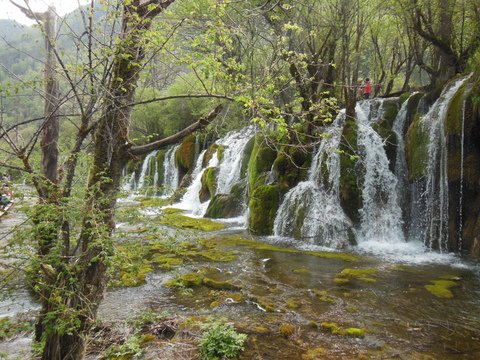
Jiuzhaigou National Park 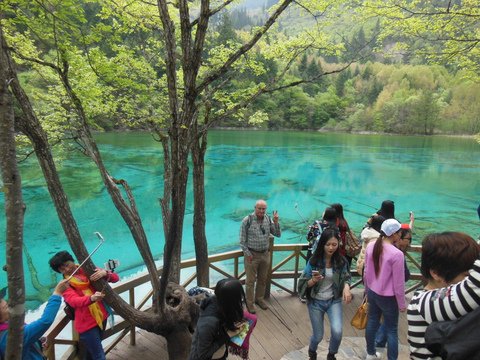
china 2016 023 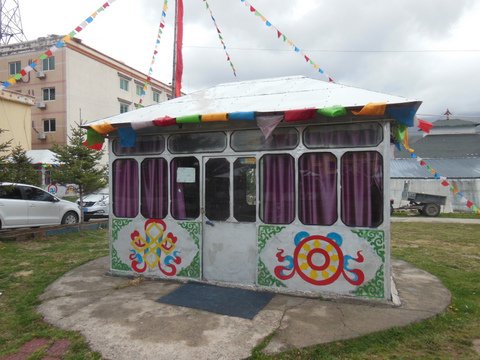
The lunch box 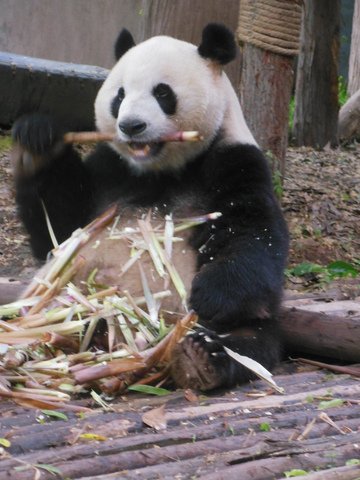
china 2016 063