Categories
China Tibet

Second time around China

Kay: Dennis says that it’s my turn to start the bit about China.

In China they say that foreigners travel to learn, the locals travel to eat. Well, we must be very much at home because we’re doing both with alacrity, even devouring yak schnitzel. Our guides are often surprised that we’re not looking for western food and in 2.5 weeks we’ve succumbed to very fine pizza just once. On that occasion we sat on the streetfront verandah of a restaurant on Foreigner Street in Dali and provided immense entertainment for passersby who, after their initial delight at seeing whities, asked for photos with us and giggling got up-close and personal.

Most of our meals have been taken at small local places (unkindly known as “fly restaurants”) where we’ve relied very much on the photos in the menu or simply pointed to desirable dishes we could see others eating. The glossy food photos on the walls are generally not available.

There are immense numbers of Chinese tourists so they’re not all in NZ as you may have thought, but are being herded on & off coaches, up & around monuments and released into streets endangering others as they endlessly capture themselves on selfie-stick phone cameras. Luckily they avoid places slightly off the beaten track that require a bit of effort so we’ve had these largely to ourselves.

One such place was the 300 hectare Stone Forest where, after entering the park by battery cart, we climbed up and through amazing limestone formations that were widely discovered only 80 years ago. The people living there were tipped out and the hoards bussed in but they don’t want to do much walking.

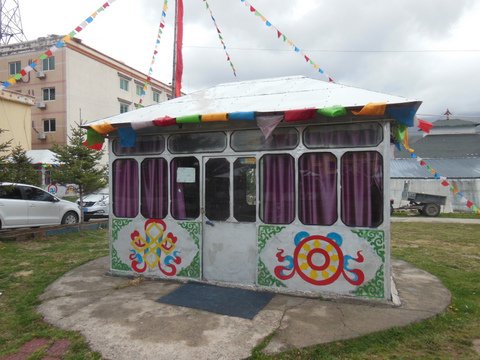
We’ve done a bit of altitude training as the plane to Jiuzhaigou landed at 3500 metres and it was certainly cold. This is the first time we’ve seen heavy coats and puffer jackets for sale right at the baggage carousel so you didn’t need to freeze before your luggage showed up. Quite entrepreneurial as the slower the bag delivery, the greater the sales. It was a 1.5 hour drive to the hotel downhill, hairpin bends all the way. Next day we wore all our clothes driving thru light snow to Hualong National Park where a gondola took us back up to 4100m and it was a 3k downhill walk back past hundreds of extraordinarily vivid coloured terraces very much like pictures of our lost pink & white terraces only in turquoise blues and greens but not thermal. Our private lunch that day was in a tiny Tibetan tin ger with purple curtains, sliding metal door and an alarmingly effective radiator set on the table top.

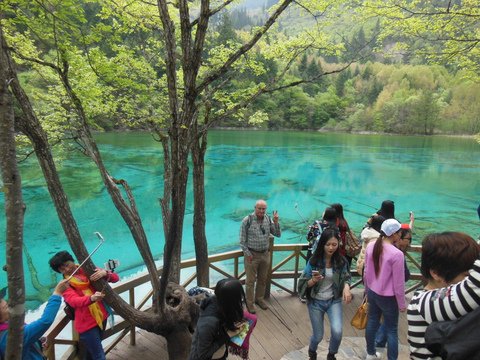
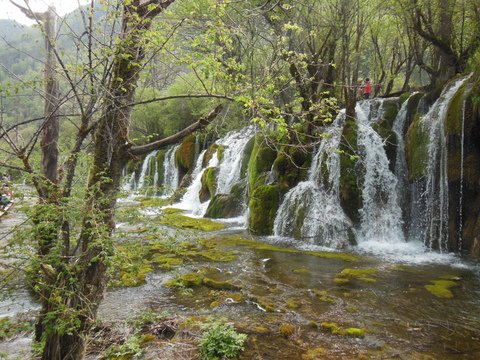
The UNESCO World Heritage Juizhiaou National Park hosts 45,000 people a day in high season and runs like clockwork. Scores of buses take everyone to the top of a glaciated valley so they can boardwalk/bus down in stages and we took the whole day viewing the hundreds of little blue lakes and wetland waterfalls. The park goes for kilometres and is absolutely pristine including No Smoking. Especially impressive are the spotless loos which, instead of “bin liners”, have heavy-duty “bog liners” and yes, it is all removed from the park by hand even for 2,000,000 visitors per annum. Because of the altitude there were brisk sales of personal oxygen cannisters or one could rest a while in “Oxygen Cafes”.

One of our requests to guides is to avoid museums and temples in favour of seeing what the locals get up to. We had a most entertaining afternoon in an enormous park in Chengdu where everyone empties out of the thousands of nearby apartments to relax, eat, exercise and socialise. Dozens of groups had their own forms of singing or dancing with sound systems at almost full blast. One requirement is that each must have a screen with the digital read out of the decibles they are creating to keep under the set upper limit. Those opting to sit quietly elsewhere to relax may avail themselves of mobile ear-cleaning services where chaps wander around with a handful of torture instruments and do a brisk job of twizzling inside people’s heads with long skinny brushes warmed up by the previous customer. Clustered on the perimeter of the park are the Desperate Parents. These poor mums and dads despair of their offspring ever finding themselves a suitable spouse so resort to public dating. All you need is a piece of A4 placed on the ground with a print-out of your marvelous child’s achievements and a list of the requirements for the future-in-law. They wander up and down reading them all and the vital phone number is in bold print at the bottom so almost immediately a spouse-seeking parent can call for an instant family appraisal. The said children (probably in their 30’s) are nowhere to be seen but go along with the process.

All our guides have rural village backgrounds and have similar stories of hard-working parents whose grown-up youngsters, now educated, have no desire to head back home to grow vegetables or follow livestock around the mountains. But the older folk still do it as evidenced by the intense farming of the land particularly obvious from the air. We visited a prosperous farming family at their home and their only child, now at boarding school, will not be back. Mind you, when a city-dwelling daughter has a baby, the grandmother is expected to move post-haste to the city apartment to look after the child for 12 years. One guide saw this as a particular problem because her mother has never lived anywhere but the country, did not know the city, had no other family or friends there and could not even speak the same language. But still she was going to come.

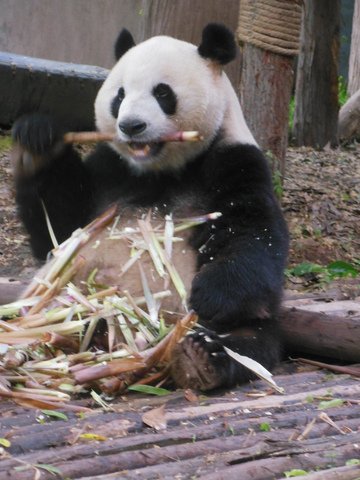
Most special thing? I must say that viewing a 2 day-old panda in an incubator was pretty darn special. The careful breeding program at Chengdu Giant Panda Base has seen the number of residents grow from 6 – 146 animals all outdoing each other for cuteness.

Dennis continues:

I approach using this keyboard with trepidation because when I was doing the NK email in Beijing I got a sudden frizzling pain in the side of my lower back, and for the first time in my life I had a seriously sore back. My apologies to those of you who have exhibited similar symptoms in my presence only to be told to stop malingering. It was fine for walking so I was happy to soldier on bravely but after about four days of involuntary groans every time I bent or sat down Kay and the jolly guide herded me into a rather grubby office where I was to be massaged by one of a group of deaf and dumb women. I had to take my shoes off and empty my pockets and lie on a well-used bed and all of me, apart from the bit being worked on, was covered by a fat eiderdown. Then I had an hour of relentless searching for sore bits starting with my head and it ended up with me hobbling out almost unable to walk and mentally planning how to get back to Beijing and on the next plane home. I said lots of negative things about traditional Chinese massages over the next 24 hours, and then things got better over the next 3-4 days and I don’t know if was the massage or just me getting better, but I am now back to the normal aches.

Kay mentioned the plane landing at 3500m and about half an hour before landing I awoke from a little nap and glanced out the window to see mountains at the same level we were and seemingly quite close enough for me to feel concern. When I looked more closely we were flying along a valley between some serious looking stuff well above us – I made my usual assumption for such situations, that the pilot probably wasn’t lost and also didn’t want to die. Anyone who wants to tell me about suicidal pilots need not bother.

We did lots of flying and a couple of airports later I ran foul of the security system and was stopped at their counter and sent back which resulted in my waving goodbye to Kay as she passed through. In China your baggage is x-rayed straight after check in and usually if you have a bomb you get called out straight away. In this airport they put an alert on their system so when I got to security I was flagged as a potential terrorist and told to go back to where I checked in. Unfortunately, it was a big airport and we had been guided to check-in so I didn’t have clue where to go and English was not widespread, but worked on the basis that if you keep asking and look bewildered someone will sort it out. I did eventually find counter F9 and was directed to the naughty room. You are not allowed lithium batteries in checked luggage and my old non-smart phone which had been through 5 of these x-rays previously, was the reason for the fuss. When I dug it out the guy laughed and told me to put it back and all was fine.

This is our second time in China and my request to China Guide agency (recommended) was more of the way of life and less big ticket tourist items, apart from pandas of course. My main conclusion after this trip is it sure has plenty of contrasts. The noise of what is presumably a normal conversation is amazing and you expect someone to pull out a knife and deal to the other given the way they go on; on the other hand, in the tea houses of Chengdu everyone sits around being relaxed and obviously in no hurry to do anything like work; then there are the dangers of being in a queue and not keeping your elbows at the ready because if you are not vigilant some middle aged lady will barge right on by; and as against that in one town we saw a group of old men in a park under a pergola which had lots of bird cages hanging from it and the old men bring along their birds so they can have a bird chat with all the others. The biggest contrast is the urban/rural one. The big cities are no different in most ways from anywhere else in the world, and often better, but the country is largely hands-on manual labour in ways that haven’t changed in a long time. The villages are not modern and still have a Leninist feel about them. When we were talking to the farming couple I asked about land ownership and it appears they own the plot their house is on but the farmed land is theirs only in the sense that they have a right to occupy that applies to their heirs, and they can sell the right to occupy, but the local authorities can also take it when they want to with an uncertain formula for recompense. Not the best way of encouraging aging farmers to spend capital on doing things more efficiently.

All of our guides had parents and grandparents still living in villages and they all are never going back to live there, which is the same as millions of other young people. One guide told us that over 200 villages a week are becoming depopulated and ceasing to be communities. I have no idea how accurate that is but has a ring of logic. We saw plenty of terraced paddie fields now growing a few fruit trees and young people are not obvious when you see a group in the fields. There is no ability to get spontaneous volunteers as in North Korea. Another of the guides had a mother from Shanghai which was about 5 days train rides away from where we were. This was explained by the fact that when the Cultural Revolution started the mother was a student in Shanghai and was trucked across the country to Yunnan, next to Tibet, to become a farm labourer and learn the joys of real work. Luckily she met the local accountant who eventually saved her from all that nonsense and she too never went back. There is a lot to be said for being an accountant.

There has been one major financial problem on this trip, apart from a couple of items Kay has had to have. When I left Auckland I also left my best travelling sunglasses behind. So first day in Beijing I went out exploring around the hotel and saw a shop that had a sign in English that said “Glasses”. Telling myself how clever I was at finding it I went in and found exactly what I wanted for about NZ$40. On the train back from NK they got lost. Nothing to do with the vodka. I was back in the same hotel in Beijing so I went back to Glasses, this time with Kay, and bought a replacement pair which weren’t as good but cost the same. Within 5 days they had disappeared so as the expense was now hurting I bought a pair in a market that cost $3 and they are pretty good and look the part. Because of this success I boldly bought another pair a couple of days later that cost $6 which have a complete wrap around look but as yet have not been properly tested in the field. About the difference between the cost of the first and second pair was squandered on a rare bottle of wine, in the sense that drinking wine is a rare thing at present, when Kay and I were entertaining the street crowds and eating pizza in Dali.

It’s a tough life and there is one instalment to come from Mongolia where we are presently, many miles from a tar sealed, or even metalled, road at a hot springs resort. But as an international guide book puts it “Don’t think it will be like NZ where you sit in a hot pool and look at mountains”.

The big question is why don’t old guys want a selfie stick?

Kay and Dennis.
Categories
China Tibet

Free Tibet !!! Yeah right.

We got back yesterday and now I can use my Gmail and send this little opinion bit that might have caused me a problem if I had done it in China. I heard of a couple of instances of tourists sending critical emails and getting an early flight home so decided not to take the small risk.

Background.

When the Chinese army took over Tibet in 1950 it ended 50 years of sort of independence from China which before had been the overlords, to grossly simplify. In 1959 there was a big revolt against the Chinese because of land reform which is when the Dalia Lama and others went to India. At that time the only people with any education were the monks and the monasteries also owned a lot of land. These people had ruled Tibet as a theocracy just like the Ayatollahs in Iran and lead the revolt because not only was their land being taken but closure of the monasteries was starting. I think the peasants who did all the work were not too upset about the land reform but would not have liked the closures of monasteries. Between 2008-12 there were protests by the Tibetans about Chinese rule and the inflow of Han Chinese into Tibet which included over 100 people setting themselves on fire.

What I saw.

Probably the heaviest security presence of any place I have been. Police stations at every major intersection both in urban and rural areas; crowd control infrastructure every place of cultural significance; police checkpoints outside every town and village; controls at all petrol stations so it is hard to buy petrol to douse yourself with; police with fire extinguishers at all major cultural places and police, military, fire brigades and flinty-eyed guys in matching tracksuits and caps all over the place. And that is just the stuff you can see as a tourist. However all of this is just the short game to stop embarrassing things happening now. The long game is to make the native Tibetans a minority in their country and in doing so to ensure the troublesome culture gradually becomes not much more than a tourist attraction. Independent travellers are not encouraged and you cannot use local transport and you have to have an officially accepted guide. I organised my trip through an agency in Beijing and they told me not to include my Tibetan itinerary in my visa application and gave me one that was completely fictitious, and assured me no would know and I wouldn’t go to jail.

When you talk to Chinese about Tibet they are genuinely unable to understand why there is a problem. They have provided the infrastructure to take the place from being a feudal religious dictatorship reliant on subsistence agriculture, provided health care and education, put in amazing roading and railways and generally spent heaps on the place, so why are they unhappy ? When you try and explain that their culture is their religion and vice versa and that it is being gradually squeezed away you get a blank response of the “what is wrong with them” kind. All of the stuff being done by the Chinese that can be construed as good for the Tibetans is also good for allowing more and more Han Chinese to settle there and from what I glean there are certainly more Chinese than locals now with the gap continuing to grow. A knowledgeable Tibetan told me it was 10 to 1 which I think that is a big exaggeration but it indicates how it feels to him. If you want a job outside farm labouring you need to speak Mandarin and the education system is based on that language so in the longer term the language is under threat. The monasteries which are the guardians of the Tibetan culture have largely been rebuilt but are controlled as to the number of monks and what they can do – you never see or hear anything about the present Dalai Lama or the Panchin Lama. It is expected that the next generation of religious leaders will owe their existence to China. Nothing is possible without your identity card and apparently if you are a nuisance, but not jailable, your card can be cancelled and you have several problems one of which being that you will be fired from any job.

The Tibetan devotion to their exotic religion and the photogenic Dalai Lama seem to have fired a western sympathy for the Tibetan people in their fight against the Chinese and that is easy to understand. However I bet very few of the people who support the Dalai Lama and think Tibet should be free would be keen to live in a country where a bunch of monks are completely in control. One can have sympathy and all that but it is not going to change the reality which is that “Free Tibet” is never going to happen while the communists rule China and one suspects that is for a while yet. And even if some time in the future China does a bit of a USSR and bits fall off, Tibetans are going to be a small minority in their country (and they don’t have a treaty to fall back on).

The last thing I did in Tibet was an interesting metaphor for what is happening. It was a debate in a monastery that took place outside in a lovely old courtyard with a gravel surface and lots of leafy trees. There were about 40 maroon cloaked monks who drifted in and paired off, with one sitting on a stool and the other standing in front. The standing person seemed to be making the running, emphasising his points with emphatic claps which started like an overhead tennis serve. The one sitting replied quietly although a few got a bit heated. I gather that after an hour they changed sides and it was mostly an exercise in examination and education. The crowd watching was mostly Chinese tourists and locals, and included the guys in tracksuits who one would not want to have to talk to. Quite clearly one lot of the watchers thought it was really important and the other was wondering why would so much effort go into something that was a bunch of fairy tales and of no significance today.

Dennis.

Categories
China Tibet

The land of the Snow Lions.

I have got back to the smog of Beijing this afternoon and already the memories of Tibet have a sharp colourful quality. The country is basically a high mountainous desert with some large and wide river valleys where irrigation allows cropping and fruit trees over the summer, which is just starting The biggest of these valleys starts in the west from Mt Kailash and when it reaches the sea after flowing eastwards is known as the Ganges. Right now out in the villages it is sowing time and I didn’t see any tractors but there were a few of those two wheel rotary hoe things as well as yaks and horses pulling ploughs. After that all the work is done by hand with shovels and hoes, men and women and plenty of traditional dress as well as sitting around drinking tea.

According to my main source of information Tibetans are now a minority in their land but I can’t check that here and I will report on this and other similar matters when home. In the villages they are the locals and having a wander around these places is a bit like going back in time apart from mobile phones, motor bikes, solar water heaters and TV. The houses all have a walled courtyard in the front where animals are kept and the bottom floor is also theirs. Wood is stacked about as well as dung patties for the fires. A couple of cows are mandatory and right now the yaks are all out grazing. Yaks are the Tibetan equivalent of the palm tree in the Pacific. Everything they produce is used as well as providing reasonable meat. The people are very indulgent to children and readily swap a smile, and in marked contrast to the other lot they speak quietly. However when they are on a mission at some religious site you can get moved sideways pretty forcefully.

I got to do some wandering because of the Nepal earthquake which also had a serious effect in southern and western Tibet. I was supposed to go to the Tibetan Everest base camp which I was looking forward to because if you say you went to an Everest base camp everyone thinks you have done some hard tramping. In Tibet you can get there by bus. But it was not to be because the area was wrecked as was the road in and that lead to a rearrangement of the itinerary. Then a couple of days later when the scale of the problems became known the Chinese government stopped all travel to the cities in the south because of possible road damage due to ongoing aftershocks, but also because they took over all the hotels for refugees. We were now on itinerary three and I took the chance to get a bit of village wandering built in.

The two main things that strike on Tibet are firstly the effects of the altitude and secondly the Tibetan culture. Lhasa is 3650 m and I topped out at 5050m on a pass. There were several 7000m peaks sticking out above the brown foot hills – more like foot mountains, and a general feeling of being up high.. I was somewhat concerned about how it would affect me and dutifully started the pills the day before. As long as I was not in a hurry I coped really well and gave my 30 year old smoker guide a run for his money, as it were, but never actually running, more climbing very steep steps and stairs in monasteries. I thought getting to 5050m was pretty good and it is a pb, however at the top of this pass it was like a circus with bus loads of people and souvenir sellers all over the place. When I got to 5000m on the wonderfully named Ecuadorian mountain, Chimborazo, there were about six very tired people including Kay and it felt like an achievement.

The big thing about Tibet despite all the amazing physical stuff is that the locals’ culture is their religion and it is a very colourful, esoteric, complicated deal. And I am an expert after innumerable monasteries, temples, chapels, stupas and all sorts of other things that are holy. This is not the place to even try and explain Tibetan Buddhism so I will cruelly simplify and say it is all about getting enough points on the board so you don’t go to hell, don’t get reincarnated as something nasty and do try to end up in nirvana. You achieve this by living a good life and doing stuff that the multitude of gods will look favourably on. Tibetans like to go and visit holy places and do choras (clockwise walking around), on the inner chora in the chapels they have a word to each effigy, which are statues of past religious leaders, and put yak butter in the candle burning places, and place small denomination notes where they think it will work best. The piles of money are astounding even if the notes are only a few cents – in one room where counting was going on there was a pyramid of notes a metre high. If your knees are up to it you might duck walk under the shelves of scriptures so the accumulated wisdom falls on you. Mine weren’t. The number of times you do these choras helps but there is also the middle chora which is around the main building and then the exterior one around the outside boundaries. Some of these places a very large. The most famous big one is around Mt Kailash which takes about 10 days in an inhospitable place.

Not only do you walk around, clockwise, you can also prostrate yourself onto the ground whenever you want. In front of the most important monastery in Lhasa there are people doing this for hours on end using wooden sliding bits on their hands and most have a thin little mattress. Those really trying just have an apron and the hand things and do the prostrating all the way instead of walking a chora. All this stuff is not isolated to a few nutters, although there are degrees, as this is what people do in their holiday times and days off work. My guide and driver who one would not see as innocents got quite excited about the placers we visited and did most of the stuff described above. I had great mana because I have seen and listened to the present exiled big boss of all things religious, even though we couldn’t understand a word he said.

Where I stayed in Lhasa was close to the important place and I had to walk by it to get to restaurants so every time I had to go the long way there and back because I was too scared to try going the short way which was anti-clockwise. Most pilgrims carry a personal prayer wheel which with no visible effort they keep rotating (guess which way) and I decided I had to have one as my only souvenir, and after much getting my eye in I finally found one that was pretty much like most of the ones I had seen. Bargaining took place by pressing buttons on a calculator and the deal was done. When I got back to my room I had a go at making it turn, and I damned if I know how they can make it look so effortless.

Food was not a highlight but in most places you could get something that didn’t worry one too much. The first thing I saw on the first menu I looked at said “Fried mutton lung”. Yak sizzler was my favourite and I also tried yak butter tea, once. The more rustic places don’t have tables you can get your knees under, instead they have a chest you can’t even get your toes under and they are quite low which is fine for Tibetans who generally are shortish. I usually ended up with a small pile of escaped food on the floor. Tibetans don’t eat fish because one of their burial options is to be put in a river and eaten by fish, known very logically as water burial. An alternative is sky burial which is to be left on a mountain for the big birds, just like the Jains who use towers. The guide who talked about this on the way to another monastery showed me a photo there of a large number of vultures doing exactly that and I bet he thought my hurried walk away was very western.

Our driver liked to hang over the middle lane just in case some unnecessary option appeared and when it didn’t, lean long on the horn. He was like all the other local drivers and a lot better than the ones from the mainland who happily stop for photos on skinny mountain roads expecting everyone else to wait. No wonder a few of them come to grief in NZ.

It is hard to give a meaningful description and explanation of this country. For me it was plan B when a tour to North Korea had to be cancelled and I had not given much thought about what I would be doing because it was organised in a bit of a hurry. I can say it is right up there on my list of top places I have been to. It is memorable and if you get the chance to visit you must do so.

Tomorrow Kay arrives along with Colin and June and we are off touristing in mainland China.

Dennis