Categories
China Tibet

Second time around China

Kay: Dennis says that it’s my turn to start the bit about China.

In China they say that foreigners travel to learn, the locals travel to eat. Well, we must be very much at home because we’re doing both with alacrity, even devouring yak schnitzel. Our guides are often surprised that we’re not looking for western food and in 2.5 weeks we’ve succumbed to very fine pizza just once. On that occasion we sat on the streetfront verandah of a restaurant on Foreigner Street in Dali and provided immense entertainment for passersby who, after their initial delight at seeing whities, asked for photos with us and giggling got up-close and personal.

Most of our meals have been taken at small local places (unkindly known as “fly restaurants”) where we’ve relied very much on the photos in the menu or simply pointed to desirable dishes we could see others eating. The glossy food photos on the walls are generally not available.

There are immense numbers of Chinese tourists so they’re not all in NZ as you may have thought, but are being herded on & off coaches, up & around monuments and released into streets endangering others as they endlessly capture themselves on selfie-stick phone cameras. Luckily they avoid places slightly off the beaten track that require a bit of effort so we’ve had these largely to ourselves.

One such place was the 300 hectare Stone Forest where, after entering the park by battery cart, we climbed up and through amazing limestone formations that were widely discovered only 80 years ago. The people living there were tipped out and the hoards bussed in but they don’t want to do much walking.

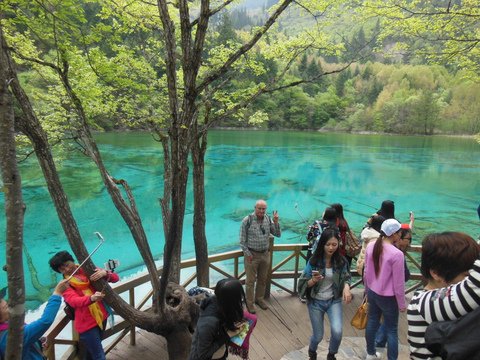
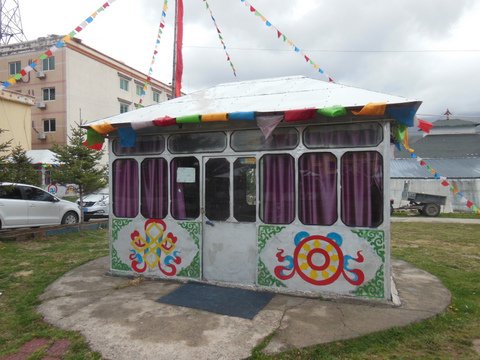
We’ve done a bit of altitude training as the plane to Jiuzhaigou landed at 3500 metres and it was certainly cold. This is the first time we’ve seen heavy coats and puffer jackets for sale right at the baggage carousel so you didn’t need to freeze before your luggage showed up. Quite entrepreneurial as the slower the bag delivery, the greater the sales. It was a 1.5 hour drive to the hotel downhill, hairpin bends all the way. Next day we wore all our clothes driving thru light snow to Hualong National Park where a gondola took us back up to 4100m and it was a 3k downhill walk back past hundreds of extraordinarily vivid coloured terraces very much like pictures of our lost pink & white terraces only in turquoise blues and greens but not thermal. Our private lunch that day was in a tiny Tibetan tin ger with purple curtains, sliding metal door and an alarmingly effective radiator set on the table top.

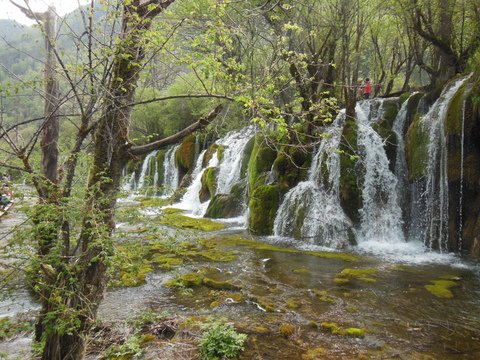
The UNESCO World Heritage Juizhiaou National Park hosts 45,000 people a day in high season and runs like clockwork. Scores of buses take everyone to the top of a glaciated valley so they can boardwalk/bus down in stages and we took the whole day viewing the hundreds of little blue lakes and wetland waterfalls. The park goes for kilometres and is absolutely pristine including No Smoking. Especially impressive are the spotless loos which, instead of “bin liners”, have heavy-duty “bog liners” and yes, it is all removed from the park by hand even for 2,000,000 visitors per annum. Because of the altitude there were brisk sales of personal oxygen cannisters or one could rest a while in “Oxygen Cafes”.

One of our requests to guides is to avoid museums and temples in favour of seeing what the locals get up to. We had a most entertaining afternoon in an enormous park in Chengdu where everyone empties out of the thousands of nearby apartments to relax, eat, exercise and socialise. Dozens of groups had their own forms of singing or dancing with sound systems at almost full blast. One requirement is that each must have a screen with the digital read out of the decibles they are creating to keep under the set upper limit. Those opting to sit quietly elsewhere to relax may avail themselves of mobile ear-cleaning services where chaps wander around with a handful of torture instruments and do a brisk job of twizzling inside people’s heads with long skinny brushes warmed up by the previous customer. Clustered on the perimeter of the park are the Desperate Parents. These poor mums and dads despair of their offspring ever finding themselves a suitable spouse so resort to public dating. All you need is a piece of A4 placed on the ground with a print-out of your marvelous child’s achievements and a list of the requirements for the future-in-law. They wander up and down reading them all and the vital phone number is in bold print at the bottom so almost immediately a spouse-seeking parent can call for an instant family appraisal. The said children (probably in their 30’s) are nowhere to be seen but go along with the process.

All our guides have rural village backgrounds and have similar stories of hard-working parents whose grown-up youngsters, now educated, have no desire to head back home to grow vegetables or follow livestock around the mountains. But the older folk still do it as evidenced by the intense farming of the land particularly obvious from the air. We visited a prosperous farming family at their home and their only child, now at boarding school, will not be back. Mind you, when a city-dwelling daughter has a baby, the grandmother is expected to move post-haste to the city apartment to look after the child for 12 years. One guide saw this as a particular problem because her mother has never lived anywhere but the country, did not know the city, had no other family or friends there and could not even speak the same language. But still she was going to come.

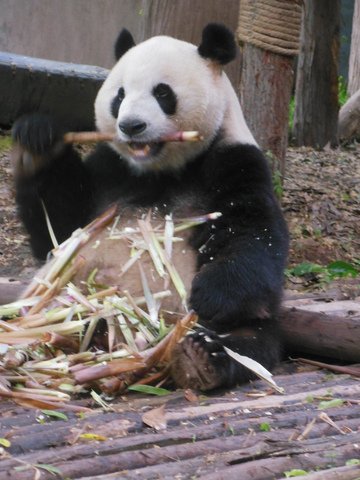
Most special thing? I must say that viewing a 2 day-old panda in an incubator was pretty darn special. The careful breeding program at Chengdu Giant Panda Base has seen the number of residents grow from 6 – 146 animals all outdoing each other for cuteness.

Dennis continues:

I approach using this keyboard with trepidation because when I was doing the NK email in Beijing I got a sudden frizzling pain in the side of my lower back, and for the first time in my life I had a seriously sore back. My apologies to those of you who have exhibited similar symptoms in my presence only to be told to stop malingering. It was fine for walking so I was happy to soldier on bravely but after about four days of involuntary groans every time I bent or sat down Kay and the jolly guide herded me into a rather grubby office where I was to be massaged by one of a group of deaf and dumb women. I had to take my shoes off and empty my pockets and lie on a well-used bed and all of me, apart from the bit being worked on, was covered by a fat eiderdown. Then I had an hour of relentless searching for sore bits starting with my head and it ended up with me hobbling out almost unable to walk and mentally planning how to get back to Beijing and on the next plane home. I said lots of negative things about traditional Chinese massages over the next 24 hours, and then things got better over the next 3-4 days and I don’t know if was the massage or just me getting better, but I am now back to the normal aches.

Kay mentioned the plane landing at 3500m and about half an hour before landing I awoke from a little nap and glanced out the window to see mountains at the same level we were and seemingly quite close enough for me to feel concern. When I looked more closely we were flying along a valley between some serious looking stuff well above us – I made my usual assumption for such situations, that the pilot probably wasn’t lost and also didn’t want to die. Anyone who wants to tell me about suicidal pilots need not bother.

We did lots of flying and a couple of airports later I ran foul of the security system and was stopped at their counter and sent back which resulted in my waving goodbye to Kay as she passed through. In China your baggage is x-rayed straight after check in and usually if you have a bomb you get called out straight away. In this airport they put an alert on their system so when I got to security I was flagged as a potential terrorist and told to go back to where I checked in. Unfortunately, it was a big airport and we had been guided to check-in so I didn’t have clue where to go and English was not widespread, but worked on the basis that if you keep asking and look bewildered someone will sort it out. I did eventually find counter F9 and was directed to the naughty room. You are not allowed lithium batteries in checked luggage and my old non-smart phone which had been through 5 of these x-rays previously, was the reason for the fuss. When I dug it out the guy laughed and told me to put it back and all was fine.

This is our second time in China and my request to China Guide agency (recommended) was more of the way of life and less big ticket tourist items, apart from pandas of course. My main conclusion after this trip is it sure has plenty of contrasts. The noise of what is presumably a normal conversation is amazing and you expect someone to pull out a knife and deal to the other given the way they go on; on the other hand, in the tea houses of Chengdu everyone sits around being relaxed and obviously in no hurry to do anything like work; then there are the dangers of being in a queue and not keeping your elbows at the ready because if you are not vigilant some middle aged lady will barge right on by; and as against that in one town we saw a group of old men in a park under a pergola which had lots of bird cages hanging from it and the old men bring along their birds so they can have a bird chat with all the others. The biggest contrast is the urban/rural one. The big cities are no different in most ways from anywhere else in the world, and often better, but the country is largely hands-on manual labour in ways that haven’t changed in a long time. The villages are not modern and still have a Leninist feel about them. When we were talking to the farming couple I asked about land ownership and it appears they own the plot their house is on but the farmed land is theirs only in the sense that they have a right to occupy that applies to their heirs, and they can sell the right to occupy, but the local authorities can also take it when they want to with an uncertain formula for recompense. Not the best way of encouraging aging farmers to spend capital on doing things more efficiently.

All of our guides had parents and grandparents still living in villages and they all are never going back to live there, which is the same as millions of other young people. One guide told us that over 200 villages a week are becoming depopulated and ceasing to be communities. I have no idea how accurate that is but has a ring of logic. We saw plenty of terraced paddie fields now growing a few fruit trees and young people are not obvious when you see a group in the fields. There is no ability to get spontaneous volunteers as in North Korea. Another of the guides had a mother from Shanghai which was about 5 days train rides away from where we were. This was explained by the fact that when the Cultural Revolution started the mother was a student in Shanghai and was trucked across the country to Yunnan, next to Tibet, to become a farm labourer and learn the joys of real work. Luckily she met the local accountant who eventually saved her from all that nonsense and she too never went back. There is a lot to be said for being an accountant.

There has been one major financial problem on this trip, apart from a couple of items Kay has had to have. When I left Auckland I also left my best travelling sunglasses behind. So first day in Beijing I went out exploring around the hotel and saw a shop that had a sign in English that said “Glasses”. Telling myself how clever I was at finding it I went in and found exactly what I wanted for about NZ$40. On the train back from NK they got lost. Nothing to do with the vodka. I was back in the same hotel in Beijing so I went back to Glasses, this time with Kay, and bought a replacement pair which weren’t as good but cost the same. Within 5 days they had disappeared so as the expense was now hurting I bought a pair in a market that cost $3 and they are pretty good and look the part. Because of this success I boldly bought another pair a couple of days later that cost $6 which have a complete wrap around look but as yet have not been properly tested in the field. About the difference between the cost of the first and second pair was squandered on a rare bottle of wine, in the sense that drinking wine is a rare thing at present, when Kay and I were entertaining the street crowds and eating pizza in Dali.

It’s a tough life and there is one instalment to come from Mongolia where we are presently, many miles from a tar sealed, or even metalled, road at a hot springs resort. But as an international guide book puts it “Don’t think it will be like NZ where you sit in a hot pool and look at mountains”.

The big question is why don’t old guys want a selfie stick?

Kay and Dennis.
Categories
North Korea (DPRK)

The Democratic Peoples Republic of Korea a.k.a. North Korea.

Should you ever get sick of where you live and want a complete change I have a suggestion for you. NK is about as opposite to NZ as you can get. My week’s visit was very intensive with no real unexpected adventures because that is pretty much impossible. I went on a tour, and our group was 8 in total including our leader and I think I was the least intellectually qualified which meant I had to be a bit careful before opening my big mouth and having an opinion. Our leader was a professor in north east Asian studies and an international leader about NK. He grew up in East Germany and Russia so had a good understanding of living in a communist society. There was a NSW Supreme Court judge who sounded like an Oxford graduate because he was, and he was also the author of several books with another one on the Korean War under way. His wife was also a graduate. The next intellectual was born in Iceland but lived in Norway, now retired as a professor, and his PhD was in economics and his speciality is fisheries economics. He was the oldest and is a considerable traveller who after a drink can recite his own humorous poetry in English. The only solo woman was a university career person in education and libraries who got a terrible cold for a few days and had firm opinions about what she was seeing. There was a younger couple, both Oxford graduates and she described herself as a conceptual artist but was far from flaky. The male rejoiced in the name of Mustafa Suleyman because his father was Syrian although he was born and lived in England, and if you want to be nosey google him – he and 2 others formed a company called DeepMind which they sold to Google a few years ago for $US140 million. A very sharp mind and a pleasant person, also very useful at fixing any tech problems those with smart phones had. And then there was me with a C average B Com from Auckland. I learnt lots just being in that group and if any of you have stuff on your computer or on a cloud you will be pleased to know that strangers getting at it is even easier than you thought.

As with all NK tours you also have guides/minders who are with you at all times apart from when you are in your hotel room or a toilet somewhere. There is no wandering off on your own, no walking down the street without them and if you are wearing unsuitable clothing they will sort you out – I had an informal jacket on when visiting the mausoleum and it got put aside. The librarian in our group was wearing a red puffer jacket and was told she should take it off and she flatly refused, which was a winning tactic. If you take a picture of the wrong thing they will help you delete it – I did this only once. Pictures of any one in a military uniform or of any construction are not allowed along with anything that might put the country in a poor light. Our leader said the first day with these people was very important because if they get the impression there are no stirrers they will relax and not make your life too difficult, so were very good and the next day there was no one observing from the back of the bus so we could do low down pictures whenever we wanted, and it stayed that way. We also got to do a few accompanied walks that were not on the itinerary and generally the guides were not too bad in the context of what could happen.

Times in NK are a bit tense at the moment because of the first congress of the ruling party in 30+ years. People work 8 hours a day, 6 days a week and on top of that have to do another 8 hours a day of helping the state which may be work such as gardening or rehearsing for spontaneous demonstrations of love and affection for the Leader, which was going on in a big way when we were there. On top of that they may spontaneously volunteer for extra work so things can happen much faster than normal. At present they are just finishing a 70 day period of spontaneous volunteering for all people in the country. They all look tired. Some of the terminology I am using is the translated stuff they use and became part of our conversations during the tour. We all did spontaneous stuff, but mostly we liked to do ON THE SPOT GUIDANCE. This what the very big boss does and there are lots of paintings and pictures of all 3 Kims looking leaderish and pointing while offering OTSG, and in the background support staff all have a note book and pen to record these divine utterances. . Mustafa said that he is known to do flyby micro management but now he is going to move to OTSG.

NK is a theocracy which for those who want to know, is a religious dictatorship. The religion is headed by Kim 3 at the moment but his departed dad and grandad are also gods and treated as such. The official paintings try to make them look similar but that fails especially with the present Kim 3 because not only is his face quite different but he is also really fat. More often than I expected we would all line up in front of statues, pictures or paintings of them and show our respects by bowing. Once we had to show respect at a big marble plaque that had Kim 2’s autograph on it. The nice ones in our group bowed deeply and I moved my head. We visited mostly big government stuff and there were always lots of statistics as in when the building started and finished, measurements, number of bricks and blocks of marble, and the deep significance of the relationship of some of these numbers to Kim 1, 2 or 3. So the length might be the numbers in the date of a birthday or something similar. Absolutely fascinating but surprisingly I can’t remember any thing specific. Also everything was finished really quickly, often in exactly one year because of the spontaneous volunteering of extra work by the worker soldiers.

Conscription is for 10 years and starts at about age 16. They do a lot of construction work and also are very good at military displays. You can tell the serious ones by the callouses on their hands because NK is keen on martial arts, and because civilians are often in uniform-looking clothes you can pick the real ones by their footwear – and avoid taking a picture of them. The famous traffic directors have very smart uniforms and very little traffic to direct and we were told the female ones are known as the flowers of Korea. They do actually do their stuff even when there is nothing on the road. Outside of the capital, Pyongyang, there are mostly bicycles and trucks with very few cars or buses and the roads are not too wonderful with some being about 6-8 lanes wide. We wondered if they were auxiliary airports. The locals apparently have a great regard for the army which may be because one of the axioms of the country is “Army First”. This came from Kim 1, or maybe 2. Hence the fixation on nuclear weapons and delivery systems in a country where oxen-pulling plows are common. Every bit of land that can be cultivated is. Rice is the main thing but they also do wheat, millet , potatoes and every vegetable. The countryside at present is brown because it is has been prepared for planting and in addition to the ox plows there are tractors for the big fields and paddies. The agricultural correspondent, who is not present, would wonder how such old and battered machinery could still do the job. They have no fertilizer because of sanctions and you see them making little piles of combustible stuff which is then burnt on the tilled ground. The villages all look the same with whitish cottages and curving tile roofs built after the war because everything got destroyed. There are no trees apart from ones planted (voluntarily) in the last few years, mostly along the roadsides. It gets really cold in the winter and firewood is hard to find.

Pyongyang is very, very different from the rest of NK. We were all surprised at how developed it is but this is not just something caused by economics. Because there is almost no market economy the big buildings and modern stuff you expect in a main city are there for a political reason. To live in Pyongyang you have to be a proven top supporter of the political structure and show that in all you do. Even if you wanted to get there from some hole in the country there are movement restrictions so a visit has to be approved by the authorities. The city, therefore, has to be better than anywhere else both to make people strive to get there, and to act as a symbol of power to the peasants who get to go there once or twice in their lives to do some spontaneous demonstrating or whatever else is decreed. Continuing on that approach the places that such people visit exude power – the mausoleum of Kim 1 and 2 is all marble and huge works of “art” that make you feel small, the passages are very long, the main rooms are very high and the lighting in the rooms where the supposed bodies lie is very gloomy and a bit spooky. I say supposed because all you see are the heads and I reckon Peter Jackson could have them made very easily. This place is called The Kumsusan Memorial Palace and apart from the remains, also has each of the two Kims Mercedes cars as well as a room each of all the honorary degrees, medals, welcoming plaques and other junk they received from repressive countries like Niger and the Congo. This does sort of spoil the impressions for ignorant westerners like us, but it shows how internationally important they were to the locals. NK is very keen on stating how all the world respects them and their achievements.

Some of the places we went to have very cool names. The Pyongyang Grand Peoples’ Study House is a sort of library and continuing education place where we were shown how they can play any sort of music as proved by a rendition of Hey Jude. Of course it stuck in my brain for the next few days partly because it was so incongruous. The Three Revolutions Museum had lots of cool stuff from the Korean War and the US Navy vessel Pueblo, (remember that ?) along with lots of exhibitions about how the glorious army captured it from the bastard imperialist Americans. Not surprisingly the Korean War is serious stuff for NK. I didn’t know the extent of the damage to them which was massive. All cities except one were levelled by unopposed bombing and it was a war so all participants did stuff that was not nice, although in NK it was only the bastard etc guys who were bad. Or so we were told. Down near the border with SK is The US War Crimes Museum which is pretty grim and covers in obsessive detail some nasty stuff the US forces did, and it is almost certainly true, but once again there is no balance and no mention of the SK troops. Or NZ for that matter. To say that NK is unable to move on is an understatement. They seem to want to stay there in the 1950s and that is a deliberate political position because a dictatorship that keeps its people in penury has to have an enemy to blame. And that is the bastard imperialist Americans. The DMZ was very peaceful and I sat at the table where the 3 years of armistice negotiations took place. We were also shown bits of a concrete wall built by SK which the NKs say stretches right across Korea and it can only be seen from the north, but SK and US say there are tank traps but no wall. I have done a quick google but can’t find anything definitive. This is not unusual as there is a lot of stuff about NK that is unknown. Our team leader often replied to our questions with an opinion but also a qualification that no one really knew.

NK used to be a non-monetary economy which meant no money was needed because the government provided everything and there was nothing, and nowhere, to buy stuff. After the famine in the 1990s people had learnt that when the government can’t supply you have to find another way and a small black market started. This still exists in a larger form and, as a counter, official markets have been set up. They generally have round blue roofs so can be seen, but visiting is not allowed for tourists. Basics like apartments, essential food and clothes, bikes and presumably cars are still provided but supplemented by buying privately, so capitalism is there and I can’t see it going away unless there is some catastrophe. All our questions to the guides about comparative wages were slid around so we don’t know who gets paid the most, or even if anyone does. There is certainly a more-equal-than-others class and they are obvious, especially the children who flaunt their superiority. This includes the guides who while not being ostentatious are from privileged backgrounds as tips in hard currency are very important. There is a local currency which tourists cannot have so all cash transactions are in Euro, $US or Rimimbi and everyone is good at the maths. The stuff we could buy was in hotel and museum shops and the range was limited, shall we say.

Geopolitically NK is a buffer between China, Russia, SK, Japan and the USA in several ways. It is paranoid about all of them and conducts a balancing act based around its nuclear weapons which is largely a bluff. They know that using a bomb anywhere would result in massive retaliation from which they have no defence, so they have to act like they are unpredictable and seemingly a bit crazy in order to keep the enemies off balance. And they do it well. I am sure in the back of the minds of the Kims and their mates, is the fate of Ghadaffi who stopped his nuclear program and ended up dead in a drain. It appears to be generally accepted that most of the enemies are quite happy to have NK between them but worry about Kim 3 having a meltdown and going away from the set routine and actually pressing the launch button, or offering OTSG for someone else to do it. NK, as it presently is, will not give up the nuclear option, they are very clear about that. Which raises the question about what will happen to the regime? There seems to be two choices: a gradual change as per China, to a more capitalist society or a big collapse. which would involve SK taking over. It is hard to see the later happening but who knows? NK talks big about unification but their formula is completely unacceptable to SK because they want equal votes but only have about half the population.

We never felt unsafe in any way despite all the military and police guns everywhere. Although we were mostly kept away from the locals we sometimes got to mingle and “hellos” and waves were swapped. We saw plenty of other tourists but in the hundreds at the most, not thousands. There is a beaten track and we kept running into the same people, our favourites being a couple from Kansas – the wife, who was in her 50s, had a penchant for filmy, very short-hemmed dresses which caused our guides much concern. The locals are quite conservative and restrained in their dress and always have a lapel pin starring the 2 first Kims. However, the lady from Kansas redeemed herself in our eyes when we visited a big park on May 1, an important holiday, when everyone had been issued with picnic food and beer and had crowded into this park to celebrate. This included women in traditional costume dancing and right in the middle was the tall blond from Kansas in the Korean costume of a colourful floor-length, A-line dress having a grand time and wowing the locals. We thought that took some doing so decided she must be ok. The hotel we were staying in had 43 floors with slow lifts and she was in the same lift as me the next morning so we a chat on the way down and she was in recovery from the exercise. Earlier in the tour we were staying in an old, traditional hotel with paper-thin walls and she and her husband were next door to our team leader. He heard them come in late at night, having partaken of the local rice wine, expressing endearments loudly for each other. He was very concerned at what noises might follow but luckily the rice wine won and all he heard was snoring. All the hotels we had were fine if a bit tired and we had plenty of food mainly of a sort that was what they thought imperialists would like. The local beer was fine and the best one was pointed out to us early on so we were experts and able to give OTSG to other tourists.

We left by train to Bejing, a 24 hour trip in 4 berth cabins. Being a generous person, and aware of the need of assistance to sleep, I repeated the exercise that Colin I did in Uzbekistan which was to buy a bottle of vodka. It came from Lithuania and apparently was good because everyone felt fine next morning. We could not get any glasses so I advised everyone to keep their empty water bottles for conversion to handy drinking receptacles with my Swiss army device, our German leader being very impressed at my experience in such matters.
When we arrived in Beijing I discovered I was a day ahead of myself because Kay was supposed to be there but wasn’t. But it was all right because I had a hotel booking and she turned up early the next morning.

There is lots more I could bore you with but this enough. If you want to know anything not mentioned just ask – I can go on for hours.

Dennis.

Categories
Mongolia

Mongolia – no boundaries, no fences and not many sealed roads.

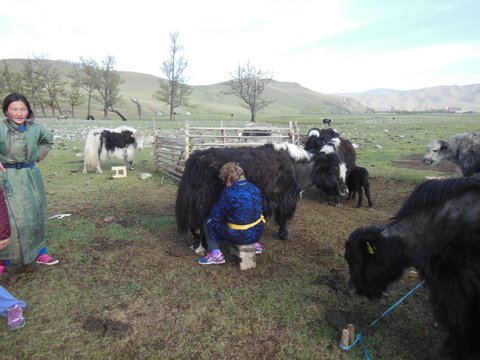
Mongolians understand their place in life which, for females, is responsibility for everything inside the ger (also known as a yurt in other strange places) and the milking. There is plenty of that so they do get outside a fair bit. Men are in charge of all the outside stuff mostly related to stock management and discussing important other things like prices , but women get all the money earned. This division of labour specifically applies to 40% of the 2.7 million population who are nomadic herding farmers, but it also applies to village and city people as in most cases there is no more than a generation of removal from their living in the nomad world. Therefore Kay will write about inside the ger and I will deal with outside.

I organised our Mongolian trip through a local agency and we were provided with a husband and wife team of Nasan and Tuyu, the later being the guide and in charge of inside stuff and she spoke pretty good English. Nasan was the driver and owner of our 1998 Land Cruiser which was immaculate and never missed a beat in 10 days. He knew a bit of English but was reluctant to try when his wife was around. They were wonderful and I was happy to pay the exorbitant tip the agency suggested because they did a great job and looked after us like we were their grandparents.

Mongolia is a democracy following a peaceful revolution in the early 90’s although there is not a great deal of respect for those in charge who, I gather, are the elite and corruption starts from the top here. On our first day we were battling through the horrible traffic in the capital, Ulaanbaatar, where half the population lives, and there was a complete stop of movement because some one important was having a drive through town. When the large black car and outriders swept past the locals all made very sarcastic noises with their car horns which I suspect was not by mistake. The big industry is coal mining, not a good place to be now, especially when their trade is mostly with China which has stopped importing coal. They have other minerals the most important of which is copper and there is a huge big mine that has been some years now getting started and it is supposed to be the financial saviour of the country. Unemployment is currently high and there seemed to be a lot of big trucks parked up. But they have a safety valve for economic problems and that is agriculture.

It would have been good to have had the agricultural correspondent with us but he was otherwise engaged being luxurious in some couth part of the world. So I will just have to try hard to explain what happens in Mongolia. We have to start with land ownership because it is the basis of all economic processes. Everyone is entitled to a small plot of free land although you can’t ask for a specific one (unless you know some one who has influence and an unexplained pile of assets) and for most people, including just-born infants, this land will be near their village or city. For the nomads it is usually their winter camp which has sort of permanent stock shelters. These bits of land are mostly fenced and don’t amount to much in terms of area in the country. Then there are national parks of which there are a few, and then there is everything else which is owned by everyone and can be used by everyone and there are no boundaries and no fences and the only trees are on the steep non-grazable parts. It is one vast, wide open space with big plains, low rolling country and some not too precipitous mountain areas. In other words it is the steppe. So anyone who can get a few animals together and find a ger can set up camp and be a nomad.

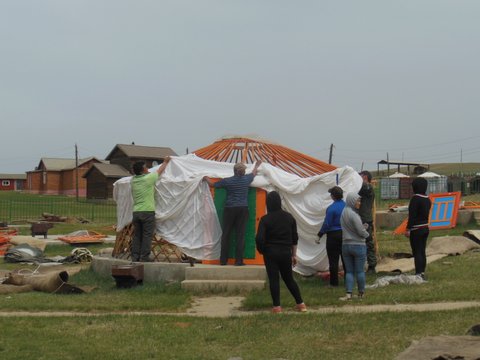
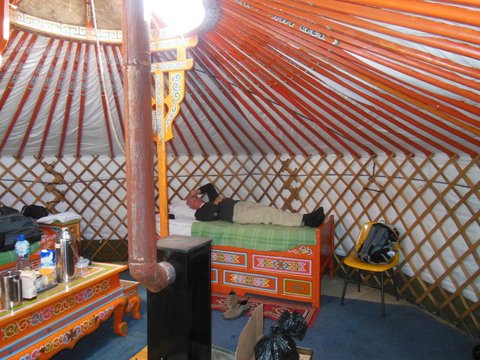
Nomadic life here is not quite what you would think because they move between two main camps usually no more then 30 kms apart and often a lot closer. The winter camp is sheltered from the northerly winds as it gets extremely cold, and summer camps are near water supplies and somewhere the breeze can lower the hot temperatures. They live in a ger which is round, about 6m in diameter with one low door and no windows apart from the opening in peak of the roof. All the family lives in this building so as you can imagine they are very compact with what they have inside. The toilets are 3-sided flimsy things with no roof, a long way from home – say 50-70 metres and could be described as rudimentary. I did see a tin bath so presumably they can have a wash once in a while. We spent visiting time with 3 families and had 2 nights “living” with a family at a homestay where thankfully we had our own ger, but no ensuite facilities. Livestock are sheep and goats which run together because sheep are stupid and need goats to lead them, cattle, yaks, horses and camels (2 humps) in combinations that suit the nomads and land conditions. A good ewe is worth US$80, a cow $400 and a camel $750. I never got an answer about yaks. All are milked and the magic herd total that signifies wealth is a combined 1,000 head. The only technology they use are 2 poles in the ground for breaking-in horses. No machinery apart from motor bikes. Dogs are for warning about bad people and wolves, and rounding up stock takes several people on horse, bike or foot. I doubt anything about the operations of this range life have really changed in hundreds of years, apart from mobile phones which make finding out where missing stock are much easier. An example is from our homestay visit when in the evening it was time to separate the calves from the adult yaks so the later could be milked in the morning. The calves were put in a sort of rackety pen made of 4 gate-like things tied together with leather straps. Then everyone milled about trying to catch the calves while a few horsemen lurked in the distance to return the animals that didn’t want to be caught or stay and watch the action. A few metres of wire netting set up in a right angle would have made it all a lot quicker and easier. No one has ever heard of a mechanical shearing set up let alone a portable one and hand milking is how it is done. All of which is the main attraction. These guys are a living, viewable anachronism and they are very welcoming in a reserved way.

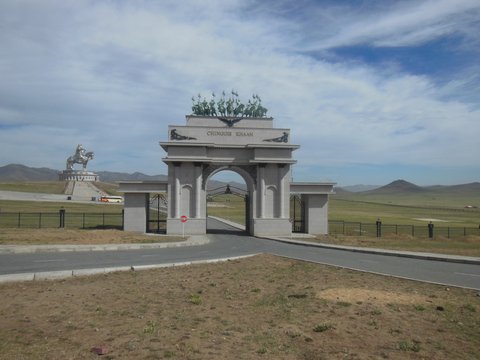
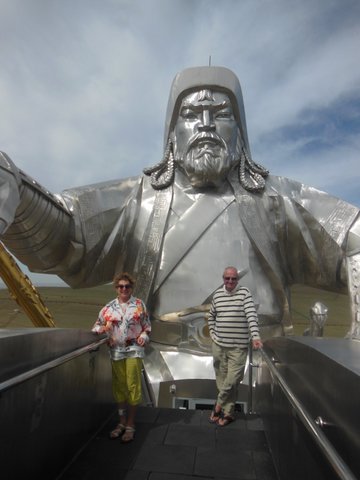
Our tour also took in other sights and worthy things like a couple of museums; several Bhuddist places including one that took 3 hours of hiking up and down to get to where the highlight for me was Tuyu and I having lunch with the only monk in his ger; the country’s biggest waterfall that would not get a mention in NZ; and best of all a huge stainless steel sculpture of Chiingis Khan, possibly known to you as Ghengis. Not much really but we only saw the central part of the country and really it is the land and the nomads that are the highlights.

The roads were a hoot. There are sealed roads between the major towns of which there are not many, and once you leave those roads you are on dirt tracks. Didn’t see any metalled roads. Even when we went to a hot springs tourist place with lots of camps and accommodation there were just tracks across the steppes and over the hills. Naturally each driver has their own idea about the best way to proceed so there are usually a wide range of tracks to choose from, or you just start a new one. Nasan loved it. We met only 3 bridges off the sealed roads and one was spectacularly busted, and the other two were of the “passengers walk across before the car” variety, so we just cautiously forded all the waterways we came to. The weather we had was unseasonally cold,with times of snow, hail and freezing wind from Siberia all which added to the fun of open country driving. It also made visting the open air toilets somewhat uninviting and helped when we had 4 days with no running or heated water, because no one sweated. Our accommodation outside of Ulaanbaatar was in gers and I liked them – they make excellent roomy and warm accommodation as long as you keep feeding the stove. The slightly unreal thing about living in a ger is the divide between out and in. When you are in with the door closed it is dark and there is no connection with the outside given no windows. Then you bend down and go outside and you are immediately in the farm with no porch or path to the gate. Just straight into the huge big outside.

Kay’s turn:

Before we got to experience a ger we had a day in Ulaanbaatar where we could access google and go to a concert. Magnificent!! We were treated to throat singing, traditional dulcimers, hearty ballads and a contortionist for good measure.

Next morning we headed off for the first ger visit but it was so darn cold even our hosts would not venture outside for a scheduled camel ride but were content to watch us eat the hotel packed lunch and, with Tuya translating, ask about farming in NZ. Being springtime, the tourist season was just starting and we were amongst the first to arrive. It was 3 hours driving 180 km to the Sweet Gobi Ger Eco-Camp which hadn’t quite got itself into gear but our thickly felt-lined ger was ready with a goat dung fire but no heating in the dining room. Have you ever tried eating with your hands in your pockets wearing 5 layers on the top and even golf wet-weather pants over the lower layers? It was candlelight only in our ger but we got the thermometer up to 38 degrees so there’s a lot to be said for good goat dung. Next morning we clambered into our Cruiser still wearing 5 layers until the vehicle warmed but happily heading for 2 nights at Tenskher Hot Springs with steaming pools to look forward to. Enroute we had the compulsory monastery visit. It was under renovation and all the wooden carved features from 1600’s had been taken down for refurbishment and, it was covertly revealed, could be quietly purchased if the guide could please secrete it up her jacket until we left. Nice little earner for the workmen.

With snow gently falling for part of the trip we took 4 hours to drive 260 kms which was plenty of time for Tuya and Nasan to present D with questions as to how to go into the tourist guiding business on their own account. The mentoring continued until we arrived at the not-Hot Springs. It seems there was a rather obvious problem with the spring only dribbling. This was log cabin-style lodge accomm with a room for us upstairs. Maybe it was the height from ground level but no water could make it up that high to our taps nor to our toilet so there was an expressionless young lady detailed to intermittent bucket brigade. Late that night there was a warmish outside pool available so I plonked in wearing a fair number of clothes that needed washing and as the little snowflakes fell around us we lolled about to the amusement of builders working well into the night on the lodge extension. The owner of the establishment was a bulky, jovial retired wrestler who rocked up the next morning with his bone-crushing handshake. He would have been just the man for dealing with 2 carloads of Mongolians who had pulled up at 1a.m. demanding hot water and food or they’d shoot the pregnant hotel manager. There was no food, there was no hot water and, fortuitously, there was no shooting just a lot of yelling.

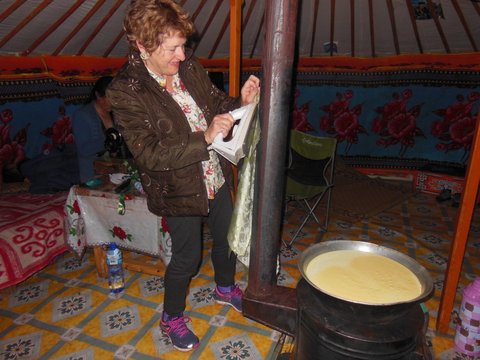
We walked 4kms the next morning to visit a nomad family who welcomed us traditionally with warm yak’s milk, a snack of bread with clotted cheese and an offering from the snuff bottle. Apparently the conversation was about their intention to venture into homestays with special reference to the toileting requirements of visitors. Later in the day I trudged to a neighbouring “resort” to have a shower as there would be no likelihood of such things for several more days. There would also be no electricity for lighting or charging devices.

In China I had tried, without success, to buy velcro to mend the handle on D’s bag. Tuya knew just the very place to get it at a “blackmarket” in a small town so when we stopped off for that she was insistent that I also buy some fabric for a child’s garment. She’d seen me knitting (first tourist ever) so thought that at our ger homestay The Lady would show me what to do. Somehow I couldn’t quite see this as a good idea but went along with it. It turned out that The Lady of the family who was hosting us had a household (rather, gerhold) of herself, husband, a visitor who seemed interested in the daughter, 3 almost-adult children, a 2 year-old and a baby and just 2 beds. (I suspect we had the usual 3rd bed in our ger). She had to get up early to make the fire, boil up milk to make yoghurt, seive the cottage cheese, feed the baby, sweep out and make breakfast bread for everyone. Then it was yak-milking time (I helped with that) before more boiling of milk, feeding of baby (who didn’t have any form of diaper – don’t ask) and soup making. Tuya couldn’t see what my problem was with expecting her to fit in a few hours sewing. So in due course I was summoned to the family ger with my fabric, the hand-operated sewing machine from the 1930’s was set on the only flat space and, using a piece of soap, The Lady traced around an existing child’s deel (pronounced dell). That is the outer layer that everyone wears. No pins, just place the fabric under the machine needle and go for it. The iron was needed but with few places to look, it became obvious that the neighbour had not returned it. A son was despatched on the motorbike and he returned victorious with an old electric iron from which the surplus electric cord had been cut off and he quickly placed it on the top of the covered fire to heat. It wouldn’t get hot enough to do the job so I suggested that if I held the fabric against the burning hot chimney and pressed with the iron it wouldn’t need to be hot. Not sure how Tuya translated that but everyone was suitably impressed with the solution. There were a few snowflakes or hail coming in through the chimney gap in the roof landing on my head.

A small family arrived on a motorbike looking for their goats so they too crowded into the ger and there were now 17 of us. They left before the evening meal – primarily a tasty boil-up of goat, potatoes and carrots. They eat a terrific amount of meat and milk product with a few purchased vegetables. They can’t have gardens because the roaming animals would ruin it and they would probably be moving camp before any harvest.

That night it was so dark, it hailed, the wind got up, the temperature dropped and the distance to the plastic-walled shortdrop seemed to double. The Kapiti ice cream container no longer held the medical kit.

A couple of days later we were in international departures at Chenggish Khaan airport, Ulaanbaatar (cheapest duty free perfume in the world) and as I looked out at our plane I commented that my bright orange suitcase had not appeared to be loaded and I couldn’t vouch for D’s either. However, one must trust the system and as we were transitting through Beijing to Shanghai perhaps they had been given special treatment. “Special treatment” is right as they finally rocked up 20 hours behind us.

And now we’re back where we belong.

Until next time…..

Dennis and Kay