We were picked up at 5.30pm to be taken to the Uzbekistan border and I think it was that early for the midnight crossing because we were a nuisance that needed to be sent away. It normally takes about an hour to the border but we got tangled up in a traffic jam and it took two and a half hours. The jam up was all to do with a completely woggish attitude to an intersection.
It was dark when we arrived, 8pm, and our man reckoned we had a chance of getting through the Uzbek formalities early. Yeah right. We walked along paths and various buildings for the Tajikistan farewell and then dragged our bags down the road for about 500m to the first check in Uzbekistan. This was a soldier who was supposed to be a dumb idiot, but he wasn’t and saw immediately we were trying to enter on the 14th when our visas were for the 15th. “Nyet” was his response and we were pointed back the way we had come. Not far from the Tajikistan side was a closed duty free shop with useful looking steps so we decided to sit there. I went back to see if we could use a table in the Tajikistan building, but more nyet. So we settled down, the temperature was fine, we ate our evening snack, Col found a nice pile of straw to put his sleeping bag on and I got on with Spyder Solitare. Then an unnamed person that wasn’t me decided to take a photo and as it was dark his flash went off. The response was as predictable as it was speedy, and a soldier came to discuss local security concerns and point us further down the road.
So we trundled to about the center of no mans land and found another good spot each, to wait out the hours until midnight. I had a strong street light to read by and a big cube of concrete to sit on. It got a bit chilly as the time dragged by and we both ended up in warm jackets and beanies. Col was lying on the verge of the road and occasionally remarking that it was great to go travelling with me.
At a quarter to twelve we started to walk as slowly as we could to the nyet soldier. After an initial hesitation and a radio discussion he let us continue. There were absolutely no other border crossing people about. We got to the foot of the steps to the Uzbek immigration building and were stopped and pointed to a seat because it was four minutes early. Eventually the four minutes passed and we were allowed in at midnight. The passport checking guy took about quarter of an hour to do his thing, and then we got to meet the customs man.
He was rude, arrogant, abusive and the very worst of any of that sort of official I have ever dealt with. He was probably bored and he probably decided we were gay and therefore in possession of graphically explicit pornography, or he was just the complete prick. He rummaged through all my stuff, throwing it on the table, and then he got into my laptop. Initially I couldn’t get it open and he made it clear I was an idiot and that I was trying to hide something. He hooked up my little speaker to see if it went but didn’t believe me when I tried to explain that my iPod had stopped working and he had a go at prising it open. By this time he had the laptop going and was searching through it, showing a particular interest in pictures. Then he found the little short videos that you mistakenly make when trying to take a picture. The first one was of orangutans in Borneo, but then he came up with something really interesting which I didn’t know was there. It was of the almost naked Vanuatu people dancing as the young guys do their version of a bungee jump. Very exciting for him and he thought he could see a topless woman. Next was all my pills and medicines which he tried to check with a Cyrillic check list. Eventually I was dismissed as some sort of deviant cretin and I packed up as he started on Colin.
I thought that if he found my medical stuff interesting he was in for a much bigger thrill. Col was being suitably calm even when escorted into a room along with another guy who he said was police. When Col held his arms out for the search he was told no, and the other guy was patted down. We cannot understand what that was about. He did all the same computer stuff and finally asked a question in one word plus hand movements which was “Sex ?”. I watched Col give him a long look and reply “I have a wife.” As Col was trying to pack up our friend turned the lights off twice, and then we walked out the door at 1.30am to find our car.
It was at least half a k to the end of a dark track where another soldier checked our passports and a sleepy driver emerged from a car. He had been there eleven hours. At 4am we reached our hotel in Termiz to find it surrounded by a smart wrought iron fence about 2.5m high with each gate securely padlocked. Our driver has a dicky leg. Col is really old. And I was very keen to get into bed so I climbed over, nearly getting stuck on the pointy bits on the top and hammered on the front door, which turned out to be open. People appeared, keys were handed over and we went to bed in Uzbekistan.
Author: Dennis
Categories
Chapter 2: Tajikistan.
We are presently in the capital of Tajikistan, Dushanbe, after eight days of fairly rough travel from the last reporting place. Dushanbe is warm and civilised with smooth pavements, lots of trees, the worlds 3rd largest flagpole and a very nice Hotel Lotus which is where we are. However, all is not as it should be. Yesterday we found out that our visas for this country were only valid until today and we are supposed to be here for 2 more nights. Although the visa says it was for a month which gave us plenty of spare days, the dates do not agree with that, so we have to go. But to do that we need a visa for the next country, Uzbekistan, and that was the job for the two days planned here. Moderate panic stations were manned and this morning with the very necessary help of the boss of our local tour agents we now have an Uzbek visa but it is for entry tomorrow. We are told the border is open 24 hours so the present plan is to rock up this evening before it is dark and check out of Tajikistan and then hang about somewhere in between to go through the Uzbekistan formalities after midnight. I rather suspect it will not be that simple but we shall see. Dilshon, our man in Dushanbe, went to the front of the queue at the Uzbek consulate and told the people inside that we were diplomats and we got the visa in ninety minutes which is astounding, but for good reasons they wouldn’t make it for today. Even the suggestion of a special payment didn’t work which I suppose is good in one way but a nuisance for us.
I feel sorry for the main agent of this trip who has to now reorganise every thing for the next four days and find someone to pick us up in the early morning at the border. But we did have a little credit because a couple of nights ago due to Dilshon’s error we only had one bedroom and I had to share with Colin, and even worse he had to share with me, for two nights. Colin got the double bed and generously suggested I could use it as well but I didn’t find that idea very alluring. This was the most upmarket of the places we stayed on the way here but it had the hardest beds ever and made our times of sleeping on the floor or ground seem luxurious.
We left Osh in Kyrgyzstan and headed south on the fabled Pamir Highway which was built by the Soviets 1930-40 to provide access around the edges of their empire where it borders China and Afghanistan. The scenery is consistently mountainous and spectacular but some days were even more. The roads were consistently horrendous but some days more than others, and I reckon we would have been lucky to average more than 30kph. Our Special Correspondent for Roading and Sanitation will have more detail about this later. The border was again in the middle of nowhere and on the Kyr. side Colin handed over NZ stickers as part of the deal and then we stood idly around while the customs guys made someones life difficult by making them take every bag and box out of their vehicle and off the roof. Apparently that was the wrong thing for us to do because a bloated youth in uniform looked at us and said “CAR” so we promptly got into ours where Colin mouthed off about jumped up little pricks, and I said shut up. On the Taj side we picked up a new vehicle and a new driver along with a guide. The driver should have been born in a rugby playing place because he had the build of a front rower and the guide reckoned he was a good wall. The guide had a damaged right arm and it didn’t take Colin too long to inquire what the problem was – he had wrecked his hand in a car crash and it had been removed but the medically cool thing was that his arm had been split into two long “digits” using the two bones in the arm, and then by some surgical wizardry the muscles and tendons had been rearranged to enable him to hold things with it like a pair of bbq tongs. Both guys came from the Pamir which is mainly populated by Ismailis who probably can be traced back to Persia and their spiritual leader is the Aga Khan. Their religion is not intrusive and is a Shia offshoot grafted onto the old Zoroastrian faith which means there is a bit of fire involved in their worship. Thank goodness they don’t have mosques making loud noises early in the mornings because getting a good sleep wasn’t easy. We spent several days over 4000m and it was cold at night. Our beds were either pallets on the floor or little beds with slats so either way there was a rush for the spare blankets and “mattresses”. On the third day we branched off the Pamir Highway into the Wakhan Valley and then spent four days following the Amu Darya river which is the border with Afghanistan. This river used to be known to us as the Oxus and for those of a historical bent it is well known – from memory Alexander the Great got to it and he or others decided that was far enough. It used to flow into the Aral Sea but now disappears before there and more will be told about that when we get there. Initially the rivers were all glacier water and a bright turquoise. The Wakhan was the highlight of this part of the trip. At one stage we had the colourful river, the big rocky mountains on our side and the same on the Afghan side, but behind them towering up all steep, jagged and white were the peaks of the Hindu Kush range in Pakistan.
Anyone who has read Kipling or more recently A Small Walk in the Hindu Kush, or anything about the Great Game would have to find this exciting beyond the scenery. I did. The next day was Independence Day and as it is autumn it is also harvest time. The little villages are on any spare flatish land, which is usually an alluvial fan with irrigation, and the crops are grain and hay. Being a holiday everyone was out working and this looks like a long time ago as the the main tools are sickles and the main transport is human or donkeys. We did see one mechanised thresher and apparently it was home made. We stood around watching while they got it going and moved away pretty quickly becauseit was rather noisy and the dust was thick. The standard female attire is a variation on the long dress and leggings style and usually in bright colours with shiny and sparkly stuff or animal skin print. Scarves are usual but not pervasive. Colin is a serial watcher of the younger women and I am sometimes dragged down to his level, as there are some very attractive sights. The men are all boring in the usual jeans and t shirts or old suits. School children are very formally dressed and the girls in the last little town had tunics that looked like zebra patterns.
Getting a snack for lunch is not easy and if the lunch is included we end up with 2 courses plus lots of extras. When we have been doing 7-8 hour drives and not wanted the full meal we end up eating Snickers Bars which is a new experience for me. Colin has one secreted away so he won’t starve if we end up sleeping in no mans land tonight. The food has generally been good plain stuff and I have never drunk so much tea. It comes in two varieties, black and green and being the sensitive townie I have green, Colin has black. The homestays we have been in are not flash in appearance, in fact most of them would be dismissed as completely unacceptable if you could find such a place in NZ. En suites are not known and some of the bathrooms are best not looked at too carefully, but one gets used to anything and lowered expectations mean one can delight in the small things like a shower that runs hot and doesn’t change its mind about releasing water, and eating dinner on a dodgy terrace over a river. I find it is necessary to have simple systems when doing this sort of travel like always putting things away in their appointed place as soon as you have used them. Colin is used to such micro management being driven by someone else he knows very well, and I don’t want to be a nuisance so I haven’t checked each morning that he has got all his stuff. A few days ago he managed to leave not only his towel but also his torch behind and I just muttered a few words about systems and the consequences of not having any. This was not wise. However our guide picked up on it and made a couple of phone calls which meant we picked up these goods from a hotel in another town two days later.
Tajikistan is 93% mountains over 1500m, has a population of over 8 million of which 1 million work in Russia and their money sent back is something like 50% of GDP. No one is sure how much is earned by being the main conduit for heroin out of Afghanistan, but there are a few suspiciously large houses to be seen.. Half the working age population is unemployed. They had a civil war for 7 years in the 90s which killed about 60000 people and the country is now ruled by an ex communist who was elected by 98% of the votes last election. The opposition weren’t allowed to stand any candidates which explains his popularity. There are lots of expensive ego driven buildings and monuments that don’t help the country at all and one wonders if this guy has ever driven on some of the roads we have. Probably not because beside each of the stupid buildings is a tidy helicopter landing site. Ten days ago the deputy defence minister apparently was the leader of a terrorist attack that killed about seven people in and near Dushanbe. He is rumoured to have been killed today but it is not confirmed. There is also a gathering of the leaders of Russian orientated countries starting so security is very visible including an armed personnel carrier we saw on the way in and lots of soldiers with effective looking guns..
And now, the Special Correspondent for Roads and Sanitation.
The roads are the worst I have ever experienced. Dennis says he has seen similar in the Amazon Basin and it’s a toss up as to whether the so called sealed roads are better or worse than the metal ones. Huge potholes, corrugations, collapsed culverts and water courses down the middle. Most roads follow river valleys and twist and turn looking for the easiest contour. Sometimes on the rivers edge and also high above where we tip toe along cuttings in the rock face. It seems much better to be sitting on the cliff face side but that is certainly illusory as a 100m fall is neither here nor there in relation to which side of the back seat you are in. The on coming traffic is searching for the best pothole free route too, so we have to be prepared for a sudden swerve away from a certain head on followed by a last minute correction, and we survive again. The large red Chinese trucks demand respect and frequent off road sanctuary to allow them passage.
The tour routine is to take turns in the front seat on a daily basis. I calculate that the team leader D has a 4.5 hour advantage so I will be bringing this up at the next scheduled tour meeting. Meetings usually start about 5pm and continue until libations are finished. To be fair we have had several AFDs, mostly because the villages had no corner yurt grog shops and we couldn’t find Good Neighbour type pubs at 4000m, snowing, mud brick building and depressed Karakul or Murgab.
The Chinese, Iranians and Turks are building roads which are a huge boon to this country which is badly in need of infrastructure investment.
I trained assiduously for fitness in preparation for this trip but D didn’t tell me to practice knee bends and squats to strengthen my muscles for some of the facilities we have had to use. Those at camping and yurt level are a dunny out the back somewhere, being a huge hole in the ground, a little shed over it and corrugated brown paper that requires stitches after use. The wash basin is usually somewhere else outside and not easily identified. Thank goodness June insisted I bring antiseptic hand wash. Bathrooms are varied, but at Johns level accommodation specifications one must be grateful for some water, hot or cold, at all. An old saucepan ladle and warmish tap water was novel but refreshing at Murgab.
Washing ones socks, undies etc at ablution times has been surprisingly successful. I don’t understand why washing day is reputed to be such a chore – and of course no ironing is required at all and we continue to look sharp and neat.
The present luxuriating in Dushanbe with all facilities and a large room is too good to last and next time we will tell you all about getting into Uzbekistan and what happened over night.
Dennis again. Don’t believe everything a diary farmer says.
Farewell.
Categories
Chapter 1. Kyrgyzstan.
Kyrgyzstan is not only a difficult name to spell but it is also full of mountains. Each day when we are driving there are amazing views and geography lessons passing us by. We have been across lonely plains where the only human evidence is the odd yurt and a lone horseman in the distance; up switchback mountain passes over 3000m where instead of going down on the other side you look out over rolling hills that have a cover of low grass and look like wrinkled velvet, and in the distance are really big snowy mountains; along wide and narrow valleys where irrigation allows intensive agriculture and through scruffy villages and towns. We have stayed by lakes and in a gorge; beside an old caravanserai in a yurt; in a canyon in a tent and in a variety of guesthouses and sort of hotels that have not always been equipped with ensuite facilities. It has been a pretty good start.
We were picked up from our hotel in Almaty, Kazakhstan, by Azamat our driver for Kyrgzstan and set off in a comfortable Jeep Cherokee. Azamat was quiet, spoke good English and drove well. We went to the Charyn Canyon where we bribed a guard to let us drive down to the bottom of the canyon and camp there. I had to share a small tent with Colin. Next day we went out onto a very wide and deserted plain and ended up at the border to Kyrg. where the formalities went well. It was in the middle of nowhere with razor wire fences stretching either side but I suspect smugglers wouldn’t have too much trouble driving around the ends. Stayed that night at a place called Karakol near a big lake , Issyk Kol, and the next night at Tamga on the southern shores of the lake. Then to Tash Rabat, where there was the caravanserai and our first yurt – this was at the bottom of the pass from China. Next was two nights at Song Kul, another lake, and more yurt experience. And on to Osh the second city in Kyrg. with about a million population which is where this is being written.
This is not a rich country and sights along the road make you feel a time machine has sent you back quite a few decades. My agricultural correspondent will report later on these aspects. There are plenty of modern cars and trucks but also donkey carts, people on horses and donkeys, loose livestock wandering on the road and herds of sheep and goats going to market or their village for the winter. At one stage we were passing a truck with a few sheep on the back when their dog fell off and was in danger of being strangled by his short lead. Needless to say the agricultural correspondent was able to alert the truck’s occupants. Outside of the main towns the houses are small and generally far from new. There is a very definite sense of not much having happened since Soviet times which was before 1990 so there are decaying apartment blocks, abandoned factories and in the towns the footpaths need repair and there are lots of weeds and rubbish. Scruffy is definitely the word that comes to mind. It is not easy to work out what is inside buildings that might be shops because not only is all the writing in cryllic but also shop windows are not common. Even when you get in problems can occur such as when I bought fizzy water instead of still, and Colin didn’t like it. Trying to avoid buying sweet red wine needs the guidance of Azamat and for those interested the wines come from Georgia or Moldova.
Local cemeteries are a bit different, as when you are driving along you see these small towns in the distance and as you get closer you find they are cemeteries with the tombs being small scale replicas of religious buildings. In the valleys there are presently lots of produce stalls with water melons that would make Maurice’s heart happy. We stopped to buy some stuff before camping in the canyon and Colin couldn’t help having a bit of a flirt with the ladies selling and there is photographic evidence. After that we stopped in a very scruffy town where I caused great interest by setting off the alarm in the car. In Karakol we were able to attend the weekly livestock market which the agricultural correspondent will report on and we had hopes of seeing a local polo game which is played with a beheaded goat instead of a ball. But it didn’t happen.
Yurts are a good example of human ingenuity in their construction and we tested them in very cold conditions at over 3000m. We stayed two days at Song Kul where one is supposed to marvel at the scenery because apart from walking left or right and behind up a hill there is nothing else to do. You can vary that by doing it on a horse. Our yurt came with six beds which had a very very thin mattress each, so we put three each on our little slat beds and doubled up on the duvet things because it was below zero at night. The first night my top mattress moved to the edge of the bed as I tossed about trying to get warm. The pillow stayed in the middle and I was unaware of what was happening until a final turn resulted in there being no bed below me, and I fell onto the floor. The floor is bare ground with a felt mat covering so I bounced a bit and managed to put a foot through my sleeping bag liner, all of which amused my companion. This yurt camp had good food and the ultimate luxury of a sit down toilet seat over the very large hole in the ground. Usually there is just a hole in the covering boards, and the boards seem a little thin. We arrived at Song Kul about 1 pm and Azamat told me he was off to find a phone coverage spot for about an hour. When he turned up at 7 he was patently drunk and our quiet conservative driver now had a different voice and manner and couldn’t walk straight. The next day he was walking a bit better but still obviously under the influence. This was something of a worry because we were a very long way from anywhere and I had visions of him turning up to drive us the next morning still drunk and with us having no way of getting out of the place on our own. But he was his original self again at breakfast and the only problem was our Jeep wouldn’t start. A bunch of locals had a good time playing under the bonnet but it still wouldn’t go and a replacement had to be requested from Bishkek, the capital and head office, which took nine hours to arrive. Colin and I had by this time done the walking left and right several times and were not too interested in doing it on a horse , and walking up the hill was not easy because of the lack of oxygen, so we settled down to reading, napping and a little walk to the shore while we waited. The camp people didn’t really speak English but they knew we were being stoic so they kept the stove in our yurt going during they day, which is probably only done for soft tourists, and time gradually passed. Colin did remark that he hadn’t got to be a captain of industry by shagging around in yurts, but eventually an inferior Opel Frontera arrived and we set off into the evening finally reaching our destination at 11pm after going over a snow covered pass and some very rough roads. Luckily it was my turn in the back so Colin had the job of worrying about driving on unmarked roads in the night with rain and a little snow and I reckon he put a dent in the wall where he thought the brake should be.
Roads have varied from not too good to horrible with a few exceptions which are the major roads in parts. We have seen our fair share of single lane metal and dirt tracks and when we went to the world’s largest natural walnut forest we went over a couple of bridges that Fulton Hogan would have been horrified about. The worlds largest natural walnut forest was very nice but probably not worth the 160k drive. The locals drive with reasonable consideration with a few exceptions but during the night trip we did have to stay away from a guy in a Lada who we passed and were shortly after passed by him going very fast. He then showed what he had been doing that evening with several close encounters with the water course at the edge of the road and other unpredictable stuff.
Politically Kyrgyzstan is the least despotic of the Stans and is due for elections shortly and there is an actual competition. But it also has the usual corruption so probably if there is a change of leadership nothing much will be different apart from another similar lot getting their hands on the money. The population is about 5.5 million with a million working outside the country mainly in Russia. It is about 20% smaller in area than NZ and 70% is over 2000m high. It is part of the Russian customs union but there is plenty of infrastructure work being done by China so it is trying to balance between the two. It is poor but not at the far end of poverty – there are a few beggars in the cities but they are not widespread. Fewer than in Hamilton. As a tourist destination it certainly has spectacular scenery and the soviet charm of the cities and towns could be optimistically seen as interesting. We have come across lots of French and Germans and there are plenty of motorbike enthusiasts touring about as well as a fair number of cyclists who are very welcome to it. One of the more amusing sights is the local funny hat worn by a minority of the men. It’s about a foot tall, domed on the top, made of four pieces of white felt and with a trilby brim. Depending on the wearers perception of style there is black embroidery and occasionally a black tassel on the top. I momentarily thought about buying one.
The Agricultural Correspondent report follows:
These were originally a nomadic people and vestiges of that culture are still pursued. Black brown and brindle grazing sheep and goats are shepherded daily up on the mountains with a cowboy flair. Mobs of up to 200 are common. The farmers live at high altitudes of over 3000m for the summer and then the stock is driven down to the village for the very severe winter and kept indoors or in walled enclosures. As we drive through villages hay is stacked everywhere and those of you who have built haystacks can feel nostalgic as the hay is in square bales.
The impression is of a system that hasn’t and won’t change unless some unlikely economic change occurs. Intriguing and unforgettable sights have been:
The Karakol stock market, Sunday mornings, where willing buyer meets willing seller. A very long line of sellers with 2 or 3 tethered sheep each and the buyers trying for the best price. The horse sale area with a demonstration of the horses ability to compete by two young riders jostling and lunging at each other.
The numbers of stock wandering around on the roads as there are no fences at all.
Boys and men riding skinny legged donkeys herding sheep and goats.
Tractors that are all old square nosed and blue out of some Soviet factory a long time ago.
Square balers and combine harvesters that are rusted relics but still operating.
Men in hay paddocks with pitch forks stooking the grass for loading on carts pulled by horse or donkey.
As we got closer to the fertile valley of the Osh district the tractor quality improved and maize was a popular crop along with water melons and other vegetables sold in stalls littering the side of the road. Altogether an extreme time warp leap backwards particularly considering the intensive mechanised nature of the industry we have in NZ.
Dennis again. I have watched Colin looking in wonderment at the agriculture and it is very amusing.. Tomorrow we head for Tajikistan and the rigors of the Pamir Highway. I am pretty sure we have several nights of hard beds, nasty outside squatter toilets, rough roads, high altitudes and cold. Sounds wonderful doesn’t it.
Dennis.
We got back yesterday and now I can use my Gmail and send this little opinion bit that might have caused me a problem if I had done it in China. I heard of a couple of instances of tourists sending critical emails and getting an early flight home so decided not to take the small risk.
Background.
When the Chinese army took over Tibet in 1950 it ended 50 years of sort of independence from China which before had been the overlords, to grossly simplify. In 1959 there was a big revolt against the Chinese because of land reform which is when the Dalia Lama and others went to India. At that time the only people with any education were the monks and the monasteries also owned a lot of land. These people had ruled Tibet as a theocracy just like the Ayatollahs in Iran and lead the revolt because not only was their land being taken but closure of the monasteries was starting. I think the peasants who did all the work were not too upset about the land reform but would not have liked the closures of monasteries. Between 2008-12 there were protests by the Tibetans about Chinese rule and the inflow of Han Chinese into Tibet which included over 100 people setting themselves on fire.
What I saw.
Probably the heaviest security presence of any place I have been. Police stations at every major intersection both in urban and rural areas; crowd control infrastructure every place of cultural significance; police checkpoints outside every town and village; controls at all petrol stations so it is hard to buy petrol to douse yourself with; police with fire extinguishers at all major cultural places and police, military, fire brigades and flinty-eyed guys in matching tracksuits and caps all over the place. And that is just the stuff you can see as a tourist. However all of this is just the short game to stop embarrassing things happening now. The long game is to make the native Tibetans a minority in their country and in doing so to ensure the troublesome culture gradually becomes not much more than a tourist attraction. Independent travellers are not encouraged and you cannot use local transport and you have to have an officially accepted guide. I organised my trip through an agency in Beijing and they told me not to include my Tibetan itinerary in my visa application and gave me one that was completely fictitious, and assured me no would know and I wouldn’t go to jail.
When you talk to Chinese about Tibet they are genuinely unable to understand why there is a problem. They have provided the infrastructure to take the place from being a feudal religious dictatorship reliant on subsistence agriculture, provided health care and education, put in amazing roading and railways and generally spent heaps on the place, so why are they unhappy ? When you try and explain that their culture is their religion and vice versa and that it is being gradually squeezed away you get a blank response of the “what is wrong with them” kind. All of the stuff being done by the Chinese that can be construed as good for the Tibetans is also good for allowing more and more Han Chinese to settle there and from what I glean there are certainly more Chinese than locals now with the gap continuing to grow. A knowledgeable Tibetan told me it was 10 to 1 which I think that is a big exaggeration but it indicates how it feels to him. If you want a job outside farm labouring you need to speak Mandarin and the education system is based on that language so in the longer term the language is under threat. The monasteries which are the guardians of the Tibetan culture have largely been rebuilt but are controlled as to the number of monks and what they can do – you never see or hear anything about the present Dalai Lama or the Panchin Lama. It is expected that the next generation of religious leaders will owe their existence to China. Nothing is possible without your identity card and apparently if you are a nuisance, but not jailable, your card can be cancelled and you have several problems one of which being that you will be fired from any job.
The Tibetan devotion to their exotic religion and the photogenic Dalai Lama seem to have fired a western sympathy for the Tibetan people in their fight against the Chinese and that is easy to understand. However I bet very few of the people who support the Dalai Lama and think Tibet should be free would be keen to live in a country where a bunch of monks are completely in control. One can have sympathy and all that but it is not going to change the reality which is that “Free Tibet” is never going to happen while the communists rule China and one suspects that is for a while yet. And even if some time in the future China does a bit of a USSR and bits fall off, Tibetans are going to be a small minority in their country (and they don’t have a treaty to fall back on).
The last thing I did in Tibet was an interesting metaphor for what is happening. It was a debate in a monastery that took place outside in a lovely old courtyard with a gravel surface and lots of leafy trees. There were about 40 maroon cloaked monks who drifted in and paired off, with one sitting on a stool and the other standing in front. The standing person seemed to be making the running, emphasising his points with emphatic claps which started like an overhead tennis serve. The one sitting replied quietly although a few got a bit heated. I gather that after an hour they changed sides and it was mostly an exercise in examination and education. The crowd watching was mostly Chinese tourists and locals, and included the guys in tracksuits who one would not want to have to talk to. Quite clearly one lot of the watchers thought it was really important and the other was wondering why would so much effort go into something that was a bunch of fairy tales and of no significance today.
Dennis.
I have got back to the smog of Beijing this afternoon and already the memories of Tibet have a sharp colourful quality. The country is basically a high mountainous desert with some large and wide river valleys where irrigation allows cropping and fruit trees over the summer, which is just starting The biggest of these valleys starts in the west from Mt Kailash and when it reaches the sea after flowing eastwards is known as the Ganges. Right now out in the villages it is sowing time and I didn’t see any tractors but there were a few of those two wheel rotary hoe things as well as yaks and horses pulling ploughs. After that all the work is done by hand with shovels and hoes, men and women and plenty of traditional dress as well as sitting around drinking tea.
According to my main source of information Tibetans are now a minority in their land but I can’t check that here and I will report on this and other similar matters when home. In the villages they are the locals and having a wander around these places is a bit like going back in time apart from mobile phones, motor bikes, solar water heaters and TV. The houses all have a walled courtyard in the front where animals are kept and the bottom floor is also theirs. Wood is stacked about as well as dung patties for the fires. A couple of cows are mandatory and right now the yaks are all out grazing. Yaks are the Tibetan equivalent of the palm tree in the Pacific. Everything they produce is used as well as providing reasonable meat. The people are very indulgent to children and readily swap a smile, and in marked contrast to the other lot they speak quietly. However when they are on a mission at some religious site you can get moved sideways pretty forcefully.
I got to do some wandering because of the Nepal earthquake which also had a serious effect in southern and western Tibet. I was supposed to go to the Tibetan Everest base camp which I was looking forward to because if you say you went to an Everest base camp everyone thinks you have done some hard tramping. In Tibet you can get there by bus. But it was not to be because the area was wrecked as was the road in and that lead to a rearrangement of the itinerary. Then a couple of days later when the scale of the problems became known the Chinese government stopped all travel to the cities in the south because of possible road damage due to ongoing aftershocks, but also because they took over all the hotels for refugees. We were now on itinerary three and I took the chance to get a bit of village wandering built in.
The two main things that strike on Tibet are firstly the effects of the altitude and secondly the Tibetan culture. Lhasa is 3650 m and I topped out at 5050m on a pass. There were several 7000m peaks sticking out above the brown foot hills – more like foot mountains, and a general feeling of being up high.. I was somewhat concerned about how it would affect me and dutifully started the pills the day before. As long as I was not in a hurry I coped really well and gave my 30 year old smoker guide a run for his money, as it were, but never actually running, more climbing very steep steps and stairs in monasteries. I thought getting to 5050m was pretty good and it is a pb, however at the top of this pass it was like a circus with bus loads of people and souvenir sellers all over the place. When I got to 5000m on the wonderfully named Ecuadorian mountain, Chimborazo, there were about six very tired people including Kay and it felt like an achievement.
The big thing about Tibet despite all the amazing physical stuff is that the locals’ culture is their religion and it is a very colourful, esoteric, complicated deal. And I am an expert after innumerable monasteries, temples, chapels, stupas and all sorts of other things that are holy. This is not the place to even try and explain Tibetan Buddhism so I will cruelly simplify and say it is all about getting enough points on the board so you don’t go to hell, don’t get reincarnated as something nasty and do try to end up in nirvana. You achieve this by living a good life and doing stuff that the multitude of gods will look favourably on. Tibetans like to go and visit holy places and do choras (clockwise walking around), on the inner chora in the chapels they have a word to each effigy, which are statues of past religious leaders, and put yak butter in the candle burning places, and place small denomination notes where they think it will work best. The piles of money are astounding even if the notes are only a few cents – in one room where counting was going on there was a pyramid of notes a metre high. If your knees are up to it you might duck walk under the shelves of scriptures so the accumulated wisdom falls on you. Mine weren’t. The number of times you do these choras helps but there is also the middle chora which is around the main building and then the exterior one around the outside boundaries. Some of these places a very large. The most famous big one is around Mt Kailash which takes about 10 days in an inhospitable place.
Not only do you walk around, clockwise, you can also prostrate yourself onto the ground whenever you want. In front of the most important monastery in Lhasa there are people doing this for hours on end using wooden sliding bits on their hands and most have a thin little mattress. Those really trying just have an apron and the hand things and do the prostrating all the way instead of walking a chora. All this stuff is not isolated to a few nutters, although there are degrees, as this is what people do in their holiday times and days off work. My guide and driver who one would not see as innocents got quite excited about the placers we visited and did most of the stuff described above. I had great mana because I have seen and listened to the present exiled big boss of all things religious, even though we couldn’t understand a word he said.
Where I stayed in Lhasa was close to the important place and I had to walk by it to get to restaurants so every time I had to go the long way there and back because I was too scared to try going the short way which was anti-clockwise. Most pilgrims carry a personal prayer wheel which with no visible effort they keep rotating (guess which way) and I decided I had to have one as my only souvenir, and after much getting my eye in I finally found one that was pretty much like most of the ones I had seen. Bargaining took place by pressing buttons on a calculator and the deal was done. When I got back to my room I had a go at making it turn, and I damned if I know how they can make it look so effortless.
Food was not a highlight but in most places you could get something that didn’t worry one too much. The first thing I saw on the first menu I looked at said “Fried mutton lung”. Yak sizzler was my favourite and I also tried yak butter tea, once. The more rustic places don’t have tables you can get your knees under, instead they have a chest you can’t even get your toes under and they are quite low which is fine for Tibetans who generally are shortish. I usually ended up with a small pile of escaped food on the floor. Tibetans don’t eat fish because one of their burial options is to be put in a river and eaten by fish, known very logically as water burial. An alternative is sky burial which is to be left on a mountain for the big birds, just like the Jains who use towers. The guide who talked about this on the way to another monastery showed me a photo there of a large number of vultures doing exactly that and I bet he thought my hurried walk away was very western.
Our driver liked to hang over the middle lane just in case some unnecessary option appeared and when it didn’t, lean long on the horn. He was like all the other local drivers and a lot better than the ones from the mainland who happily stop for photos on skinny mountain roads expecting everyone else to wait. No wonder a few of them come to grief in NZ.
It is hard to give a meaningful description and explanation of this country. For me it was plan B when a tour to North Korea had to be cancelled and I had not given much thought about what I would be doing because it was organised in a bit of a hurry. I can say it is right up there on my list of top places I have been to. It is memorable and if you get the chance to visit you must do so.
Tomorrow Kay arrives along with Colin and June and we are off touristing in mainland China.
Dennis
Categories
Buses, taxis and cobblestones
Kay says she has writer’s block so I am called on to open this last lot of words from Greece. I never liked opening when I tried to play cricket because nasty fast bowlers with a shiny new ball would try and hurt the fool at the other end who never really sorted out how to play defensively. But the chance of injury here is slight.
We are at our last tourist destination before having to return to the delights of Athens and the flight home. This place is called Momenvasia and it is a beautiful old cobblestoney small town inside walls, on the side of a precipitous rock which is a little island connected to the mainland by a causeway. Our hotel is a series of beautifully restored old buildings and our room has heaps of space, nice furniture, a beamed ceiling, and a lovely patterned marble floor. Of course perfection is elusive and here it is missed because there are no cars in this town and it is a long bumpy walk, with lots of steps up and down, from the front entrance of the fortress. Kay’s bag has already sustained an injury and a young man had to be found to carry it – we both were expecting the handle he held it by to break off. I gather an arrangement for returning has been settled. Also, the owners and staff are not great at English which was a small problem for Kay this morning when she was trying to get across that her dumb husband had washed a shirt, rolled it up in the towel, stamped on it, gone to breakfast and then went out for a walk leaving it in the towel on the bathroom floor. Of course when we returned, the room had been sorted out and the towels all gone to the laundry and were in a washing machine, which is where Kay and the owneress found the shirt which is now cleaner than ever on this trip. I had to part out for a very nice lunch because Kay was exhausted from all the sign language.
We came here by a four-bus journey from Nafplio which is also by the sea, also very pretty, with a castle on a hill and lots of shops and restaurants. Out hotel there was about one third of the price of the present place but it had two large and effective chandeliers. One was right over our bed and I did wonder how well it was attached to the ceiling. The castle was supposedly 999 steps up from sea level so we took a taxi up and walked down, after an exploration that at times had my stomach twitching at the vertical drops to the rocks below. Kay seems to quite like that sort of thing.
We got to Nafplio by a three-bus three-taxi journey that took all day from Meteora in the north. Meteora is the sight of some amazing high, stand alone rocks (I think over 300m high) upon which keen male people laboriously built monasteries many centuries ago. At one stage there were twenty eight monasteries but now there are only six, but that represents an upward trend because female religious people have turned up and taken over a couple of ones that were abandoned. We did a tour and visited two of places and it is hard to imagine what it must have been like building these things all those years ago. The one we saw now inhabited by nuns was much tidier than the monks one, with neat gardens and all the signs in matching writing. Nowadays these institutions are on the tourist trail and last year a million people visited – €3 a pop to go in each one, plus souvenirs to buy, means they are doing quite well financially.
But they were not the big thrill of the tour. At the end we drove a to a cave where recently some amazing archaeological stuff was found. This place is called Theopetra Cave and rather than give you all the gen you can google it. The best bits were seeing a footprint made by a seven year old Neanderthal child which was one of several that were all made with a left foot, so many thousands of years ago this child went hopping through a muddy section and probably got told off by the mother for getting a nice clean Hyena skin tunic all dirty. Then there was the oldest known man made structure which is a wall of stone across the entrance which has been cleverly dated and coincides with the onset of the coldest ice age. I could imagine the women telling their men to give hunting a miss for the day and do something about the drafts. This place is not on the main tourist trail and I had never heard of it, so it was great to be taken there and find it was actually a really important site.
We went to Meteora from Athens, and we arrived in Athens from Naxos where we last emailed you. Many years ago I was briefly in this city and I remember stating that it was a dump apart from the big tourist sites. And things haven’t really changed much. This memory was quickly reinforced when we had to get into a very crowded metro carriage where someone kept jiggling my bag as I strained to keep my balance and not tip over – when we got out I found my wallet pocket had been opened but my rudimentary defence system against such actions had stopped my wallet disappearing. Then we had a bit of fun finding our hotel. We ended up stopped on a footpath trying to coordinate the detail of three maps when I looked up and saw the hotel over the other side of the street. It was very close to the Acropolis so we got there early the next morning, thank goodness, and did all the walking reading and photo taking. It has changed a fair bit since my first time and is at present pretty much a construction zone, but the presence of the Parthenon remains as always. We did most the rest of the tourist stuff over a couple of days and there is a bit left that will be sorted before we leave.
WARNING – the following paragraph includes gross generalisations. I have a theory about cities that have been the centre of tourism for several thousand years. Along with Athens I have been to two others, Cairo and Varanasi and they are all the same as far as this theory is concerned. The theory is that the people who deal with tourists in these long-visited places have a new gene, developed over centuries by survival of the fittest processes so they now are hard wired to lie, cheat and thieve with absolutely no sensation of the slightest wrongdoing. They also automatically understand how far they can go with each punter and adapt their behaviour accordingly without any thought. So in Athens the accommodation is the most expensive it can be without stopping the trade. The meals are the least they can get away with without making you get up and leave. The all round service is perfunctory and just enough to stop you wanting to trip up the tardy nearly insolent waiters. But one taxi driver’s calculation was not quite right, or he didn’t realise I had looked up the detail of what they are supposed to charge – by my reckoning he wanted 30% more than was needed and although it wasn’t going to break the bank, a matter of principle had arisen and had to be dealt with. This involved sharp words, a couple of reciprocal insults and the punter walking into the bus terminal feeling justice had been done.
My wine research took an upturn in quality yesterday when I followed little hand painted signs to ”Byron’s Wine Tasting. Byron is a very cultured 78 year old who has retired to Monemvasia after a high powered career and in order to not get bored has an interest in a local winery. The wine tasting was not very commercial as there was only me and him and eight different wines (all from newly opened bottles) with some nibbles – when we seemed finished, and it took a while, I asked how much did I owe and he named a small figure, and then said I had one more to try. This was a beautiful sweet wine, and a bottle of it is my bag. As usual the whites were outclassed by the reds, which were pretty good. It was dark when I found my room and wife.
Kay: Well, what could I add to that? Dennis has everything covered perfectly while I’ve been out to have my afternoon caffeine fix and attend to my knitting which is very important as #2 Grandchild will be arriving in 6 weeks and I’ m trying to make Amy an old-fashioned bed jacket in 3-ply (that’s girl talk) from a knitting pattern that was my grandmother’s and shows a 1950’s price of 1/9d. Hopefully I will finish it in time for Paul to admire his wife sitting up in bed with it and the new child.
Meanwhile we’ve used almost all our pills and contact lenses so it must be time to head home.
Hear from you soon
Cheers
Dennis & Kay
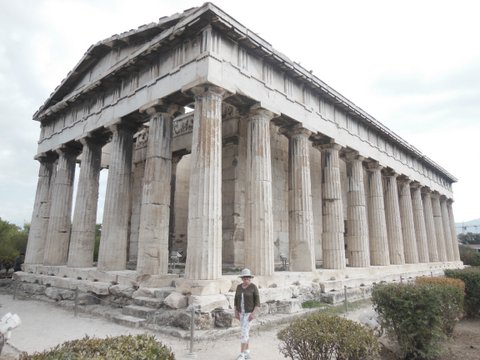
Temple of Hephaestus and goddess. 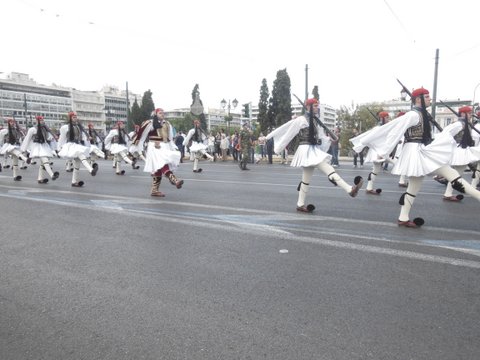
John Cleese has a lot to answer for in Athens 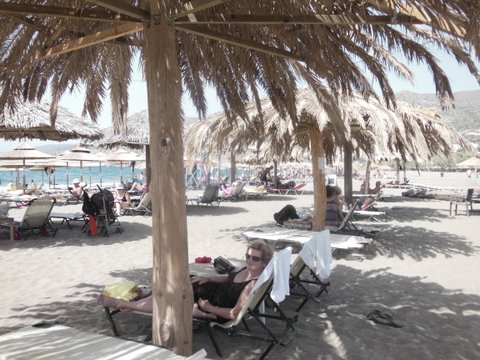
“Free” lounger on the beach at Paleohora in Crete 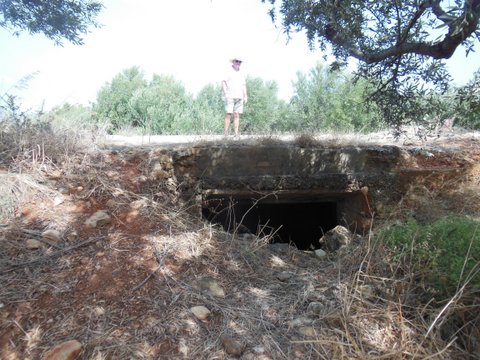
NZ Forces command bunker Hill 107, Maleme Airport, Crete 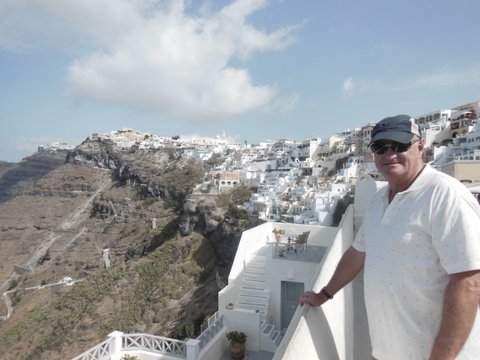
Can only be Santorini 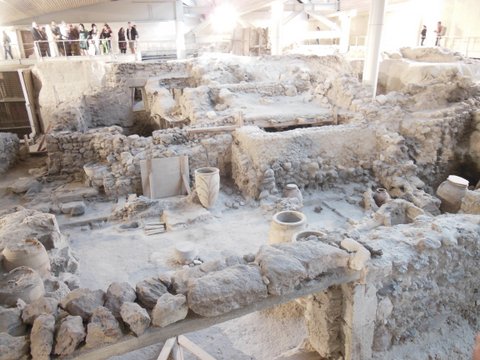
Akrotiri archealogical site 3 enclosed acres 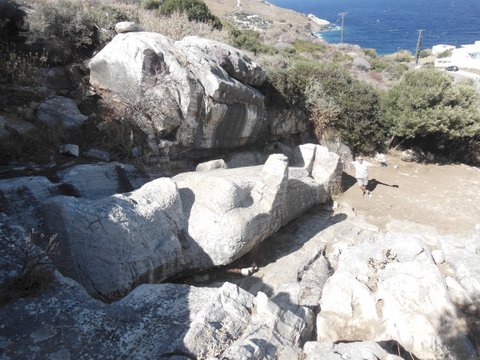
Unfinished marble statue of Dionysos 800BC Naxos 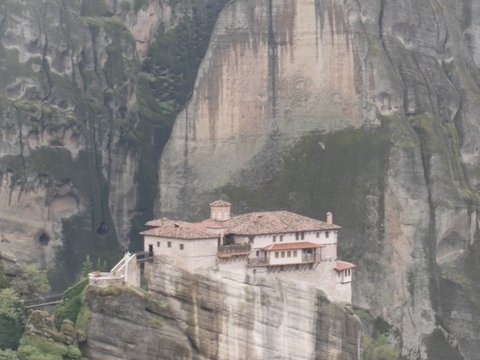
Monastery perched above Meteora 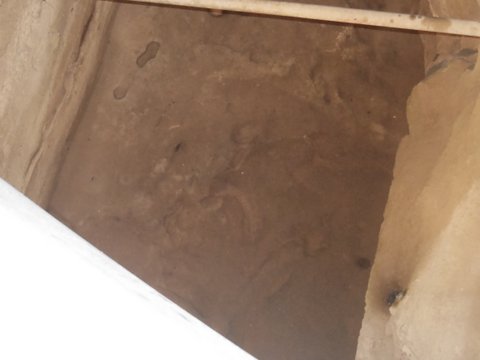
Top left Nethanderthal fottprint from 7 year old. 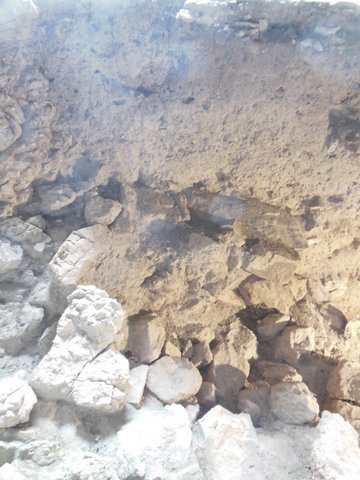
Oldest discovered manmade structure from the last ice age 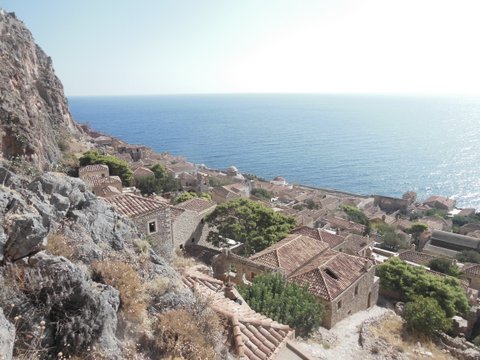
Looking down on Momembavia
Macedonia
I left off last time having just arrived in Skopje, capital of Macedonia, and I was moaning about taxi drivers. In fact getting back to the bus terminal when I left cost me about 20% less than when I arrived, not the 50% I suggested.
Skopje hasn’t got a lot of old stuff because it got flattened by an earthquake in 1963 which killed over 1000 people. I had read about a film made right after the event and it was a bit of a legend at film festivals of the time. It was showing on a continuous loop at a museum and I popped in to have a look. It wasn’t bad until it got to the burial scenes and I left after ten minutes of mourners lying on the fresh graves and crying. It was a bit fraught. The biggest attraction for tourists in Skopje is the developing city centre. As usual there is a river running through the place and it also has the old stone bridge, and either side of this the Macedonian government is creating an extensive series of paved areas and filling them with grandiose, patriotic statues that have no artistic merit but they a BIG. It’s kind of like Las Vegas in marble and bronze. In the centre of the areas on the two sides of the bridge are the real show-off bits – on top of pedestals that are also very complicated fountains, are massive sculptures of warriors, one with sword drawn looking fierce and wise and the other on a snorting rearing horse. I reckon they are about 5 stories high. Officially these are described as just warriors but they are actually Alexander the Great and his old man Phil the 2nd.
You may be aware that the Greeks are being very nasty to the Macedonians because they think they are cheeky using that name for their country when the name belongs to the Greeks. In their opinion. They are equally upset that the Macedonians have appropriated Alexander as one of theirs so these statues are not just Macedonians skiting about their past, they are also a very big upward pointing finger at the Greeks. If you know anyone who is Greek, ask them about the situation of Macedonia and watch common sense run away.
The Skopje bus terminal is a dark depressing place under a big flyover and as usual I got there early just in case something went wrong, and it did as the 10.30 bus became 11.30. There is nowhere to go outside and sit down so I went into a cafe and there was a replay of the ABs v Argentina on the telly. I was delighted because although I tried to watch it live I only got about a quarter of it on a very small screen covered with advertising and I was happy to spend the time waiting there with my one cup of fruit tea before heading to Bitola. It’s a nice little town with it’s best site being a set of Roman ruins with floor mosaics decaying away in the open air, but the good fun was on the first night when I got talking to, and then checking out wine, with a couple of Slovenian guys. About 4 years ago they had spent five weeks camper vanning around NZ and were big fans – one still looks up the Stuff site every day. Luckily I twigged to their being a real couple before I told any war stories about being in the YMCA in Miami many years ago. Macedonia certainly has the best wine in the Balkans. Then to Ohrid which is on the shores of a lake of the same name and a very busy tourist town. I arrived well before check in time at my hotel so decided to walk the two ks from the bus terminal towing my faithful bag. It was really easy because for the only time in Macedonia the street signs also had Latin script and I was within 100m of the hotel when suddenly I was bumping through a maze of cobbled lanes with no street signs at all. I knew I was close but just could not find the place. On my first circuit of the possible streets I asked several people who all said something like”it’s just back there” and one lady selling little cloth things just said “NO”. However when I came around the third time she took pity on me and pointed to a place about 20m away which I had been passed three times but hadn’t spied the little bit of a sign that was in Latin script. It all turned out well because they had overbooked the sort of room I had reserved and I ended up in a very large suite.
That night I inadvertently insulted a waiter. Because I was going to Albania the next day I had carefully worked out that by buying wine of a certain value I could get rid of my Macedonian dinars. It all went to plan and when I got the bill I tossed in my pocket full of coins along with the payment. Tipping is not generally a big thing in the Balkans but obviously in Ohrid it is. The coins were flung back on my table with the comment that this is nothing. I tried to explain that I wasn’t being insulting but that I was going to Albania and had no other money. That earned a very ironic “Have a nice trip”.
And I did, because when I had finally found that hotel in Ohrid I asked about getting across the border and a man who worked at the hotel offered to take me for a reasonable fee. He duly turned up with an immaculate old Merc and we had a further discussion about his taking me all the way to my destination city, rather than to the Albanian border town, and I accepted. Thank goodness because as we went through that very small border town there was no evidence of any transport although I am sure there would be for those who can speak Albanian.
Macedonia is a nice place to visit and very good to ones bank account. It has scenic countryside, great mountain drives and good food and wine. Add it to your list.
Albania.
I was expecting something chaotic and rubbish covered, with old Mercedes everywhere, and only the later is true, although there are quite a few newish ones as well. Chaos does exist at the bus leaving places if you don’t speak Albanian. My attempt at trying to find out about buses going from Korca (where the man from Ohrid took me) to Gjirokastra was lengthy and not entirely conclusive because where I was is not a place tourists visit much and there is nowhere to find such things out. I did find a sign pointing a tourist info place but I think it was someones idea of a joke. The only locals who spoke any english didn’t know much about buses and on the weight of evidence I decided that there was probably only one bus every second day and the day I wanted was the wrong one. I have always said that in these situations you spend money and solve the situation – such things are of course easier to say than do, but in the end I got a taxi and took a four and a half hour ride to Gjirokastra. Along the way I learnt why there are not regular buses as the road never had a straight of more than 200m and the surface varied between not very good to appalling, and we went over four mountain passes. All for NZ $130.
Getting out of Gjirokastra was similarly a problem of timing so I repeated the solution. The road from there to Berat was partly along the main highway to the capital Tirana, and was a showpiece of recent highway building but the second bit was not. About halfway my frustrated never-to-be-F1 driver noticed his temperature gauge was in the red which necessitated a stop, lots of phone calls, a very careful removing of the radiator cap and a fair bit of talking. Naturally it cooled down and when we left again it was not long before we hit the nasty road so the speed went down dramatically and the problem went away. Our stop was at a petrol station with a brand name I have seen a few of – Kastrati.
Albania has had a recent history of a King Zogu 1 before WW2, occupation by Italy followed by Germany, a People’s Republic lead by Hoxha afterwards (I have been to the house he was born in!!!), and he went through a Stalinist phase, then Maoist one with a Cultural Revolution, and then solo. All the time keeping the country locked up. He died in 1985 and in 1992 elections ended the communist rule. Free market policies in the literal sense meant things changed completely and the rest of Europe found their Mercedes had decided to go away and holiday in Albania. Then in 1997 about 70% of Albanians lost their savings in collapsed pyramid schemes. I mention all this because you would think a country that has had to put up with all of that might be a bit withdrawn and strange. It isn’t to my eyes, and yes you do see donkeys and horses being used, and crumbling Communist-era apartment buildings and the mushroom-shaped concrete bunkers, but you also see towns and cities creating paved central areas, the cafe lifestyle, lots of roadworks and plenty of other indications that these guys are getting on with becoming modern in the way they want. All with the usual Balkan background of venal and corrupt politicians and criminal business operators. I asked one local in Berat about a guy I had seen driving around in a Porsche Cayenne and the answer was he was a businessman but had been a gangster and really still was.
I have been doing little surveys of the percentage of cars that are Mercedes and I reckon it is close to 50% but a local told me the actual figure is over 70% – sounds a bit high to me. I haven’t had the language to check with the taxi guys I have used as to where their cars came from, but the older ones are likely stolen. I presume that with EU applications being considered this trade has diminished and boringly I have been told Germany has taken to shipping second hand cars to Albania. The traffic cops are all over the place and are keen to make additions to their savings. They have little lolly-pop things about 30cm long that they wave at you when they want a chat. The first time it happened to a car I was in the driver produced eight certificates and other bits of paper before we got let off, and so far money hasn’t changed hands but there is usually a reference to the tourist passenger which might reduce the greed.
All of the places I have been have tourist attractions of a historical nature and in Berat the Albanians have a little jewel. It has the usual crappy new bit but up the side of the valley it is in are firstly small “suburbs” of old white Ottoman houses which look great, and on top of the hill is a fully operating fortified village complete with ruined castle. A bit like the villages on hills in the Dordogne but less developed. I wandered around there for a morning and in the castle area saw some steps going down into the ground all surrounded by weeds and shrubs – I climbed down and nearly dropped into the old water cistern which was very big and very deep and had lots of plastic bottles floating in the bottom – it was marked on my map but it was a very small scale. Health and safety is not yet a priority in Albania. My second evening meal in Berat turned out to be quite interesting as I got talking to a German couple I had exchanged a few hellos with previously. He was a really good guy – had been an accountant and retired at 57 and now 65, travelled for 4 months each year, NZ was the best place in the world, we agreed on all matters relating to wine including the ones in Chile, Argentina and Australia (Margaret River), and he also was generous enough to let his wife drive his car home every time they went out for meals in the evening. Kay, at least, may recognise the some similarities to someone else. I just had to shout him a glass of the very acceptable local house red.
Next day it was back on the bus to go from Berat to Tirana. Berat has a working and helpful tourist info place and they told me to rock up in the morning to bus place and one goes every half hour, and if the one leaving looks a bit local and slow just wait at the cafe for the next one. What they didn’t tell and I didn’t know was that they have a new terminal on the outskirts of town. That created a few minutes of travel confusion but I soon got a taxi to the new place which was all shiny with no weeds or holes in the paving, also no place for travellers to sit or be under cover because all the buildings are cafes. I was sort of chatting with a local who asked me if I saw anything missing – took me a while. Buses are a cash business in Albania with no tickets and a driver’s helper with an impressive memory. They stop everywhere and the first stop is usually 200m ouside the leaving place, and people who want to get off on the side of a motorway have no problem.
When we arrived in Tirana the bus stopped somewhere that bore no relation to any information I had so I had to deal with the dreaded taxi guys and having got a bit off the asking price from an English speaker, set off to my hotel. The Rooms. It was hard to find but the driver took the challenge personally and eventually it turned out it was on the second floor of a building. I haven’t bored you with anything about the various hotels I have stayed in but this one is a bit different. Because it is the last place on the solo bit I have treated myself a little, and it is very new, extremely modern and stylish, muted colours, sharp looking furniture and very high tech. So much so that when I woke up on the first morning I though it must still be night because it was dark and I went back to sleep. Next time I woke up it was still dark but I looked at my watch and it was 9.15. The lights have four settings on a pad on the wall and the morning one turns off the lights but also very sneakily and quietly lowers metal shutters outside, and apparently I had pushed the wrong button during the night and they stayed down. The coolest lights thing is that when you open the cupboard to hang up your unironed clothes the the bar has little lights along it so you can see all the wrinkles in the shirts. It also has a very upmarket bathroom and in the shower there are three chunky square anonymous handle things in a row down the wall. It turns out the top one if turned to the right sets off the rain shower right above you and of course it is very cold to start with. It has a few other settings but none with quite the same effect on my language. I did have a shower system in a hotel a few days ago that had 27 nozzles but only the ordinary main one worked.
Tirana is a biggish city with a residue of stuff from the Hoxha times and the beginnings of new flash buildings. It is quite colourful because when the elected government got started they thought they would cheer people up by painting the dreary apartment buildings interesting bright colours. They have faded and peeled a bit but it adds character. Just in case you wondered I can authoritatively tell you that the best Albanian red wine is pretty good, and it cost me NZ$16 from a nearby wine shop, and I made it last three nights. I am staying in the trendy area apparently and there are heaps of cafes, bars and restaurants. The footpaths are not trendy and in two days I have managed to smack the same toe into an unmoving protuberances with bloody results. All through the Balkans crossing roads is a bit of a challenge but more so in Tirana, even on a green light on a crossing. It seems drivers are allowed to go through if there is no one there and the definition of no one is flexible. One night a shaven headed, gold necklaced young man in a new Volvo decided I wasn’t there and nearly cleaned me up. I reacted by slapping my hand on the bonnet of his car and walked on. I knew there was a bit of agro coming when he revved up and slid to halt beside me and jumped out – he started yelling in Albanian and I kept walking and then he twigged I must be a tourist and he showed a very complete grasp of english including telling me I was an f…… prick. I was ready to run but he gave up at that stage. Brightened up the evening nicely.
One surprising thing, in the whole of this trip I have not heard a NZ accent. A few from across the ditch including a very strange couple off to a maths conference in Montenegro and a few hybrids who immigrated there and are back having a look. Heaps of Germans and Dutch. Most of the tourists are really old – probably in their late sixties even, and it really annoys me when you go to look at something and are hindered by a busload of them who have filled the place up while their guide gives an interminable description of the meaning of some boring religious icon or similar. The women usually look politely interested and the men have obviously turned off. In Kosovo one patently bewildered Chinese guy wandered out of the monastery church and when I tried a “having fun” he managed a “no”.
My next job is to get to the Tirana airport, fly to Athens and meet Kay at the airport and we will both take off for Crete. There is room for travel confusion in that simple statement. Albania has been something of a revelation and I like it. There are lots of contrasts and you can see places where it looks like fifty years ago, and then you can be extremely up to date as I am right now sitting bat the desk in my electronic room looking out a big open window at some of those painted apartments.
Mirupafshim.
Dennis.
Categories
What is the capital of Montenegero ?
What is the capital of Montenegero ?
Should you be so clever as to know the answer you are certainly more knowledgeable than I was before I started planning this trip. For everyone else, just wait. I am presently in this city and just back from seeing the sights in about 34% heat. Since the last communication I have been in Mostar and Trebinji in Bosnia and Kotor, Cetije and ? in Motenegro and tomorrow I am off to Kosovo.
The six bus trips in the last week have almost all been through and over very rugged mountainous country with the highlight being Sarajevo to Mostar. Most of this one was down a steep river gorge with the high whitish mountains on either side, mostly covered in scrubby bush, and the river, which was dammed four times, a blue turquoise colour. It was a beautiful day as well, as it has been all the time so far. The other days travel has been similar – there are little random villages all with orange tiled buildings and quite often livestock on the road. It has been obvious there are not many tourists on these buses because they come with curtains and most people are busy keeping the sun out and I am busy looking out.
I got to Mostar in the middle of the afternoon and my hotel was right in the middle of the tourist frenzy that surrounds Stari Most, the Old Bridge . My google map had me walking with my bag down a road to the bridge which was actually a tourist stall lined alley way, and then over the bridge. So I did, annoying a lot of people with cameras in the process and learning that the bridge is pretty steep. Like Sarajevo, Mostar endured a siege during the war. This time the guys with the artillery up in the hills were Croats and one of the things they did was put about 60 shells into this bridge which had stood there since 1566, and it broke. Since rebuilt, I think it is one of the few buildings that are better to see live than in pictures, being bigger and higher than I thought, as well as steeper. It is also testament to the skill of whoever designed it because it is very graceful. The siege had a moslem v catholic front line down the main transit road and when I walked along it wasn’t hard to get a feeling for what it was like because there are still plenty of wrecked and pockmarked buildings. The town is today largely divided the same in terms of who lives where. If you lined up a bunch of the Serb Bosnian and Croat people and tried to tell which was which I think you would have a very hard time. The differences are not in the way they look but in what they believe, so religion once again has plenty to answer for here. Even the churches and mosques are political symbols – in Mostar the catholics have built a bell tower that is higher than the tallest mosque minaret. No doubt the moslems are working on a bigger one. And every where there are orthodox monasteries on the top of isolated high points letting the others around know who would be boss..
Trebinji is in the Srpska Republic which is the Serb part of Bonsnia, so it didn’t have any direct involvement in the war and is lovely town with lots of history and a cool old hotel called Hotel Platiini. I knew it was in the central paved area but couldn’t see any signs so I popped into the tourist info and asked, to find I was right beside it and foiled by cryllic script again. The next morning I had the same problem when my bus didn’t have any intelligible words on it. All of the towns and cities have huge numbers of cafes with heaps of outside seating where locals sit, talk, smoke, and make one drink last for three hours. It all looks very alluring but don’t think you can get a proper feed at these places. They do cakes and ice creams and it can be extremely frustrating when you are hungry and looking for somewhere that has the magic word “Restaran”. The other food word I know is Pekara which means bakery and they have good stuff.
Also very frustrating was the night I decided to use my unsmart phone as an alarm for a 5.30 wake up. I turned it on so the alarm would work and at 2.15 someone with an unknown number rang me, three times. I figured it was probably costing me a fortune and that I would wake anyhow so turned it off. That is how I learnt it doesn’t need to be on for the alarm to work.
Crossing from Bosnia to Montenegro was easy – we drove out of Trebinje up a mountain, went through the 2 borders in less than half an hour and then down a mountain to the coast of the Adriatic Sea. The town I went to was Kotor and it is the summer season in spades. This place has everything needed to be a tourist hotspot with the mountains coming nearly directly into the sea, fortresses up in the hills, an old walled town, lots of mini-liners at the wharf, so called beaches, a new cruise ship each day, criminals in flash cars and heaps of hot, thirsty and hungry tourists. I stayed a little way from the old town and got in a early start to climb up to the top fortress, explore the old town and go for a swim. I hate swimming at “beaches” that have nasty stones and gravel because I find it hard to get in and out with and style and grace, and this was not an exception. All the local old men were fatter and more tanned than me and wore budgie smugglers, and the corresponding women of course defied gravity in bikinis. Next stop was inland over the usual mountain range to Cetinje, another lovely old historic place. It’s main claims to fame being that some 1800s prince built a room for billiards which was an unknown and very progressive thing, so the building is known as Biljarda, and that in the local monastery is St John the Baptist’s right hand. This relic has a complicated provenance which sounds really believable and once in a while people can look at it and marvel. Dan Brown could write a book about it. After seeing all that heavy stuff I decided I deserved what was described as a Gourmet Hamburger for lunch. It took a while and turned out to be a very large frisbee of meat sitting on a bed of chips with a slice of tomatoe on the side. That was probably payback for a meal I had in Kotor. I asked my hosts for a good place to eat and was recommended to get a taxi and go a little way down the coast to a restaurant called Forza Mare. I checked the taxi fare with them and went off to interview five taxi drivers who all wanted to rob me, but finally found a reasonable one. When she pulled up outside this place I knew immediately I was in for financial hiding – it was gorgeous, on its own low jetty, beautiful everything, fawning staff. no menus, and views everywhere. A few years ago I would have run away, but folks, I have changed and I enjoyed it. I admit I didn’t order the lobster or the recommended E100 wine but it was still the single most expensive meal I have paid for.
Montenegro looks a bit more prosperous than the two previous countries. Probably because it didn’t get beaten up in the last war as it only made itself independent from Serbia in 2006, and it has money making tourism on the coast. It has a population of less than 700,000 and a capital called Podgorica. Which is a place unlikely to be on a list of the 1000 most interesting places to visit when it’s listed sights are on old clock tower, the crumbling remains of a small fort and a big orthodox church. All of which you can walk around in less than two hours which includes a very nice long lunch at a suburban Italian place.
Life on the public transport road is now quite settled for me. I know that it costs E1 to have your bag stowed although I never offer and today I wasn’t asked, so maybe that isn’t done around here. I know you can just jump on the bus and pay without getting a ticket first. I have found the taxi drivers around the terminals are great sources of happily imparted information and there is a really good website I have found that has accurate timetables. Most smaller towns have no written information at all. I am in the routine of getting detailed map info if I am walking to my hotel, although this isn’t always perfect when faced with no street signs and no street numbers, which is usual. Or if there is a sign it is in cryllic that does not have any resemblance to the name on the map. All my hotel bookings have been ok, so far, and only one place didn’t have an english speaker and they covered that by handing out a glass of the local fire water. The gaps in my itinerary that I needed to sort on the spot have been a breeze – but I am still worried about my crossing to Albania. I must be a very trustworthy looking person (don’t laugh) because locals keep stopping me and asking unintelligible things which I assume to be for directions or what is the time, or maybe have I got a spare fag. I make an effort to try and have a bit of a conversation with someone each day but in obscure places like Podgorica that is not easy. I haven’t had to get grumpy or look severely at anyone, although I nearly did at a women who demanded I give up my bus seat when there were local kids seated all around me. Some unimportant things are a bit of a nuisance such as I am having a run of hotels that don’t provide nice little soaps – the stuff that squirts out of bottles is not fun for digitally challenged people. I get my own back by using lots of it to wash my shirts. On the other hand there are good little things like 200 mill bottles of acceptable wine for about E1 which make a nice glass full, about now.
Zbogom.
Dennis.
One of the reasons I wanted to come to the Balkans is the history, where about every fifty years the various nationalities seem to need to start killing each other for a while. I remember watching TV during the 1990s Balkan wars and seeing people who looked like us being bombed and shot at, when usually it was somewhere African or Asian and thinking why do they have to do that. I have read a fair bit about it and understand the basics but going on a tour yesterday in Sarajevo called Times of Misfortunes was a rather chilling experience.
The guide who owns the business was 18 when the siege of Sarajevo started in 1992 and it ended in 1996. He fought in it and has a scary scar on his thigh from shrapnel as a souvenir. He told us he would only tell us his experiences and not go into the political complexities, but that is impossible and there was plenty of political stuff. The one thing he repeatedly referred to is that Sarajevo has always been and still is a mixture of orthodox (Serbs), moslems (Bosnians and the majority), catholics (Croats), Jews, and few others that have all existed together. When the war started and the city divided itself into armed zones between the first two it wasn’t just a religious and ethnic divide but families divided as well. I found this tour very moving and it has certainly left an impression on me. A few illustrations follow.
Sarajevo is basically in a valley surrounded by high hills and when all the fighting started the Yugoslavian army became the Serbian forces and they had plenty of heavy artillery and sat up in the hills and tried to destroy what was below them – anything of cultural significance to the Bosnians and the people. When you stand on the high ground at the end of town and look how close the guns must have been it is scary.
There are cemeteries all through Sarajevo and the ones from the siege are in unusual places because they had to have somewhere to bury people while the war was going on. One is where a football stadium was. One contains 11,000 plus Bosnian soldiers (Serbs lost about 1600) and the leader of the time whose grave is now guarded because some “terrorists” blew it up a while ago.
The guide was continually pointing out places that were no man’s land as the lines came into the city itself. There are still lots of holes and explosion marks on buildings.
During the siege the airport was controlled by Nato and the Bosnians controlled either side of it, with one side being the only route they had out of the area to Croatia (which changed sides twice during the conflict) where all food, weapons, and supplies of every type had to come from. The problem was the only way into Sarajevo was across the airport runway, about 1000 metres and initially this was done by guys running across with packs. 800 deaths later there was a tunnel built secretly which the Serbs knew about but didn’t know exactly where. We went to what is left of it
Going down Sniper Alley and seeing how close the action was bought to life a couple of novels I have read.
One doesn’t want to be boring so let’s just say the Serbians’ actions branded them as a rather undesirable lot and it’s a pity the leaders that have been dragged to the International Court can’t get the death penalty. And the Bosnians will never forget or forgive and I certainly don’t disagree with them. One wonders about the future of their country which is a federation with just under a half of it populated by Serbs who politically don’t show much desire to be part of it.
Going back to when I was in Serbia, I occasionally got to ask carefully about the 1990s and the answers generally expressed puzzlement about the politics and why it all happened. When I was in a lovely small town outside Novi Sad famous for making orthodox priests and wine I met a 25 year old law student who summarised her position more clearly – she hated what her country had done and was desperate to leave. As a tourist Belgrade and Nov Sad are excellent places to visit with nice old town centres, plenty to see and it is a really cheap country to visit. There are still a few bits of evidence of the war – I walked across the Danube in Novi Sad to visit a fortress and there was a small plaque on a rock that said the bridge was destroyed by Nato in 1999 and gave the name of a man unlucky enough to have been on it and killed. I recall thinking that 1999 wasn’t so long ago. Of course no mention was made of why Nato was bombing Serbia then.
Everyone smokes, or so it seems, and someone told me that is because Balkan people need danger in their lives. A smoke free restaurant is very rare. Bus drivers smoke. Graffiti is nearly everywhere, some includes two short Anglo-Saxon words. The Cryllic script is also everywhere which makes sorting out where you are and reading menus fun, but in the main centres English is spoken widely. It is different in small places and getting information at bus terminals there is a challenge. One small town I went to in Serbia was proving impossible until I found a taxi driver who spoke just enough English so I hired him on the spot and his last job after visiting the sights was to sort out what time the next bus left town.
I have taken one train journey and before we left was delighted to see two men with long handled hammers tapping all the wheels on the train. Very reassuring. The train was punctual, old and scruffy which is to be expected because everything owned by the Serbian state is like that. It is a poor place, not third world, but also not the first. The average monthly wage is about 350 euros. I saw mostly the northern part of it which is a big plain and the agriculture is small scale with lots of maize, sunflowers and Massey Ferguson rules. Getting up into the hills into Bosnia, farming looks almost subsistence stuff with little conical hay stacks, and Maurice will like to know that big tasty water melons are for sale beside the road for about 15 cents each.
As an ageing male on his own I have to admit that there is one delight to sitting around in the busy nice parts of Serbian towns and because I don’t want to openly admit to political incorrectness I shall cunningly tell you that Anna Ivanovic twins are everywhere.
The drive to Bosnia had everything possible except a ferry crossing – motorways, average roads, bad roads, switchbacks, mountain passes, viaducts, two border crossings, lots of stops, about twenty tunnels, and abandoned and bullet holed houses just over the border in Bosnia. This is in the Serbian populated part and apparently left over from ethnic cleansing. The best parts of getting to Sarajevo after ten hours of travel were twofold: firstly, I had had been to sleep for a while early on and after that was using the bus clock to work out how long things were taking, and when we finally got to the terminal I found out it was two hours earlier than the clock said; and the road in from the east goes up over a pass and you are in the city, just like that. No nasty industrial suburbs. The less nice part is that things cost more in Bosnia despite the wages and high unemployment rates being the same as Serbia.
The last word is about local wine – after lots of testing I can tell you the whites are boring and the reds can be ok. So far.
Dennis.
Categories
A cunning plan
Subject: A cunning plan
Hi everyone Kay here.
The plan must have been a cunning one because it worked.
After 30 hours in the air and more than that on the ground in various countries, my dear husband was waiting at Arrivals in the Athens airport. I floated off the plane in superb condition having been pampered with the spoilt-brat business class treatment all the way. Being able to really sleep on the planes was such a treat. And did you know that upstairs on the A380 there is even a lounge to recline in whilst sipping drinks and demolishing snacks?
What’s more, we’re both now enjoying a series of lovely little hotels in Crete and Greece that Dennis had spent hours researching and booking months ago. We were contacted 36 hours ago by the one we’re in at present, saying that they were having to send us somewhere else for our first night as the previous guest had had a ghastly 9-hour series of boat trips, had been frightfully seasick and was in hospital being rehydrated and not be able to check out. Having experienced several days of extreme winds and storms in Santorini we could imagine what she had been through and we weren’t exactly looking forward to our ferry trip. As it turned out ours was a much bigger boat and we had the seats in the very front allotted to us so it was a good 2-hour trip and I didn’t drop a stitch.